The fast move to cashless payments, plus government support for Fintech App Development Dubai, has made it a top place for fintech. Dubai’s money market is growing fast. Many startups now build fintech apps and platforms. These tools give new, safe, and user-friendly money services.
To build a good fintech app, you must understand how fintech works. This includes payments, loans, investing apps, and digital banking apps. This guide shares the main ideas for making fintech apps.
It also explains key features, steps to build the app, and safety needs. It also looks at new fintech trends in Dubai.
What Is Fintech App Development?
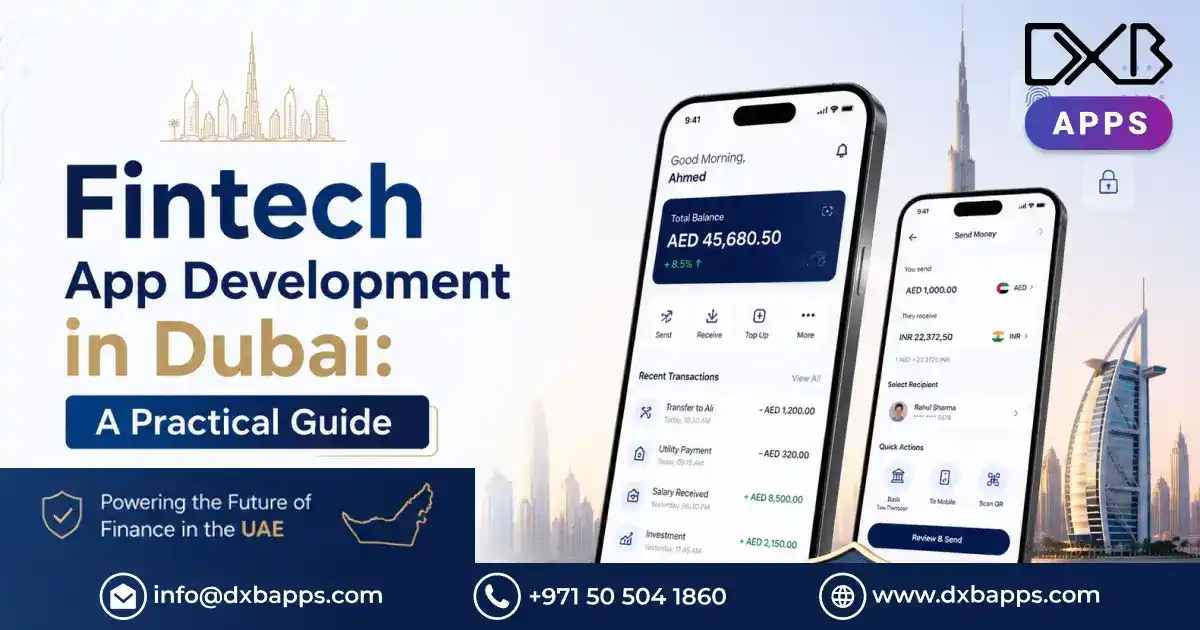
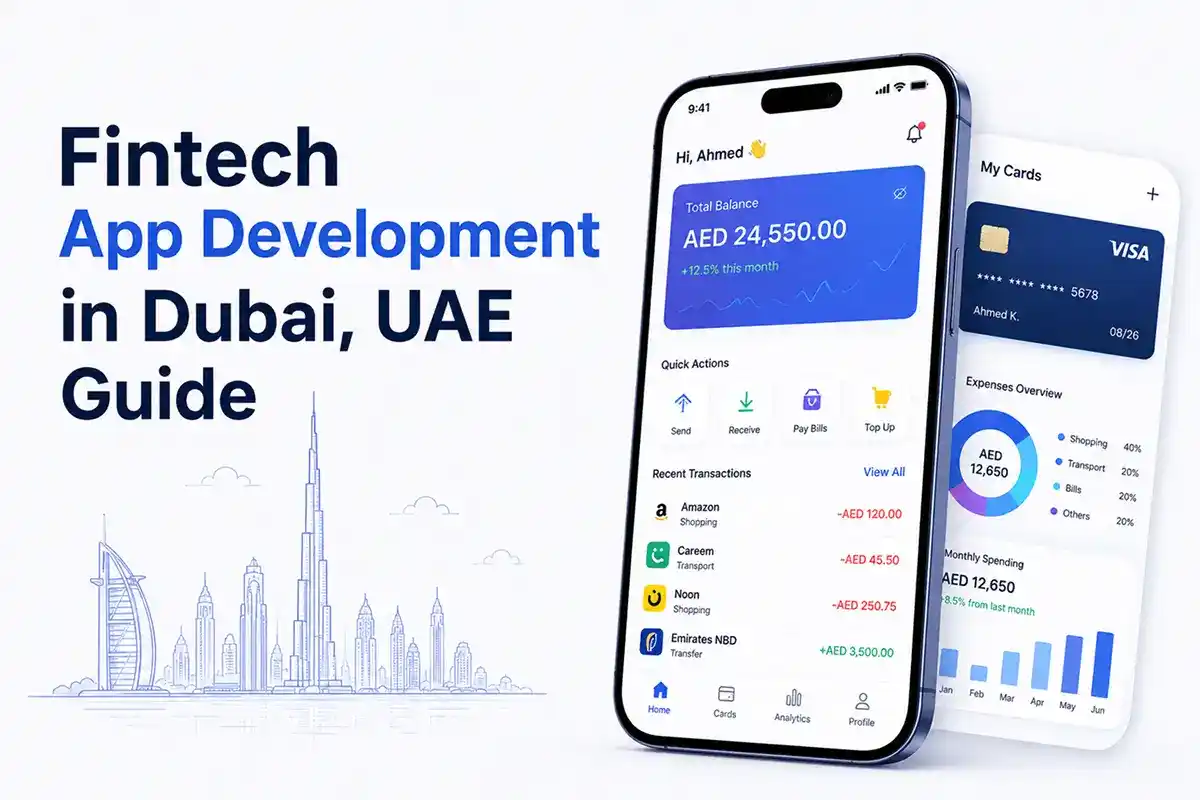
Fintech app development means making apps that help people use money services with technology. Users can pay, invest, track spending, and ask for loans. They can also use bank services on a computer or phone.
Good fintech apps are easy to use. They are also fast and safe.
Why Is Dubai a Leading Destination for Fintech?
Dubai has strong internet, modern systems, and rules that support technology. Many people in Dubai like using digital tools. This makes Dubai a great place for fintech. Fintech companies can also reach many other countries from Dubai. Many people also want digital money services. Key benefits include:
- A strong digital economy
- Many people use smartphones
- More new startups
- Government support for new ideas
- More people use digital payments
- Access to global investors
Types of Fintech App Development Dubai,UAE
Fintech apps do many jobs. Fintech mobile app development can help with payments, banking, investing, and insurance. They make money tasks faster. They also help keep things safer. They can help people and businesses.
Digital Banking Applications
Digital banking app development lets users check their accounts and do bank tasks online. People do not need to visit a bank as often. Common features include sending money, paying bills, card controls, and transaction history. Many apps use fingerprints or face scan to keep accounts safe.
Mobile Payment Applications
Digital payments are used every day. People can send money, buy things, pay shops, and split bills fast. These apps also help with safe online payments. Payment app development Dubai keeps getting quicker. They also get easier to use.
Digital Wallet Applications
Digital wallet apps save payment details. They let people buy things without cash or cards. Many also save loyalty and rewards cards. They often support many currencies. Many also support tap-to-pay.
Investment Applications
These apps help users manage money on a phone. They show market tools and simple tips. Some apps can move money in and out of investments by set rules. Many also teach users so they can make better choices.
Lending Applications
Lending apps let people apply for loans online. Borrowers can type details and upload papers. They can get quick credit results. They can also track payments in the app. This means less paperwork. It also means faster approvals.
Personal Finance Applications
Personal finance apps help people plan a budget. They track spending. They also help set savings goals. They use simple charts and tools. They also give tips to help users build better money habits.
Insurance Applications
Insurance apps help users manage their plans online. Many use AI to help with claims. This can make things faster. It can also make the app easier to use.
Cryptocurrency Applications
Crypto apps by a trusted mobile app development company Dubai can help users use digital money on phones. They may include wallets, trading, history, and live price updates. Many also include tracking tools. They also use strong safety features.
Benefits of Fintech App Development in Dubai
Dubai has a fast-growing digital economy. It also has strong money systems. This makes it a great place to build fintech apps. Many people want better money services. A financial app development Dubai can make customers happier. It can also help businesses work faster. Below are some key benefits:
Growing Demand for Digital Financial Services
Mobile banking, digital payments, and investing apps are popular. People like them because they are easy to use. Many businesses use fintech to reach customers online. Some benefits are:
- Faster money services
- 24/7 digital access
- Safe online payments
Supportive Innovation Ecosystem
Dubai supports new business ideas. It also has strong tech systems. This helps companies build new money products faster. It also gives a place to test new ideas in real time.
Global Business Opportunities
Dubai is in a great location. It helps fintech companies reach Asia, Europe, Africa, and the Middle East. Businesses can get:
- Access to customers around the world
- Strong global connections
- Chances to partner with other companies
Improved Customer Experience
Modern financial app development UAE helps customers do things fast. It is simple and easy to use. This makes people use the app more. It can also build loyalty.
Operational Efficiency
Automation helps reduce repeated work. It makes steps faster. It can also lower costs. Common features include:
- Digital sign-up
- Auto payments
- AI chat support
- Digital document storage

Essential Features of a Fintech Application
Every successful fintech application by a top fintech app development company in Dubai should offer safe user authentication, easy payment processing, along with being able to track transactions in real-time and having a user interface that is easy to use. Some of the essential features of fintech application are:
Secure User Registration
Each fintech app by a leading fintech app development company Dubai, starts with the same thing: the authentication process of their users. Because financial applications manage incredibly sensitive data, there is the utmost priority to safeguard accounts.
To minimize the risk of allowing illegitimate users to gain access, while still ensuring the process is straightforward, modern authentication frameworks use multiple verification methods.
Recommended Authentication Features
- Biometric Sign-In
- One-Time Passwords (OTP)
- Two-Step Verification
- Email Verification
- Device Identification
User Dashboard
The dashboard is where users can access their financial information. A fully functioning, easy to use dashboard increases efficiency. Key financial data like your balance, recent transactions, transaction summaries, and alerts should be displayed clearly and logically.
Digital Payment Integration
In fintech application development, payment functionality has become imperative. Today's consumers expect payments to occur instantaneously and without friction. Payment systems should enable numerous payment methods and provide rapid confirmations and comprehensive payment records.
Push Notifications
Users are more engaged when salient activities related to their accounts are pushed to them in real time. Transactions may include confirmations, key updates, suspicious activity, billing, offers, account management, and more. Timely notifications may also satisfy customer demand for enhanced security.
Financial Analytics
Many users expect a more detailed and personalized approach when it comes to their finances and accounts. They are not satisfied with a simple display of the account balance.
Advanced analytics may assist users with the management of their spending and investing, while also helping them save, as well as reach their financial goals.
Customer Support
Trust and confidence in a service are the result of being able to rely upon it and particularly the case when a user has an immediate financial concern.
The newest fintech software development usually employs an AI-driven chatbot and a live customer service agent to create a balance between rapid response and high-quality service.
Transaction History
Users can track their financial activities and spot discrepancies with the help of transparent transaction records.
A good transaction history section has records that can be searched, expenses that are categorized, statements that can be downloaded, and filtering that allows for increased usability.
Fintech App Development Process
Fintech app development UAE involves creating a secure and scalable application through planning, designing, developing, testing, and deploying that satisfies business and user needs while complying with regulations.
Market Research
Understanding the customer’s pain points, market gaps, competition, and technologies helps the business pick the right features and build an application that will meet real needs.
Define Business Objectives
Well-defined business objectives add focus to the project. Typical business objectives include the following:
- More digital payments
- Less operational expense
- Greater financial inclusion
- More customers
- Feature Planning
Essential and future features should be determined prior to application development. The use of a minimum viable product (MVP) helps with the development and the resulting product helps with the determination of further features. Advanced features can be added after gathering customer feedback.
UI/UX Design
Wireframes, prototypes and simple user experiences are easier to trust. Financial products and services should promote ease while maintaining the professional and secure fintech applications.
Application Development
The front end and back end of the application need to be built. Secure, scalable, and responsive systems focus on the following:
- Payment systems and APIs
- User auth
- Databases (cloud + system)
- Business logic (and all device compatibility)
Testing and Quality Assurance
Prior to the launch of the application, it must be secure, accurate, reliable, and tested. Trust and the integrity of the application are determined by the performance and transactional support of the app.
Testing in this phase focuses on:
- Functionality and Security
- Performance and Load
- Compatibility
- User Acceptance
Deployment
The application is published to the planned areas and launched to the planned cloud integration after the completion of testing. Developers ensure a successful integration and launch by careful monitoring of newly created connections.
Continuous maintenance
Continuous maintenance ensures an application remains dependable and secure while responding to tech and legal changes. Some aspects of maintenance are:
- Bug fixes
- Performance enhancements
- Security upgrades
- Features added as a function of user suggestions
Technologies Used in Fintech App Development
Fintech app development Dubai utilizes technologies like AI, blockchain, cloud computing, APIs, big data, and cybersecurity to create new secure, scalable, and high-performance financial services apps.
Artificial Intelligence
AI fintech solutions Dubai enhances efficiency by automating tasks, analyzing data, detecting fraud, and offering customized financial services.
Machine Learning
Machine Learning plays a role in improving the assessment of credit as well as predictions of the market and analyses of the customer and detection of fraud.
Blockchain Technology
The Blockchain app development is critical for accommodating secure transactions and smart contracts and verifies digital identity, including transparency for cross-border transactions.
Cloud Computing
Cloud computing benefits fintech UAE by increasing performance and reliability and decreasing the costs of the data infrastructures, and improving scaling, backup.
API Integrations
Fintech now has the ability to integrate applications through API connections with banks and payment gateway, third party services, and more. This has greatly improved the scope of application integration and reduced development time.
Factors Affecting Fintech App Development Costs
The cost of developing a fintech app relies on many factors. The complexity and features of the app, the app’s required platform, the app’s security needs, the required integrations, the compliance requirements, and the level of expertise of the development team will all affect the app’s development cost.
Costs of Development
Costs of development greatly depend on application type. Development of basic payment applications is easier than creating enterprise systems with investment management, analytics, AI, blockchain, or lending systems.
Type of System
Development of applications for Android or iOS (or both) is a business decision. Development for both systems takes more time and money, but allows a greater reach.
Level of Security
Development of applications with defense-grade security is more expensive and budget consuming. However, protection of client data is a legal and ethical requirement.
Amount of Integration
Custom fintech app development time and budget is impacted by the number of outside payment solutions, banking systems, identity verification, and finance APIs and their integrations.
Future Improvements
Post-launch improvements and updates should be factored into the overall cost. Updating systems, improvements in security and performance, and developing new features will support the effectiveness of the application.
Common Challenges in Fintech App Development
Data security, compliance with laws, and complicated integrations are issues faced in Fintech app development. Cyber threats continually evolve. Alongside these issues, developers are challenged with scalability and providing a smooth user experience.
High Security Standards
Security issues and cyber threats are fast evolving, making it imperative for fintech to devote money for better security. Safeguarding customer information is a key obligation.
Multiple Financial System Integration
Integration with several different banking, payment, credit, and several other financial service providers can be complicated. Development teams with the right experience and good project management skills can mitigate the complications.
Adaptation to Financial Regulations
With rapid evolution of financial services regulations, organizations need to be on constant lookout to ensure their compliance practices and adapt their applications.
Trust Building
Financial Applications need to build and maintain their customer trust to be successful. Good communication, reliable services, good customer support, and secure applications, help maintain long term relationships.
Increasing Capacity
A challenge to Fintech Applications is delivering the same reliability and efficiency to a growing user base and a growing number of transactions. This challenge can be met by adopting Scalable Architecture.
Best Practices for Successful Fintech App Development
To develop reliable and high-performing financial solutions, secure, compliant with regulations, user-friendly, and scalable apps, demand continuous testing. Trustworthy fintech apps exhibit these features.Central Bank UAE compliance guarantees that fintech and banking applications adhere to the UAE’s security regulatory requirements, data protection, AML, and safe digital financial transactions.
Make Security a Priority
As a first step, security must be included in all stages of the development lifecycle, as opposed to just being tacked on after the application has been developed.
Simplify the User Experience
The application by top fintech app developers can simplify the financial process, while still ensuring that the application is as straightforward, easy to, and easy to navigate for users of all levels of comfort with technology.
Make the Application Scalable
An application that has built in scalable architecture can accommodate the maximum number of users, transactions, and services, without having to completely redevelop the application.
Prioritize the Use of Agile Development
Using Agile Development means that new changes and improvements to the application can be made with greater ease, and at a more rapid pace, than traditional application development.
Focus on Continuous Innovation
The best way a company in the highly competitive finance technology industry can maintain a strong competitive advantage is to continuously offer application improvements using the most up to date technology and based on customer needs.
Future Trends in Fintech App Development
AI, blockchains, embedded finance, open banking, biometrics, and cloud technology are the biggest drivers for innovative fintech app development. These technologies accelerate personal financial services to be smarter and more customizable.
AI-Assisted Financial Services
AI will augment customer experience based on preferences and behavior through the provision of real-time financial insight, hyper automation, and advanced data analytics.
Integrated Transactions
Consumers will have access to financial solutions at the point of need, where payment, credit, and insurance solutions will be embedded in their favorite applications.
Collaborative Banking
Collaborative banking will focus on the safe integration of banking services and third-party applications to deliver tailor-made financial services.Expert banking app developers Dubai design secure, user-friendly, and scalable digital banking solutions that meet contemporary financial requirements.
Wider Blockchain Usage
Finance will become more decentralized with the wider use of blockchain technology for cross-border finance, smart contracts, and digital identities.
Biometrics
Fingerprint, photo, and facial, voice, or iris scans will allow biometric authentication to substitute older methods with one that is faster, safer, and more convenient. With biometric security, risks associated with passwords evaporate, unauthorized access is more difficult, fraudulent transactions increase in difficulty, and the streamlined nature of the method improves user experience and satisfaction.
Financial Forecasting
As data security advances, individuals will be able to analyze data to understand the optimum level of expenditure and forecast the best cash flow, as well as identify financial opportunities.
Why Choose DXB APPS for Fintech App Development?
DXB APPS as a leading mobile app development Company in Dubai helps businesses build secure, scalable, and user-friendly fintech applications designed for modern digital financial services.
Expert Team of Fintech App Developers
At DXB APPS, we know that flexible, secure, and scalable solutions are critical to modern businesses in developing fintech applications. Our experienced team members build performance-driven applications focused on improving customer experiences for digital wallets, payment solutions, banking services, investment platforms, and more.
Comprehensive Development Services
Fintech app development is just the beginning. At DXB APPS, a trusted mobile app development Company in Abu Dhabi, our complete set of services extend into maintenance for developed applications and include the full spectrum of design and development services from strategy to testing to deployment. Our best fintech app developers Dubai partners with your business and combines modern technologies such as artificial intelligence, blockchain, and cloud computing services to develop and implement innovative digital financial solutions that foster business growth.

Conclusion
Fintech expands in Dubai, catering to a growing sector in one of the fastest economies. With robust systems for rapid and consistent cashless integration and fintech innovations, Dubai provides an outstanding opportunity for boosted business services.
Reference the security, legal, and user protection of your application as a top priority; the working design, systems, and technologies are secondary to these. Including these as an afterthought is a lapse in innovation and will degrade your service over time.
For banking, lending, payment, investing, and budgeting applications, your business will see positive returns from building your service on sound systems with skilled innovations and integrations. This will assist in the early stages and help generate a constant, growing clientele. While the existing technologies are astounding, even future services will be far more advanced and operate with techniques and systems we have in a rudimentary form today.
FAQS
How long does fintech app development in Dubai take?
Fintech app development in Dubai takes anywhere from months to years depending on the complexity of the app. Complex features and security requirements that are higher in level will naturally take longer to complete. Apps that are AI-based, Blockchain-based, and that have Digital Banking and payment functionalities will take a longer time to develop.
What are financing applications' security features?
Financing apps take customer data and will be of interest to hackers. Therefore, financing applications should employ security features such as end-to-end encryption, secure APIs, fraud detection, and device recognition. Financing apps should also employ session monitoring and provide users with security alerts. Biometric login and multi-factor authentication should also be used to deter unauthorized access.
Why is Dubai a suitable location for fintech app development?
Some of the things that dubai is known for that makes app development a pleasure and easier is the advanced digital infrastructure, strong government support, and the high rate of smartphone use. Dubai also has a growing demand for digital banking solutions. There is also a large access of regional and international customers as clients in Dubai. Additionally, the business environment in Dubai is friendlier to Fintech innovations.