The UAE food delivery market is incredibly competitive. Multiple food delivery apps exist, and the only thing that really matters to the end-customer is which one delivers the fastest, offers the best deals, and actually provides a refund when things go wrong.
Talabat is a food delivery app that recognized this early. Talabat wasn’t even the first food delivery app in the market, but they completely mastered scale across the GCC. Compared to their competitors, Talabat developed better rider and restaurant partnerships, and most importantly, customer relationships that kept people coming back.
The interesting part is, the UAE food delivery market is still extremely competitive and wide open for new, focused, and well-localized delivery startups. Once people get used to a convenient service, they rarely go back.
The UAE end-customer expects more and more from delivery services. From App Like Talabat, the end-customer expects deliveries to happen in seconds, and to be able to pay however they want. They expect deliveries to be tracked and journeyed using AI.
The opposite is also expected of you. If you’re a developer, SaaS founder, or just someone looking to build delivery services in the UAE, this guide is for you. You will learn how to reach out to Talabat-like apps the right way and avoid developing the wrong product.
Market Landscape & Opportunity in the UAE and GCC
The UAE food delivery market isn't crowded. It's maturing and creating more opportunities.
More people are ordering food online and new categories like essentials, cloud kitchens and groceries are being added on these apps.
It is expected that the UAE food delivery market will grow to USD 1,820.1 million by 2034 at a CAGR of 9.37% (2026 - 2034).
In 2024, about 69% of UAE residents ordered food via delivery apps at least once a week, and approximately 10% of UAE residents ordered food via delivery apps daily, showing a high level of repetitive usage.
There are seasonal variations. For example, during Ramadan, about 41% of UAE residents increase their food spending, and the summer heat leads to food consumption moving even more to the evenings and online.
Hence, if you want to create a Talabat clone app, you are entering one of the best and strongest consumer-internet categories in MENA.

What Are the Core Apps Required to Build a Delivery App in the UAE?
When founders dream of creating a delivery app like Talabat, they tend to conceptualize a single customer-facing app. However, the reality is, building a successful delivery ecosystem means conceptualizing and creating several inter-connected apps that interact with each other in real time.
If you are building a delivery app in the UAE, you need to consider this structure from the onset.
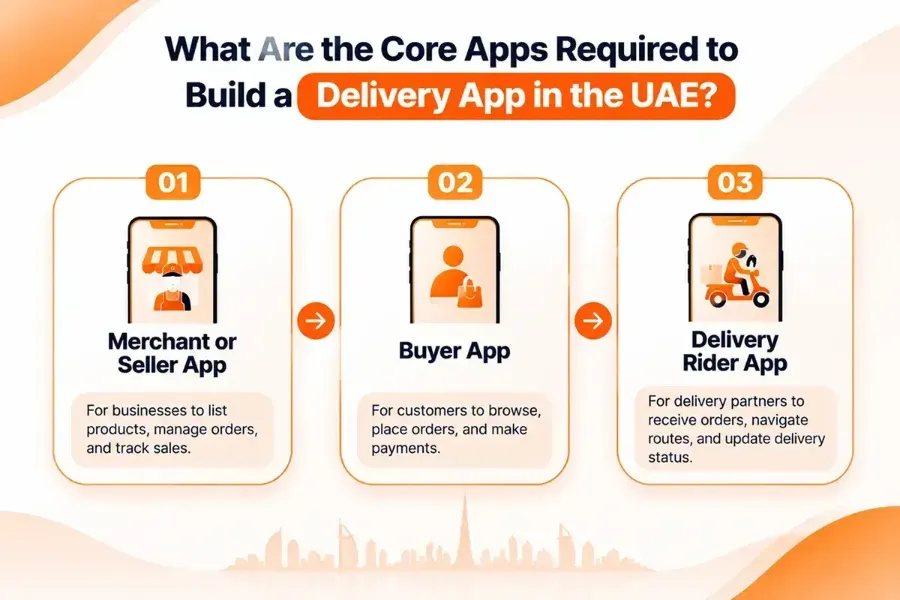
A platform like Talabat contains three main applications. Each application is designed to suit a user group involved in the process of ordering and delivering. These include:
Merchant/Seller App
The merchant/seller app enables an individual to manage one or more restaurants. Using this app, a user can manage multiple restaurants. The merchant app also offers sales analysis, restaurant and delivery management as well as payment management.
Buyer App
This app allows customers to browse through restaurants and view the dishes offered by different restaurants. Using the customer app, a user can:
- Create an account
- Search for restaurants and dishes
- View dish details and descriptions
- Select food items
- Place an order
- Make a payment
- Track order and delivery
- Provide feedback and reviews on restaurants
Delivery Rider App
Once an order is placed, a request is sent to a rider. The rider then has the option to accept or decline the request based on their availability. Like the customer app and the merchant app, the rider app helps to manage delivery and pickup locations. Delivery platforms also provide incentives to riders for achieving set goals such as a number of deliveries completed.
Talabat Business Model
Talabat is a triple-sided marketplace that balances the needs of customers, merchants, and delivery logistics. Often, when founders do not strike the right balance, the product ends up being very expensive to run and nearly impossible to scale. The best way to learn about an app you want to clone is to study the engine and not the body.
Talabat-like app development in UAE connects 3 major user groups:
- Customers who are looking for the best, fastest and most reliable food delivery service.
- Restaurants and merchants that are looking to increase their orders and grow their business.
- Delivery partners that are looking for earning opportunities and flexible working hours.
- Striking a balance between these three user groups is critical for the success of a food delivery marketplace.
How Does Talabat Make Money?
Founders are taking a serious interest in Talabat clone app development due to the platform’s multiple income sources. Talabat understands that depending on a single source to generate revenue puts a business at risk and therefore has deployed a strategy to tap multiple sources of revenue.
Some monetization strategies include:
- Charging commissions on restaurant orders
- Delivery and convenience fees
- Surge or peak hour pricing
- Paid restaurant promotions
- Restaurant subscriptions and loyalty programs
- Merchant advertising and marketing services
- Grocery and pharmacy deliveries
- Tobacco and other smoking products delivered by authorized retailers
Due to the above diversified revenue stream model, the future of delivery apps in the UAE looks very promising to founders and investors.
Choose Your Business Model Before You Build Anything
Most founders rush into building features for their businesses, but that should not be the case. The model for your business should inform your operations, unit economics, tech architecture and even your hiring.
There are two main models in the UAE Delivery ecosystem.
Aggregator Model
This model is also known as the marketplace model, and is commonly used by Talabat. From this model, you take a commission fee for each order delivered (usually between 15%-30%).
For this model, you need to balance the demands of the customers and the supply of the restaurants and drivers. This model can, however, be complicated as you are creating a three-sided marketplace. The model is, however, good for network effects.
The challenge with the model is that you will always be competing against established brands for recognition and your restaurant partners will always complain about your commission fee.
Single-Restaurant or Own-Brand Delivery
The model is similar to the Talabat Clone App, but this time you will be focusing on a single restaurant or brand, thus owning the entire supply chain. This model allows for faster and simpler time to market.
You will, however, be limited to one restaurant and one location. This model, however, gives you flexibility to control more of your brand.

Core Features: What Every Delivery App Needs
A delivery app is usually 4 different systems working together.
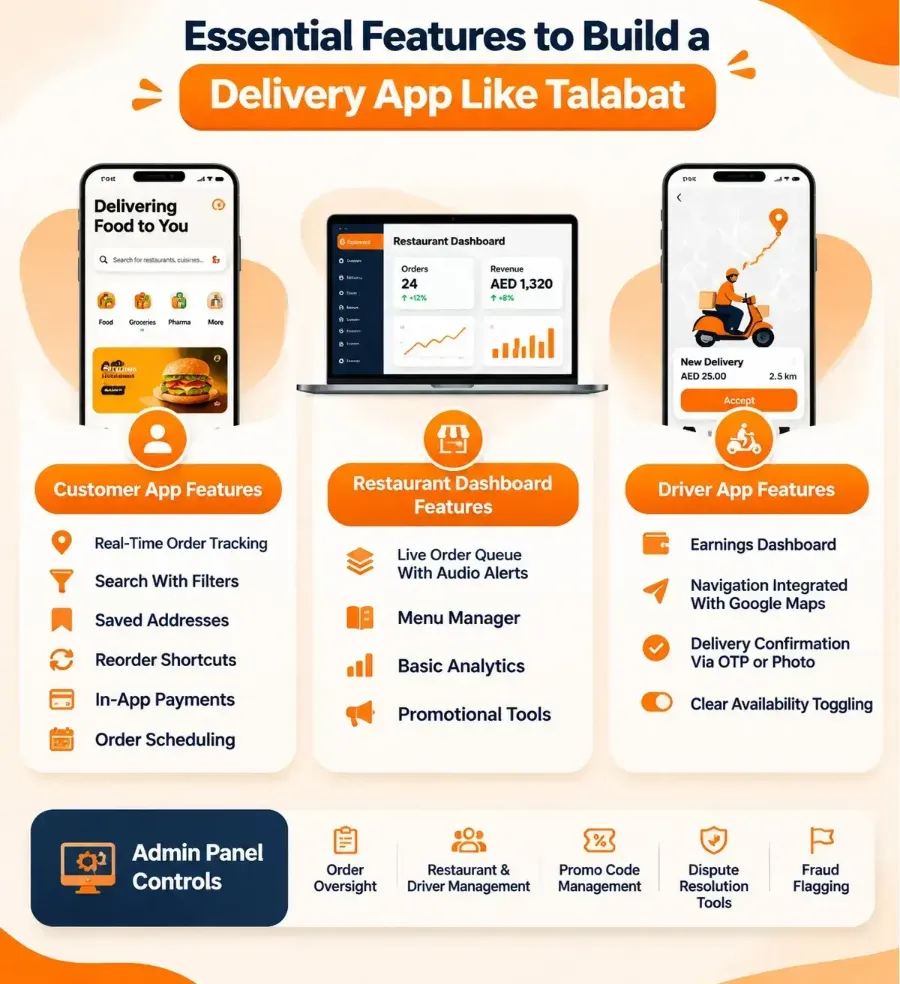
Customer App Features
Your customer experience affects your retention rate. Our core delivery app features include:
- Order Tracking: Our customers will be able to track their orders in real time and see where their delivery is at the moment. You lose customers quickly with the “your order is on its way” screens or fake ETAs.
- Search With Filters: Customers should be able to search with filters like minimum order value, cuisine type, delivery time and more.
- Saved Addresses: Your addresses should auto-populate at checkout. In the UAE, saving a map pin is way more valuable than saving a street address.
- Reorder Shortcuts: Design your app in a way that the last 3-5 orders by the user are shown on the home screen, making repeated purchases a one-tap process.
- Payments: Support Apple Pay, card-on-file, BNPL (Tabby) and cash-on-delivery at launch.
- Order Scheduling: Have customers schedule orders for a specific time in the future.
Restaurant Dashboard Features
Restaurants need operational visibility. Essential tools include:
- Live Order Queue with audio alerts: The screen notifications are not loud enough to alert the kitchen of a new order in a busy environment and often result in the preparation of the wrong or a delayed order.
- Menu Manager: Restaurant owners constantly change the prices and menu items and it's important for the POS to have a menu manager that's easy to use by non-technical staff.
- Basic analytics: Insight into the average order value, peak hours, and most sold items.
- Promotional Tools: Direct control to restaurant partners to run various offers and promotions e.g. free delivery windows.
These tools will help restaurants optimize their operations and improve profitability.
Driver App Features
Your operational backbone is your drivers, and your delivery app should offer the following to them:
- Earnings Dashboard: Show drivers their daily and weekly earnings, as well as the earnings per delivery, broken down to base pay, tips and bonuses.
- Integrated Navigation in Google Maps: Build the hand off in app navigation to enable your riders to focus on the delivery rather than taking care of different screens.
- OTP Delivery Confirmation: An OTP delivery confirmation protects the driver and the customer in case a dispute arises, and a photo of confirmation at the door is a better fallback in cases of contactless or unattended delivery.
- Clear Availability Toggles: Allow drivers to easily switch between online, break and offline states without any delays. Any lags can result in missed pickups, or double assignments. Place the toggle on the home screen.
Admin Panel Controls
Your operations system should manage:
- Order Oversight: Your operations team must have a real time view of all orders. Being able to track and adjust orders in real time prevents a customer from having to call and complain about their order.
- Restaurant and Driver Management: Your management system must be able to onboard and off board restaurants and drivers, and adjust commission rates for restaurants.
- Dispute Resolution: Your support team must have the ability to immediately resolve any and all order disputes.
- Promo Code Management: You should be able to easily create, edit, and remove promo codes and promotional offers.
- Fraud Detection: Automated detection of bad actors should surface in your admin panel. Bad actors can include: customers filing multiple refund claims, customers leaving fraudulent/bad reviews, order cancellations, abnormal payment activity, payment failure claims, payment change requests, etc.
UAE-Specific UX: Arabic, Localisation, and Cultural Design
Here’s where lots of international founders fail. They make the mistake of “launching” a global product in the UAE without proper localization. This strategy rarely works. You need:
Full RTL Layout
- Adding Arabic text is not enough. You need:
- Proper right-to-left layouts
- Arabic typography optimization
- Proper localization testing
- Dual-language support
Halal Filtering
Add a Halal filter from the start. This is a hard requirement for a significant portion of your user base. Likewise, dietary labels (vegetarian, vegan, nut-free) must be available for all restaurant partners.
Ramadan Mode
This is another big opportunity. Delivery apps in the UAE must localize their apps to offer:
- Iftar & Suhoor categories
- Prayer-aware delivery window scheduling
- Extended operating hours
Talabat does a good job at this and you can do more of the same.
UAE Payment Preferences
Apple Pay, Tabby BNPL, NEOPAY and cash on delivery (COD) are expected by UAE users. Do not launch without COD. While it is anticipated that over time the preference for COD will decline, for first time users in many cases it is still very much preferred. The more payment options you provide, the lower your cart abandonment.
Address Input
A unique issue with the UAE is that many areas still use landmarks instead of conventional postal systems. You will need to include:
- A map pin selection flow
- WhatsApp location sharing
- Building and tower references
- Saved landmark tags
Latest AI and Automation Features To Include in the Delivery App Development Process
Talabat-like app development in UAE includes modern platforms and build defensibility. Anyone can build a basic Talabat clone app today. The rest use AI in useful ways.
Personalized Recommendations
Users are used to apps making suggestions based on their preferences, habits and context. AI can help analyze previous orders, how the user browses through the app and what suggestions are relevant and timely.
Improved ETAs
Static ETAs are extremely frustrating to users. AI can analyze things like traffic, driver location, restaurant prep time, weather, historical delivery patterns, and a lot more to provide better ETAs.
Multi-Drop Route Optimization
In a Talabat-like app model in the UAE, multi-drop route optimization means one driver can complete 2 or 3 deliveries in a sequence, improving your cost-per-delivery metric. This also reduces fuel consumption and increases driver productivity and delivery speed.
Voice and Conversational Ordering
Ordering via voice or chat interfaces is quickly replacing ordering by typing. Users can ask the app to find things like “spicy chinese food”, “restaurants near me” or “my favorite meals”, and the app can interpret that.
Conversational ordering helps app users who may not be as technology-savvy like the elderly, or people who are really busy and on the go.
AI-Powered Demand Forecasting
One of the main uses of AI in the development of food delivery apps is demand forecasting. Using machine learning, apps can predict future customer demands based on a variety of factors including previous orders, seasonal trends, events, weather, customer behavior, and more.
Because of this predictability:
- Restaurants are able to more accurately predict and manage their inventory needs
- Food delivery fleets can proactively manage and allocate their riders
- Food waste for all businesses in the food delivery system can be minimized
- Plan for peak demand
Using artificial intelligence to power their forecasting, food delivery app development can improve their operations and enhance profitability.
Dynamic Surge Pricing
Food delivery systems can also use AI to power surge pricing the same way that ride sharing apps do. Surge pricing allows delivery systems to automatically adjust their fees based on factors including:
- Order volume
- Rider supply
- Weather
- Traffic
- Demand hotspots
When done correctly, surge pricing can help improve the reliability of a food delivery service and better manage supply and demand.
Automated Refund and Fraud Detection
Refund abuse is becoming more prevalent in food delivery. AI can help with fraud detection to analyze customer behavior to detect suspicious activities like order history, delivery records, and refund requests.
Fraud detection can do the following:
- Detect fraudulent refund claims
- Recognize patterns of repeated abuse
- Flag transactions automatically
- Decrease revenue leakage
- Increase processing time of legitimate refund requests
By automating fraud detection, delivery platforms can protect their profit margins, and allow for a better customer experience for legitimate customers.
Step-by-Step App Development Process for Your Talabat-Like Platform
If you’ve finalized your business model, core features, and user definition, it’s time to create a prototype of your product. Let’s discuss the app development process similar to Talabat.
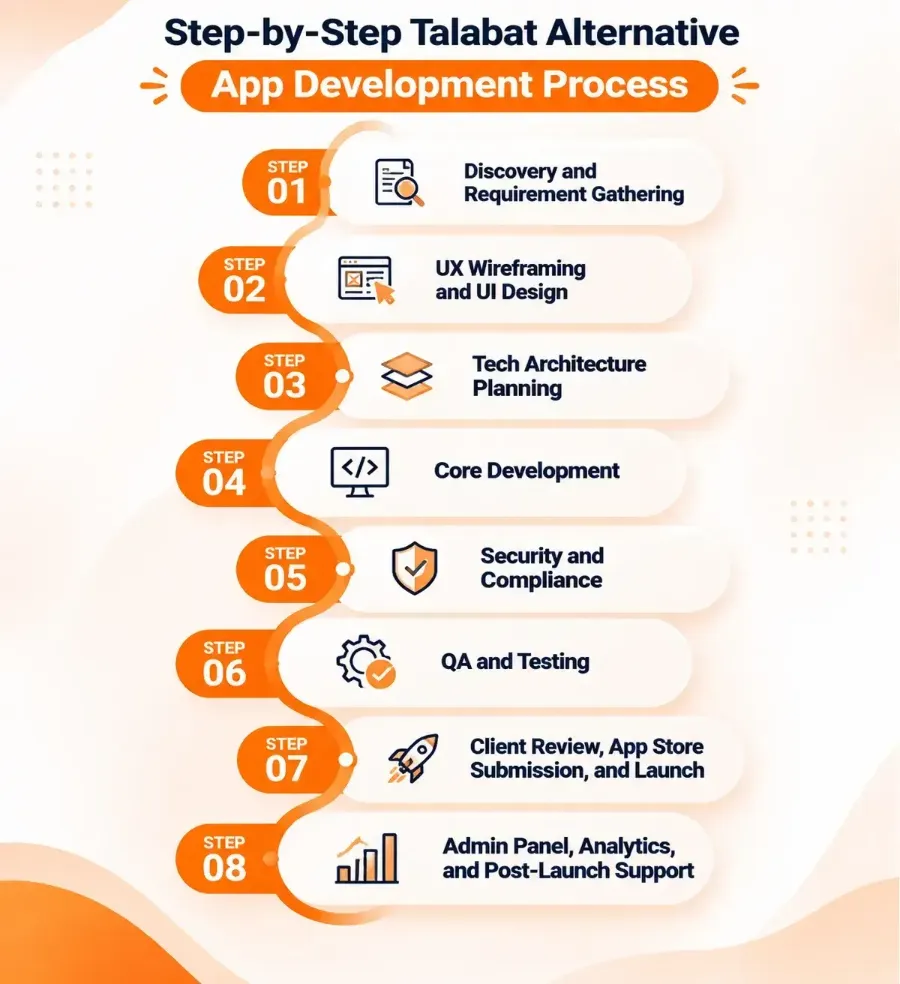
Step 1: Discovery and Requirement Gathering
The first stage is getting to know you. As a part of this process we get a baseline understanding about your business, your users, and your technical constraints.
Step 2: UX Wireframing and UI Design
Before any coding happens, the design team maps out the journey of each user and depicts that in a wireframe. This flows across all parts of your app (customer order journey, restaurant manager queues, deliveries, etc). For a UAE delivery app this means creating layouts and depicting journey elements in full Arabic RTL (including an interface that supports bi-lingual and Halal filtering), and UAE payment flows.
Step 3: Tech Architecture Planning
This step defines the architecture of the final product and the constraints of the overall system. For a delivery app, the first thing the engineering team decides is the front end framework.
Front End: Native vs. Hybrid (Cross Platform)
For something used frequently by users, like a delivery app, performance is prioritized over design. In this regard, developing natively for iOS and Android (Swift and Kotlin respectively) is the best way to ensure high performance. In the case that the goal is to achieve an MVP at the lowest cost possible, a Cross Platform Framework like Flutter or React Native would be a good option.
Step 4: Core Development
This is the main build phase. The frontend and backend teams work in parallel on all four systems.
Backend Architecture
Different services such as order processing, payments, rider allocation, and notifications, have very different load profiles. Start with a modular monolith for the backend in the MVP stage, and breakout the modules as needed with increased order volume. For your data layer, use PostgreSQL for transactional data, Redis for caching, and use either Kafka or RabbitMQ for order bursts.
Real-Time Tracking and Routing
For this, you will need three things in your stack working in conjunction. The first is a reliable maps SDK (for the UAE, Google Maps is the most reliable). The second is a traffic-aware routing SDK. The third is an ETA engine that accounts for kitchen prep time. Real-time status updates should be done through WebSockets.
Payments and Wallets
For every payment method you do not support, you will see in your analytics that a significant number of potential customers abandoned their shopping cart. To start, you need support for card payments, as well as Apple Pay and Google Pay. You should also support cash on delivery payments, and/or BNPL for higher ticket orders, for example, through Tabby or Tamara.
Using PCI-compliant processors like Checkout.com, PayTabs or Stripe with tokenisation means card details will never be stored on your server. Therefore build an in-app wallet to ensure repeated orders and boost order velocity. Stored credit drives repeat orders frequency more effectively than any discount campaign.
Restaurant Partner Systems
The better your vendor dashboard is, the more your restaurant partners can manage their menus and preps, set pauses and see their earnings, reducing your support ticket load. Add basic analytics showing top dishes, peak hours, and reasons for order failures to help them further refine their operations on your platform.
Rider App and Logistics Intelligence
The rider app should have a low cognitive load. Automate order assignment, navigation, and payment. Design clear, quick, and easy to understand earnings and status flows. On the back end, implement batching for rider and delivery trips. Use demand heatmaps to guide rider activity. Flex your real-time performance and engagement data for extrinsically motivating your riders.
Step 5: Security and Compliance
End-to-end encryption of card data and personal information. Role-based access is applied to support agents and restaurant managers, so they can view orders relevant to their access. For UAE compliance, align with PDPL for data consent and retention, maintain PCI-DSS for card data, and host in the UAE or AWS Bahrain for data residency.
Ensure requirements of the PDPL for data consent and retention, PCI-DSS for card processing, and AWS Bahrain and/or UAE for data residency.
Step 6: QA and Testing
Each feature is tested prior to release. This includes functionality, performance (peak hour load testing), real-time tracking and accuracy, payment flow (all supported methods) and RTL layout on iOS and Android devices.
Step 7: Client Review, App Store Submission and Launch
The product is made available to you in a staging environment prior to go-live. Requests for product improvements are made and prioritized during the stabilising process. Once improvement requests and fixes are approved, apps are submitted to the App Store and Google Play (optimized for the UAE with Arabic keywords and bi-lingual descriptions).
Step 8: Admin Panel, Analytics and Support
Your Admin Panel goes live for city-level management, commission and promo code changes, support SLAs, and fleet health.
Track operational metrics that influence business health including the average order delivery time, order success rate, and repeat customer purchase rate. Also track CAC and GMV by city.
The first 30-60 days post launch are the most operationally intensive. Your team is available and provides real time support to answer any questions. Performance and usage is tracked to inform the next feature prioritization and development.
How Much Does it Cost to Build an App like Talabat?
This is the first question every founder wants answered: “How much does it cost to build a delivery app in the UAE?” And the answer is actually, how big do you want to be?
A delivery app is a logistics engine to move goods from point A to point B. It's a payment system. It's a partner marketplace. It's a rider fleet management system. It's a customer-facing interface. It means the sky is the limit in terms of costs to build out your delivery app in the UAE.
The cost to build a delivery app in the UAE also depends on the scope and constraints of your MVP. Do you plan to include riders in your MVP? What about payment? Perhaps delivery windows? What about customer ratings? The sky is the limit with your MVP too.
| Build Stage | Features | Estimated Cost (UAE) | Timeline |
|---|---|---|---|
| Startup MVP | Customer app, restaurant panel, rider app, payments, real-time tracking, basic admin | AED 50,000 – 150,000+ | 5 – 12 weeks |
| Mid-Level Platform | Loyalty engine, wallet & refunds, analytics, multi-zone delivery, advanced dashboards, and more. | AED 100,000 – 350,000+ | 3 – 8 months |
| Full-Featured Advanced Ecosystem | Multi-city AI routing and batching, subscriptions, live chat, dark kitchen support, and BI dashboards. | AED 350,000 – 1M+ | 9 – 14 months |
Common Mistakes to Avoid When Building a Food Delivery App in the UAE
These are the most common mistakes made by founders creating a food delivery app in the UAE.
Not Investing In Arabic Localisation
First of all, Arabic is a right to left language, which means the entire layout including text alignment and buttons needs to be flipped. Ignoring this will lose you a good amount of potential customers.
Launching Only in Dubai
Even though Dubai is a prominent market, it is expensive and competitive. Not many people in Dubai use your app. Sharjah for example has 1.8 million residents and is underserved. So does Abu Dhabi, which has a higher average order value. During your first launch you should think about these nearby markets and not just rely on Dubai.
Estimating Infrastructure costs
In most cases, founders don't consider proper infrastructure costs to support their business and then end up blowing their runway.
Live tracking seems simple, but each active order maintains a persistent connection to your server, and during peak hours you may have hundreds of servers running at a time. Most founders are budget conscious when it comes to storage and compute, but not for trackfulness. Tracking thousands of orders and delivering them accurately and quickly is not always trivial.
No Loyalty or Subscription Program
Talabat Pro keeps customers from leaving by giving them an option to pay to have their orders consolidated. Without something similar, you're competing for low prices. Building a loyalty program is far cheaper to build at launch than to add once users have built habits with a competitor app.
Neglecting Driver Experience
Most founders obsess over the customer app, and don't think much about the driver app. That is a mistake. A confusing interface, slow navigation, or unclear earnings frustrates drivers and leads them to deliver on competing apps during peak hours.
What Are the UAE Licensing and Legal Requirements for Delivery Apps?
This is the section many blogs completely skip. If you want to legally build a delivery app in the UAE, compliance is critical.
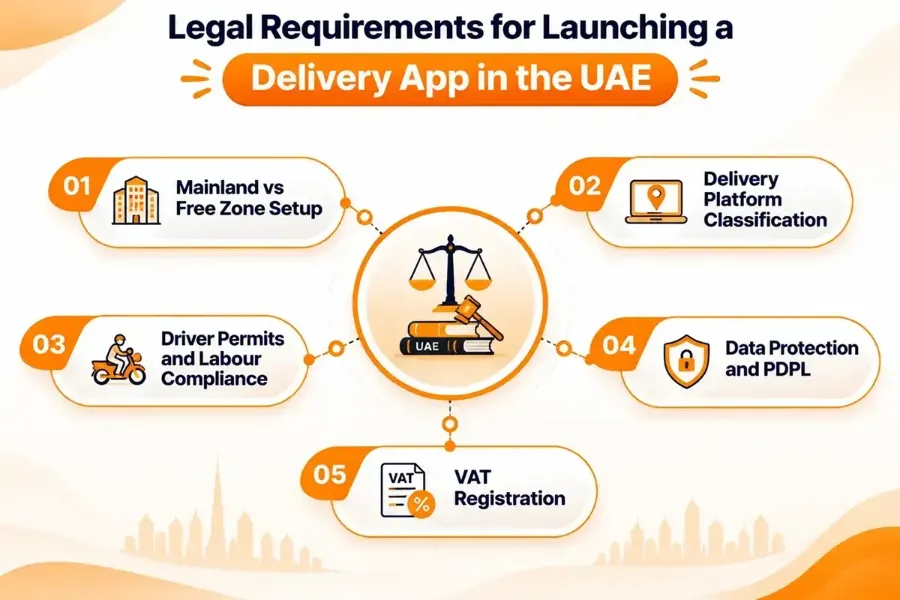
Mainland vs. Free Zone Setup
You generally have two options:
- A Mainland licence through Dubai DED (Department of Economic Development)
- Or, Free zone setup (i.e. DIFC or ADGM)
Mainland structures provide greater operational flexibility within the UAE market (especially if you're collaborating with local restaurants and logistics partners). Free zones may provide some tax and ownership benefits, but may constrain operational flexibility. UAE legal advisors should be consulted before a final decision is made.
Delivery Platform Classification
Food delivery platforms may be classified as e-commerce, logistics or technology services, depending on how the business operates. That classification determines things like:
- Licensing
- VAT obligations
- Labour laws
- Approval and inspection by relevant authorities
If a dark store is utilized (meaning you hold the inventory), additional permits from the relevant municipality (i.e. Dubai Municipality, or Abu Dhabi Agriculture and Food Safety Authority, etc.) for food handling are needed.
Driver Permits and Labour Compliance
Regulations regarding road transportation (RTA) affect you directly if you manage fleets. Currently, all delivery drivers working in Dubai need an approval from RTA, and their employment status should be in line with the MOHRE (Ministry of Human Resources and Emiratisation) regulations. Post 2022 reforms in the UAE laws, classifications of gig workers have evolved and are expected to further change in the near future.
Data Protection and PDPL
For app founders in the UAE, PDPL has major implications. You should incorporate provisions for obtaining clear and explicit consent of data subjects, data processing register, and potentially hiring a local UAE data controller. Although the UAE has not yet instituted data localization laws, from a defensive point of view, we recommend using AWS Middle East (Bahrain) or the newer UAE region.
VAT Registration
Your platform needs to register for VAT if your projected/actual annual revenues are greater than AED 375,000. Build this into your financial model early. Founders tend to underestimate the accounting and financial complexity of running a delivery business. Get your financial infrastructure ready early.
Conclusion
Talabat-like app development in the UAE is a smart business move because the market has the potential to accommodate more players and the usage of convenience services is on the rise.
Building an app like Talabat is a good idea, but only if you are also selecting the right business model and are working with the right app development team.
DXB APPS as a leading Mobile App Development Company in Dubai understands that launching an app like Talabat means you need to plan, build, launch and grow your app the right way. We have previously assisted clients in building and launching multi-vendor delivery apps in the GCC. One of the successful delivery app projects we worked on was the Expo City Eats app. Expo City Eats is an in-app food ordering and delivery platform designed to give the employees and visitors of Expo City Dubai a convenient way to order food from any location within Expo City. The app was also designed to be scalable to meet demand.
We, at DXB APPS, work as an extended team to our clients, and have the required skills and experience to build apps similar to Talabat. We also understand the latest delivery app trends and are able to build a secure and reliable app for our clients. If you have a similar idea, now is the best time to validate your idea. We will be more than happy to guide you and answer any questions you may have.

FAQS
1.What is the approximate cost to create an app like Talabat in the UAE?
A basic, but functional app like Talabat with customer apps, restaurant and rider dashboards and basic order tracking would take around AED 50,000 to AED 150,000. A mid-level food delivery app would include loyalty programs, analytics and other features which would take around AED 100,000 to AED 350,000. A full featured food delivery app with AI routing, dark kitchen and BI dashboards would cost around AED 1 million. The main factors which affect the cost of developing the app are the speed at which you want to go to market, the feature scope and the location of the development team.
2.What is the approximate time to develop a food delivery app in the UAE?
Defining the scope well at the start of the project will allow you to create a functional MVP in 5 to 12 weeks. A mid-level food delivery app with advanced dashboards, loyalty programs and other features would take around 3 to 8 months. Building a fully featured food delivery app with AI routing, subscriptions, live chat and other features would take around 9 to 14 months. The time required is affected by if you develop the app in house, with a UAE based agency or with an offshore development team.
3.What licenses do I need to start a food delivery app in Dubai?
You will need a trade license from either the Dubai Department of Economic Development (DED) or one of the Free zones like DIFC or ADGM, based on your operational model. If you plan to operate a dark store, you will also need food handling permits from Dubai Municipality.
4. Does a UAE delivery app need to support Arabic?
Yes. Arabic support is necessary from the start. Inadequate localization to Arabic means losing a huge chunk of the potential customer base, especially in Sharjah and Abu Dhabi, where Arabic-first is more dominant than in Dubai.
5. What is the difference between Talabat's model and a quick commerce app?
Talabat is an aggregator model where it takes an order from the customer, and for that it facilitates a connection between the customer and a third party restaurant and takes a commission for that, which is in the range of 15-30%. Quick Commerce app models are different, in that model they carry the inventory and utilize micro-fulfillment centers and promise to deliver in 15-30 mins. Quick commerce in UAE requires more upfront capital for inventory and warehousing, but gives better margin control.
6. What is the difference between Talabat's model and Noon's delivery model?
Talabat operates as a restaurant aggregator model. It facilitates connection between customers and third party restaurants and for that takes a commission. Noon, with its Noon Minutes model, operates more like quick commerce. Noon holds the inventory in micro-fulfillment centers to facilitate quick delivery of groceries and everyday items. In the UAE, figuring out the kind of model you are closest to, especially when developing a delivery app, will influence major decisions like the tech stack and business rights and permits.
Also Read:- Talabat Like App Development In Dubai