Navigating the local laws and regulations in the UAE can be daunting, to say the least. Mobile apps can easily be blocked if just one law is overlooked.
If you are aligned with TDRA compliance UA, it builds trust with customers and gives you an edge in the market. Detailed information on legal and regulatory frameworks, data protection, as well as the approvals process is contained in this guide.
We as a leading mobile app development company in UAE can help get your app ready for launch in the UAE!
A Market This big Deserves The Right Strategy

The UAE mobile app market is expected to reach over $2 billion by 2030, growing at a rate of 10.3% each year. The United Arab Emirates has one of the highest levels of smartphone ownership in the world, with over 95% of the population owning one.
When a region has this level of market potential, interest is bound to increase. The UAE has one of the most developed and well structured digital and regulatory frameworks in the region, and it is not to hinder business, but rather to foster trust in UAE markets.
Stable markets are attractive to investors. Understanding UAE App Laws and TDRA compliance before building is a must.
Let us see what regulations every Middle Eastern business needs to know.
Key Mobile App Regulations Each UAE Business Should Know
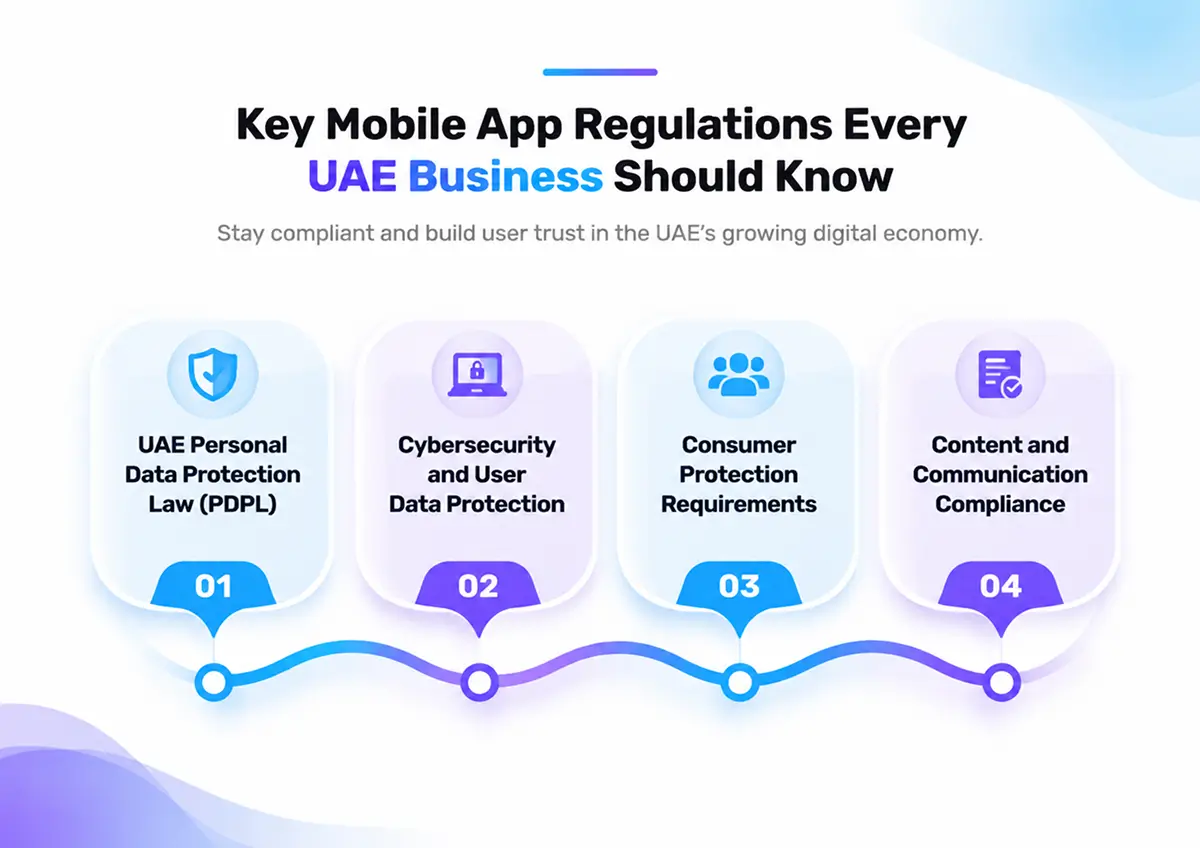
UAE Personal Data Protection Law (PDPL)
All laws pertaining to data protection in UAE are consolidated in the UAE Personal Data Protection Law (PDPL) Federal Decree-Law No. 45 of 2021 and came into effect on 2 February 2022. The law imposes obligations on mobile applications that process (or intend to process) the personal data of individuals in the UAE, irrespective of their nationality and/or residency.
There are three elements of UAE data protection law for mobile apps which present challenges to founders most often.
Consent
Consents cannot be implied. Consents must be informed, specific and unambiguous. Under UAE mobile apps privacy law, consent must be obtained prior to collection of personal data.
User Rights
Users are granted rights to access, amend and/or delete their personal data. UAE data protection law (PDPL) places an obligation on data controllers to respond to such requests in a reasonable time.
Breach Notification
There is an obligation on data controllers to report a data breach to UAE Data Office within 72 hours from the time data controller becomes aware of the breach if there are reasonable grounds to believe that the user’s (or data subject’s) privacy has been affected.
There are demands for due diligence on PDPL during fundraising. Lack of documentation on user consent creates legal exposure and adversely impacts the valuation of the app.
Consumer Protection Requirements
Consumer protection laws of the UAE require apps that facilitate monetary transactions, purchases, or delivery of services to provide adequate protection to consumers and clearly inform consumers of the prices they will be charged prior to their commitment to the transaction. Further, apps must disclose their terms and conditions of subscriptions, including the length of the subscription, the terms of automatic renewal, and the terms of cancellation.
When it comes to subscription-based services, unclear terms and conditions are among the most reported violations of consumer protection in the UAE Apps market.
Another area that is largely overlooked by founders relates to compliance with mobile app licensing in UAE, which varies by industry. For example, an app in the health sector or a fintech app may require additional business licenses beyond a general TDRA license. This would affect the timing for the launch of your app.
- Clear pricing
- Terms and conditions
- Subscription disclosures
Content and Communication compliance
Guidelines of TDRA for Mobile Applications are more encompassing than one can imagine. The content of your mobile application must align with the UAE Cultural and Ethical Values. Advertising in your application must not include false claims or misleading information and must be labeled as advertisements. If user generated content (UGC) is included in your application, you must have a moderation policy and disclose it prior to releasing the application.
This catches most people off-guard. If your application allows users to place calls using the application, prior approval from TDRA is required. TDRA maintains a list of VoIP applications that have been approved. Everything outside this list is blocked by the carrier. This is a product architecture decision. Build your product roadmap keeping this in mind.
Now let us simplify all these legal requirements to specific doable steps.
TDRA Compliance Checklist for Mobile App Owners
This checklist is for the legal requirements of mobile app development Abu Dhabi and UAE. Go through the checklist and include the necessary information in your app before submitting it to the app store.
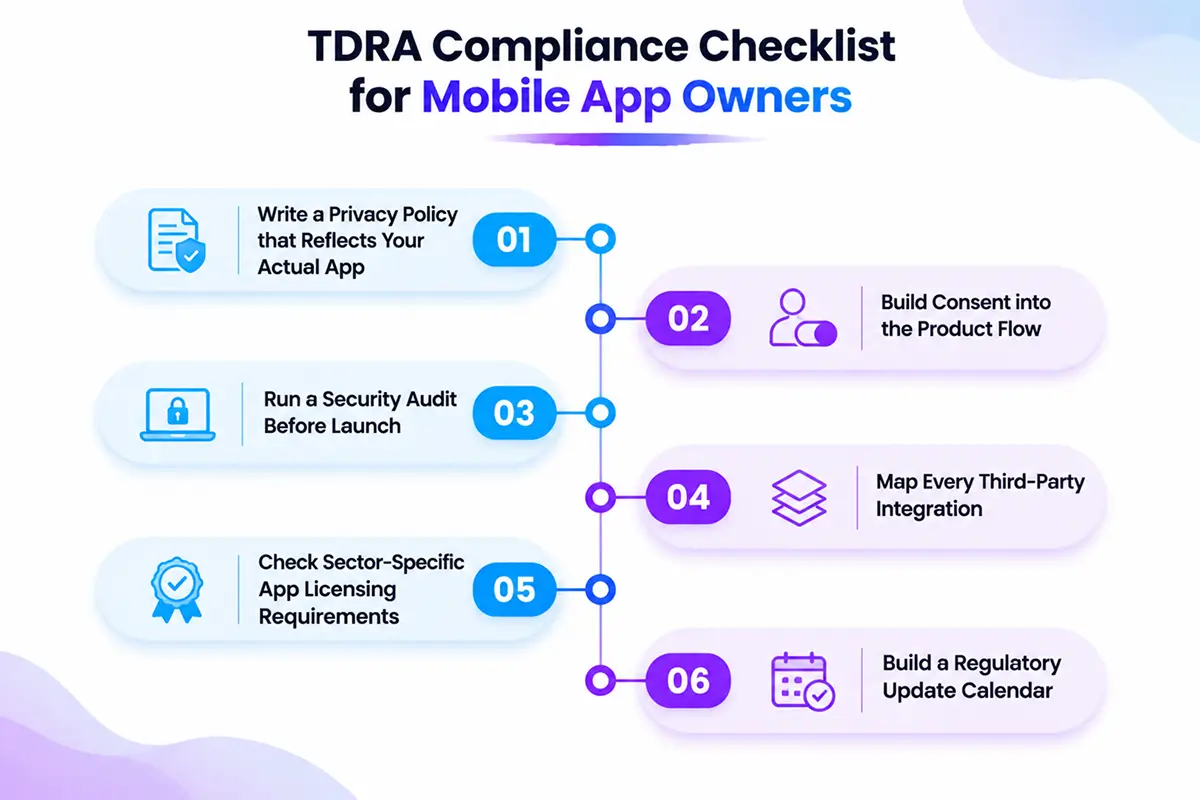
Your Privacy Policy Should Reflect Your Actual App
Make sure your policy is specific and real. Do not use a generic or boilerplate policy. The UAE Data Office compares policy to practice and may fine you for lack of compliance.
Obtain User Consent
Do not touch users’ personal data without first obtaining user consent. There should be a clear and explicit explanation that the user should see and agree to beforehand. Log consents and investigate if accused.
Perform a Security Audit Before Launch
This should not be a static analysis or testing done by the mobile app developers in Dubai. You should break your app yourself to find flaws and vulnerabilities.
Identify Third-Party Data Collectors
Disclose third-party data collectors in your privacy policy.
Assess Sector Specific App Licensing Requirements in the UAE
Depending on the sector that you operate in, you may require further licenses to be granted before launching your app.
Build a Regulatory Update Calendar
TDRA and the UAE Data Office change regulations frequently. Assign someone to track and review these updates.
How Can You Build A TDRA Compliant Mobile App from the Start?
Compliance issues are seldom due to willful violation of laws. More often than not, it is due to poor sequencing. Often, teams build a product first, and then look to add compliance layers to it later. By the time they realize their product architecture does not support compliance, they are either carrying risk, or forced to rebuild it from scratch.
When building mobile apps for the UAE, one of the easiest ways to be sure that you are compliant is to start considering the mobile app development UAE regulations as product requirements from sprint one.
Where your product team is making decisions about what data to capture, and how to structure the data, is a legal decision. The data localization laws in UAE stipulate that some types of data must be kept within the UAE. Before even writing a single line of code, your team is making legal decisions, and possibly infrastructure decisions, about where your data will be physically hosted.
- Compliance First Development Approach
- Legal meets Tech
- Testing and Auditing
When your product manager is deciding on the onboarding process, they should not consider the consent screen a trivial step to be checked off before the “real” product is presented to the end user. The consent screen is part of the real product. The decisions made will impact the product’s engineering and design.
When your engineering lead is integrating third-party APIs, making the decision to use a particular API is a legal decision as to the obligations you will assume under the UAE data protection laws.
The companies that build TDRA-compliant mobile apps without drama are almost always the ones where a founding team member took responsibility for this from the start, and the legal and tech teams were actually communicating with each other throughout.
Also Read:- How to Choose the Best Mobile App Development Company in Dubai for Your Business?
Common Compliance Mistakes Made by Businesses
One small error can cause a huge delay in the regional launch of your app. Let’s look at the most common mistakes made by businesses.
Not Meeting Privacy Requirements
You can’t leave legal requirements for your app for the last minute. The most expensive policy is the one written 2 days before getting a regulatory letter. Think and act proactively, and update your policy when your data practices change.
Poor Data Security Measures at the Time of Launch
We’ll tighten security after product validation” is something many founders say. While it’s understandable, it’s a significant business risk. A breach of mobile app security after launch is significantly worse than a pre-launch breach.
Unclear User Agreements
Vague or broad terms do not protect you, and can be used against you. Users in the UAE can complain to regulatory bodies and may cause your app to be put under investigative review.
Failure to Monitor Regulatory Updates
2026 brought a new law requiring UAE based mobile apps to incorporate age verification and content filters, and to not be used by those under 18 years of age and prohibited behavioral marketing directed towards minors. App developers who were unaware of the legislation were suddenly non-compliant.

DXB APPS – Trusted App Development Company in Dubai
DXB APPS is a best AI app development Company in Dubai, focusing on transforming smart ideas into innovative app solutions. DXB APPS offers a wide array of app development services keeping innovation and quality at the core of our business.At DXB APPS, our expert app developers assist clients in achieving business success by creating outstanding apps that encourage business growth and enhance customer experiences.
Final Thoughts
We cover the primary mobile app compliance requirements in the UAE for 2026, including the UAE's data protection law, cybersecurity and consumer protection laws, and the TDRA mobile app guidelines.
Founders considering these laws as requirements rather than noise will help them launch and scale faster and more efficiently. This will also allow them to avoid needless problems and raise cleaner capital. Investors placing bets on this will help founders protect their valuations.
There are several factors that help a company succeed in the UAE. One of those factors is trust. Compliance helps build trust.
Knowing and understanding these laws and implementing them are two different things. Most founding teams do not have enough time to thoroughly implement these laws and make sure their product is compliant.
DXB APPS is a leading mobile app development company in Abu Dhabi that founding teams and startups work with to incorporate compliance in their products from day one.
FAQS
Q 1.What is TDRA compliance in the UAE?
When mobile apps comply with the Telecommunications and Digital Government Regulatory Authority (TDRA) of the UAE on content, data localization, VoIP and internet access, the apps are said to be TDRA compliant. Any app that does not comply with the above UAE mobile app regulations may be blocked by the local carrier.
Q 2.Do you need TDRA Approval for Mobile Apps in the Middle East?
Most consumer apps are not required to obtain prior approval by TDRA, but are required to comply with all TDRA provisions after launch. The exception to this rule is apps with VoIP functionality which are required to receive TDRA approval first, to allow them to activate VoIP within the app.
Q 3.What are the legal requirements for mobile apps in the UAE?
There are four main legal frameworks that regulate app development in the UAE. These are the UAE data protection law, UAE cybersecurity law, consumer protection law and TDRA framework.
Q 4.What happens if an app is not compliant in the United Arab Emirates?
Not being compliant can lead to fines, removal from app stores, and ISP blocking. For investors, an app that is not compliant can result in a blocked funding round or reduce the valuation of the app. The regulations are ever increasing and the UAE has a history of enforcing strict laws.
Q 5.Does the UAE require a privacy policy for mobile apps?
Yes, and it has to be accurate, not generic. Under the UAE mobile app privacy laws, any app that collects personal data from UAE residents must have a policy that describes what data is collected, the reason for collecting the data, how long the data is retained, and how the data subject can exercise their right.