Mobile apps dominate the digital landscape, driven by billions of users, high daily usage, and technologies like AI, 5G, AR/VR, and super apps that enhance user experience and engagement.
Key Takeaways
- The mobile app market is growing fast. Billions of users drive huge yearly download numbers.
- Mobile apps now take up many hours of user time each day.
- Apps are now the main digital interface for most people.
- Businesses are moving to mobile-first plans to stay competitive.
- Tracking app trends is key to grow, engage users, and earn money.
- This blog covers app trends, tools, and strategies shaping mobile apps in 2026.
Mobile applications are expanding at a high rate in the world. Most companies have made them one of the major online channels. By 2025-2026, the number of smartphone users will have topped 4.69 billion all over the world. The adoption process is increasing both in the developed and emerging market. To most companies, mobile applications are no longer a luxury. Apps usage by users has increased to more than 4.2 hours per day.
This indicates a significant move towards mobile first behavior. Globally, the number of downloads of apps will be almost 299 billion. The last years generated more than 935 billion in mobile app revenue.
Due to this fact, a number of industries are becoming mobile-first. These are retail, fintech, healthcare and logistics. Every day, people purchase, socialize, and entertain themselves with apps. A good number of individuals open applications numerous times daily. The level of competition is on the increase in almost all categories of apps. Firms need to adhere to trends in mobile applications to remain in touch.
This blog discusses the mobile app development trends to follow in the year 2026. It involves emerging technology, change of user behaviour, and monetization. It is also a co-owner of ideas about the future ready to make the mobile space.
Why Mobile App Trends Matter for Businesses?
The latest mobile app trends are not just related to the new technology. They influence the ways businesses are operated, competed, and related to customers. Agile organizations are faster and easier to use. They are also in a position to maintain a high competitive advantage. Any firm that does not respond to trends is likely to lose track and stagnate.
Increasing Mobile Dependency
The use of mobile devices continues to increase all over. The majority of the population uses smart phones to go online. This transforms the interaction of people with brands and services.
- There are more than 6.8 billion smartphone users predicted in 2026.
- The mobile devices contribute more than 60 percent of the worldwide web traffic.
- Applications are more favourable to browsers because many users prefer using them.
Key shifts in user behavior:
- Apps support shopping, banking, messaging, and entertainment.
- In many industries, mobile use now beats desktop use.
- Mobile apps power most on-demand services.
- Mobile-first is required for many businesses today.
- It is critical for winning and keeping modern users.
Competitive Advantage Through Innovation
Trends help businesses stand out in crowded markets. Early adopters often gain an edge over competitors.
- Many apps now add AI, machine learning, AR, and VR.
- Automation and real-time data improve work efficiency.
- Super apps bundle several services in one place.
The role of innovation in growth:
- It attracts new users with standout features.
- It strengthens the brand as modern and forward-looking.
- It improves retention through steady feature updates.
Voice tools and AI suggestions are trending today. They can boost engagement and activity. They also help create smarter, faster apps.
Impact on Customer Experience
One factor behind an app’s success is customer experience. Many trends focus on smooth, personal user journeys.
- Good UI and UX help users finish tasks faster.
- Content and offers are personalized.
- Chatbots and voice tools improve access and support.
Improvements based on modern app trends include:
- Faster response times and easier use.
- Context-aware services like location and notifications.
- Consistent experiences across mobile, web, and wearables.
- Better mobile experiences drive more interaction.
- They can also raise conversion rates and customer loyalty.
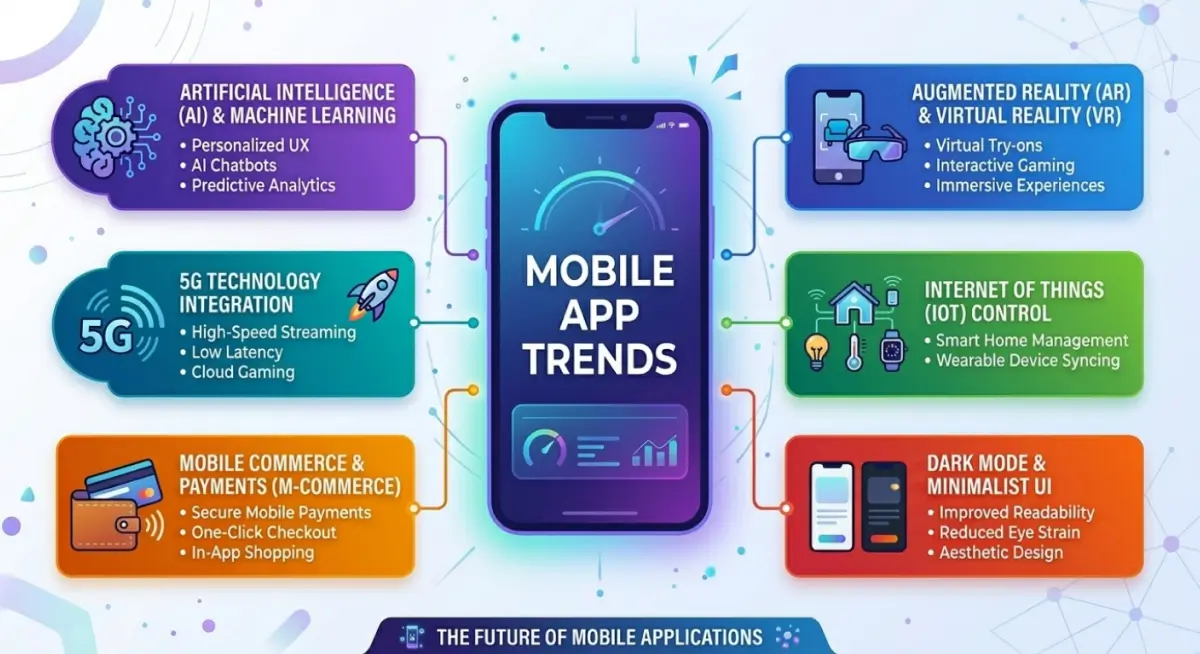
AI-Powered Mobile Applications
Integration of Artificial Intelligence
Many apps now include AI. It helps businesses deliver smarter, faster experiences.
- AI can recommend items based on user behavior.
- AI automates tasks to improve efficiency.
- AI analytics help teams make better decisions.
Impact:
- Higher user engagement.
- Lower operating costs.
- More data-driven business plans.
Chatbots and Virtual Assistants
Chatbots and assistants enable automated chats in real time. They use AI to respond fast at scale.
- They provide 24-hour service with fewer staff.
- They answer common questions right away.
- They can serve many users at once.
Benefits:
- Faster support.
- Lower support costs.
- Better user satisfaction.
Predictive Analytics for Personalization
Predictive analytics helps apps predict what people need. It supports more personal experiences in the app.
- Apps track actions to gather useful insights.
- Apps can deliver personalized content and offers.
- Apps can recommend items based on preferences.
Outcome:
- Higher conversions.
- Better user experience.
- Stronger customer loyalty.
Rise of Super Apps
Super apps combine many services in one place. Users can pay, shop, and book services in one app. This reduces the need to switch between apps.
What Are Super Apps?
A super app offers many features in one ecosystem. It combines chat, payments, shopping, and bookings. It acts as a one-stop app for users. It focuses on convenience and ease.
Examples of Super Apps
Some apps bundle payments, rides, food, and shopping. Many include wallets and on-demand services. They are common in Asia and the Middle East.
Benefits for Businesses
- More interaction since users stay in one app.
- Higher retention when users have no reason to leave.
- More cross-selling across services.
Outcome:
- Better customer relationships.
- Higher lifetime value per user.
- More revenue streams.
5G Technology and Faster Connectivity
5G improves app speed and reduces latency. It also makes connections more reliable. This enables advanced features and real-time experiences.
Impact of 5G on Mobile Apps
- Faster access to apps and media.
- Lower latency for smooth, instant responses.
- Better real-time features like tracking and streaming.
Result:
- Faster, more responsive apps.
- Less time wasted on data-heavy tasks.
Enhanced User Experiences
5G supports higher-quality features.
- Less buffering and smoother playback.
- Better mobile gaming with live chat.
- Stronger AR and VR support.
Outcome:
- More realistic app experiences.
- Higher satisfaction and longer usage time.
Opportunities for Businesses
5G creates new opportunities for mobile apps.
- More live apps like tracking and smart services.
- New service models enabled by faster networks.
- Better IoT links to smart devices.
Business impact:
- Faster innovation cycles.
- More advanced, data-driven services.
- A stronger edge in tech-focused markets.
Augmented Reality (AR) and Virtual Reality (VR)
AR and VR are changing the future of mobile applications with immersive experiences. Companies use them to boost engagement and improve product views. They also support more creative services.
Growth of AR and VR in Mobile Apps
- Use is growing in retail, health, and gaming.
- Retail AR shows products before purchase.
- Healthcare VR supports training and simulations.
- Games create more interactive environments.
Trend: AR and VR are moving into mainstream apps.
Use Cases for Businesses
- Virtual try-ons for clothes, makeup, and accessories.
- Interactive tours and product demos.
- Story-driven marketing experiences.
Benefits:
- Better understanding of products.
- Higher engagement and conversions.
Future Potential
- Closer ties to metaverse-like online worlds.
- More engaging mobile app spaces.
Internet of Things (IoT) Integration
IoT integration is a set of mobile apps that can be linked to smart hardware to exchange data and automate in real-time. This enables companies to track systems, be more efficient and provide more connected user experiences.
Integrated IoTs and Mobile Apps.
- Connection to smart appliances (Lights, thermostats, security systems)
- Connection to the wearable devices (fitness trackers, smartwatches).
- Control and monitoring without any interruption.
Result:
- Greater convenience and control for users
- Continuous data flow between devices and apps
Business Applications of IoT
- Logistics: On-site delivery monitoring and fleet control.
- Healthcare: Health data tracking and remote patient monitoring.
- Smart cities: Traffic, energy management and safety systems.
Impact:
- Increased operational efficiency.
- Connected data makes it possible to make better decisions.
Data Collection and Automation
- Real-time insights from connected devices
- Automated workflows based on live data
- Predictive maintenance and performance monitoring
Outcome:
- Faster response to issues
- Reduced manual effort
- More efficient and scalable operations
Voice-Powered Mobile Apps
Voice mobile apps are changing how individuals interact with technology through hands-free and conversational interaction. The voice interface is advancing towards more precise and fast AI and natural language processing, which increases its application in every industry.
Growth of Voice Search
- Blistering growth of voice assistants on smartphones and smart devices.
- The voice is favored by the users to use voice in quick searches and daily chores.
- Expansion based on convenience and increased accuracy.
Trend:
Voice search is also becoming a common feature of contemporary mobile applications.
Advantages of Voice Interfaces
- Multitasking convenience to users.
- Better accessibility among the disabled.
- Faster interactions compared to typing
Impact:
- Better user experience
- More interaction and functionality.
Voice Commerce and Commands
- Shopping, bookings and payment transactions are done using the voice.
- Assistants to facilitate smooth execution of tasks.
- Natural support, conversational commands.
Outcome:
- Simplified user journeys
- Faster conversions
- Improved interaction with customers and satisfaction.
Mobile Commerce (mCommerce) Expansion
Mobile commerce is becoming an increasing trend with more consumers making purchases with smart phones. Businesses are investing in mobile-first shopping experience in order to win this demand and convert more.
Rise of Mobile Shopping
- Strong shift from desktop to mobile purchasing
- Users prefer apps for convenience and faster checkout
- Expansion under the influence of better mobile UX and safe payments.
Trend:
The online purchase channel is turning into mobile shopping.
Features Driving mCommerce Growth
- Fast transactions through one- click payments.
- Mobile wallets that can facilitate secure and smooth payments.
- Streamlined check out procedures to decrease cart abandonment.
Impact:
- Higher conversion rates
- Increased customer satisfaction.
- Faster purchase decisions
Personalization in Shopping Apps
- Recommendations of products based on behavior of the user with AI.
- Individual offers and discounts.
- Personalized user shopping experiences.
Outcome:
- Increased engagement
- Higher average order value
- Stronger customer loyalty
Cross-Platform App Development
Cross-platform development will allow the companies to develop a single application that can be used across various operating systems such as iOS and Android. Such a solution would conserve time, cost, and complexity and also provide the end-user experience to be the same irrespective of the device.
Popular Frameworks
- Fast UI development and even design Flutter.
- React Native to ease of reuse and well maintained community.
Note:
Such frameworks allow developers to create a single code and deploy it to more than one platform.
Benefits for Businesses
- Saved on development through not using individual native applications.
- Rapid deployment using a common codebase.
- Faster maintenance and renewals.
Impact:
- Shorter time-to-market
- Effective use of resources.
- Platform consistency of user experience.
Performance vs Native Apps
- Cross-platform applications can slightly be limited in terms of performance in comparison to native applications.
- Native applications have greater optimization and device performance.
- There is a trade-off between cost-efficiency and the maximum performance.
Consideration:
Companies are to make decisions depending on the level of project complexity, the performance requirements, and financial limitations.
Blockchain Technology in Mobile Apps
Mobile apps are being upgraded with blockchain through decentralized systems, which increase the levels of security, transparency, and trust. It allows handling the data safely and eliminates the dependence on the centralized authorities.
Enhanced Security
- Single points of failure are minimized by decentralised systems.
- Secure storage and transactions are guaranteed due to strong encryption.
- The management is less vulnerable to data leaks and unauthorized access.
Impact:
- Safer user data management
- Increased reliability of mobile applications
Use Cases
- Fintech apps for secure payments and digital wallets
- Secure transactions with tamper-proof records
- Smart contracts for automated and transparent processes
Application:
- Banking and financial services
- Supply chain tracking
- Identity verification systems
Transparency and Trust
- Data integrity ensures records cannot be altered
- Transparent transaction history builds user confidence
- Eliminates the need for intermediaries
Outcome:
- Higher user trust
- Improved accountability
- Safier and more open digital ecosystems.
On-Demand App Economy Growth
The app economy on-demand model has been steadily growing with all its users wanting to have immediate access to services using mobile apps. Companies are using this paradigm to provide convenience, speed and flexibility in a number of businesses.
Popular On-Demand Services
- Transport and ride-hailing services.
- Grocery applications and food delivery.
- Home services like cleaning, repairs and maintenance.
Trend:
Consumers are becoming more comfortable with apps that offer time-saving on-demand services to solve their daily problems.
Business Opportunities
Scalability that can be expanded on location and services.
- Strong market demand driven by convenience-focused users
- Opportunities to enter niche service segments
Impact:
- Faster business growth
- Recurring revenue streams
- Wider customer reach
Key Features of On-Demand Apps
- Real-time tracking for orders, services, or rides
- Instant booking with quick confirmations
- Integrated payments and notifications
Outcome:
- Improved user experience
- Increased customer satisfaction.
- Greater application and usage.
App Security and Data Privacy Focus
Due to the increase in the use of mobile apps, issues of data security and privacy are increasing. To ensure that the business information is not violated and to ensure good faith, businesses should focus on good security to ensure that the user information is not compromised and to ensure that the business is not contravening the regulations across the world.
Rising Security Concerns
- Growing cybercrimes such as hacking and malware attacks.
- Risk of data breaches is high because of high volumes of user data.
- Increasing awareness of users regarding privacy of their data.
Impact:
- Disagreement with customers in case security is being violated.
- Business losses of both money and reputation.
Compliance and Regulations
- Global data protection laws and GDPR compliance.
- Strict policies on data handling and storage.
- Clarity in the data collection and utilization of users.
Importance:
- Avoid legal penalties
- Create trust and confidence among users.
Security Features
- Sensitive information that is encrypted.
- Secure access by multi-factor authentication.
- Frequent security patches and vulnerability scans.
Outcome:
- Safer user experience
- Reduced risk of cyberattacks
- Stronger brand reputation and compliance readiness
Personalization and User-Centric Design
Personalization and user-centric design are essential for modern mobile apps. Businesses focus on delivering intuitive interfaces and tailored experiences to meet user expectations and improve engagement.
Importance of UX/UI Design
- User-friendly interfaces for easy navigation
- Clean, intuitive layouts that reduce friction
- Consistent design across devices
Impact:
- Better user satisfaction
- Lower bounce rates
- Higher retention
Data-Driven Personalization
- Customized user journeys based on preferences and behavior
- Personalized content, offers, and recommendations
- Dynamic app experiences for different users
Result:
- Increased engagement
- Higher conversion rates
- Improved customer loyalty
Behavioral Analytics
- Tracking user actions and interactions داخل the app
- Identifying patterns and usage trends
- Optimizing features based on real user data
Outcome:
- Better product decisions
- Continuous app improvement
- More relevant and effective user experiences
Low-Code and No-Code Development
Low-code and no-code platforms are simplifying mobile app development by enabling faster creation with minimal manual coding. These mobile app technology trends allow businesses to build and launch apps quickly while reducing technical complexity.
What Is Low-Code Development?
- Simplified app creation using visual interfaces and drag-and-drop tools
- Minimal coding required for building features and workflows
- Accessible to both developers and non-technical users
Concept:
Speeds up development by reducing reliance on traditional coding methods.
Benefits for Businesses
- Faster time-to-market with rapid development cycles
- Lower costs due to reduced development effort
- Easier updates and quick prototyping
Impact:
- Increased agility
- Faster innovation
- Efficient resource utilization
Limitations
- Customization constraints for complex or unique features
- Limited flexibility compared to fully custom-built apps
- Potential scalability challenges for large applications
Consideration:
Best suited for simple to medium-complexity apps or MVP development.
Progressive Web Apps (PWAs)
Progressive Web Apps (PWAs) is one of the emerging app development technologies that combine the best features of web and mobile applications, offering app-like experiences directly through a browser without requiring full installation from app stores.
What Are PWAs?
- A hybrid between web and mobile apps
- Accessible via browsers but behave like native apps
- Can be installed on devices without traditional app stores
Concept:
PWAs deliver fast, reliable, and engaging experiences using modern web technologies.
Advantages
- Offline access using cached data
- Faster loading even on slow networks
- Reduced storage usage compared to native apps
- No need for app store downloads
Impact:
- Improved accessibility
- Better performance for users in low-connectivity areas
- Wider reach across devices
Business Use Cases
- eCommerce platforms for faster shopping experiences
- Content platforms like news and blogs for quick access
- Service-based apps that require broad accessibility
Outcome:
- Increased user engagement
- Lower development and maintenance costs
- Expanded audience reach without platform restrictions
Wearable App Integration
Wearable app integration is expanding as devices like smartwatches and fitness trackers become more common. Mobile apps now connect seamlessly with these devices to deliver real-time data, health insights, and instant notifications.
Growth of Wearable Technology
- Increasing adoption of smartwatches and fitness trackers
- Integration with mobile apps for continuous data tracking
- Rising demand for health and activity monitoring
Trend:
Wearables are becoming a key extension of mobile app ecosystems.
Business Applications
- Health monitoring (heart rate, sleep, activity tracking)
- Real-time notifications for messages, alerts, and reminders
- Fitness and wellness apps with personalized insights
Impact:
- Improved user engagement
- Better health and lifestyle tracking
- More personalized app experiences
Future Opportunities
- Advanced health analytics using real-time data
- Integration with AI for predictive health insights
- Expansion into enterprise and healthcare solutions
Outlook:
Wearable integration will continue to grow, offering deeper insights and more proactive user experiences.
Sustainability and Green App Development
Sustainability is becoming one of the top mobile app industry trends as businesses aim to reduce environmental impact while meeting growing user expectations for eco-friendly solutions.
Eco-Friendly App Practices
- Energy-efficient coding to reduce battery and resource consumption
- Optimized performance to minimize server and data usage
- Use of cloud solutions with lower carbon footprints
Impact:
- Reduced energy consumption
- More efficient app performance
Consumer Demand for Sustainability
- Growing preference for environmentally responsible brands
- Support for businesses adopting green initiatives
- Increased awareness of digital carbon footprints
Trend:
Sustainability is influencing user choices and brand perception.
Benefits for Businesses
- Improved brand reputation as an eco-conscious company
- Cost savings through efficient resource usage
- Competitive advantage in sustainability-focused markets
Outcome:
- Stronger customer trust
- Long-term operational efficiency
- Alignment with global environmental standards
How Businesses Can Leverage These Trends?
Adopting mobile app trends requires a strategic approach. Businesses must align technology choices with goals, invest in scalable solutions, and collaborate with experienced developers to ensure long-term success.
Choosing the Right Technologies
- Select technologies that align with business goals and target audience
- Focus on features that deliver real value, not just trends
- Prioritize performance, security, and user experience
Outcome:
- Better ROI on development
- More effective and relevant applications
Investing in Scalable Solutions
- Build apps that can handle future growth and increased users
- Use flexible architectures and cloud-based infrastructure
- Plan for feature expansion and integration
Impact:
- Future-proof app development
- Reduced need for costly rebuilds
- Long-term stability and performance
Partnering with Expert Developers
- Work with experienced development teams with proven expertise
- Ensure strong technical guidance and best practices
- Benefit from ongoing support and maintenance
Result:
- High-quality, reliable applications
- Faster development cycles
- Reduced risks and technical issues
Why DXB APPS is the Best Mobile App Development Company in UAE?
DXB APPS has established itself as the best mobile app development agency in Dubai by delivering high-performance, scalable, and user-focused applications. With strong industry experience and a results-driven approach, the mobile app development company helps businesses turn ideas into successful digital products.
Proven Experience and Industry Expertise
DXB APPS is one of the top app development companies in Dubai that brings years of hands-on experience across multiple industries, enabling them to understand diverse business needs and deliver reliable solutions.
- Extensive portfolio of successful projects
- Experience with startups, enterprises, and government sectors
- Strong understanding of UAE and GCC market trends
Custom and Scalable Solutions
DXB APPS is one of the top android app development company in Dubai that focuses on building tailor-made applications that align with business goals while ensuring long-term scalability.
- Fully customized mobile app development
- Scalable architecture for future growth
- Support for iOS, Android, and cross-platform apps
Advanced Technology Integration
DXB APPS is one of the best mobile app development company in Dubai integrating modern technologies to build future-ready applications that stand out in competitive markets.
- AI, blockchain, and real-time feature integration
- Adoption of latest mobile app development Dubai trends
- Continuous innovation in app development
End-to-End Development Services
From idea to launch and beyond, DXB APPS is one of the top mobile app development companies in Dubai that provides complete mobile app development Abu Dhabi support to ensure seamless execution.
- UI/UX design, development, testing, and deployment
- Ongoing maintenance and updates
- One-stop solution for all app development needs
Skilled Team and Transparent Process
DXB APPS is one of the top app development companies in Dubai that operates with a highly skilled team and a clear, collaborative development process.
- Experienced developers and designers
- Agile development methodology
- Transparent communication and client involvement
Focus on Business Growth
DXB APPS is one of the best app development companies in Dubai building applications with a strong focus on performance, engagement, and revenue generation.
- User-centric design and smooth performance
- Solutions aligned with business objectives
- Increased ROI and digital growth opportunities

Conclusion
Mobile app trends continue to redefine how businesses operate, compete, and engage with users in an increasingly digital landscape. From AI integration and super apps to 5G connectivity and personalized experiences, these trends highlight a clear shift toward smarter, faster, and more user-centric applications. Businesses that proactively adopt these innovations can improve efficiency, enhance customer satisfaction, and unlock new revenue opportunities.
At the same time, focusing on security, scalability, and sustainability ensures long-term success. Ultimately, staying aligned with evolving mobile app trends is not just about keeping up, it is about building future-ready solutions that drive growth and maintain a strong competitive edge.
FAQS
What are the latest mobile app trends in 2026?
The latest mobile app trends in 2026 include AI-powered features, 5G-driven performance, AR/VR experiences, and the rise of super apps. These technologies enable faster, smarter, and more immersive applications. Businesses are focusing on personalization, automation, and real-time services to enhance user engagement and stay competitive in evolving digital markets.
Why are mobile apps important for businesses?
Mobile apps are essential for businesses as they improve customer engagement, increase accessibility, and drive revenue growth. They provide direct communication channels, personalized experiences, and seamless transactions. With mobile-first users dominating, apps help businesses stay connected, enhance brand loyalty, and remain competitive in a highly digital marketplace.
How can AI improve mobile applications?
AI improves mobile applications by enabling automation, personalization, and advanced analytics. It helps apps understand user behavior, deliver tailored recommendations, and automate tasks like customer support through chatbots. AI also enhances decision-making by providing data insights, leading to better user experiences and increased engagement and efficiency.
What is the cost of developing a modern mobile app?
The cost of developing a modern mobile app depends on features, complexity, design, and development region. Basic apps cost less, while advanced apps with AI, real-time features, or integrations require higher investment. Factors like platform choice, scalability, and maintenance also influence the overall development budget significantly.
Which industries benefit most from mobile app trends?
Industries such as healthcare, fintech, retail, and logistics benefit the most from mobile app trends. These sectors use apps for real-time services, digital transactions, tracking, and personalized experiences. Mobile solutions help improve efficiency, customer engagement, and operational performance, making them essential for growth in these industries.