Voice-powered mobile apps let users interact with apps using spoken commands. They use speech recognition, AI, and natural language processing. This creates faster, hands-free, and more natural digital experiences. As voice tech improves, it will change mobile interfaces across industries. It will boost access, user engagement, and overall app features.
Key Takeaways
- Voice-powered apps enable hands-free, faster, and more natural user interactions, improving overall convenience.
- Advances in AI and natural language processing are making voice recognition more accurate and context-aware.
- Voice interfaces enhance accessibility, especially for users with disabilities or limited mobility.
- Integration with smart devices and IoT expands the functionality of voice-enabled apps across ecosystems.
- Businesses can improve engagement and customer support through voice assistants and real-time responses.
- Voice commerce is growing, allowing users to search, shop, and complete transactions using simple voice commands.
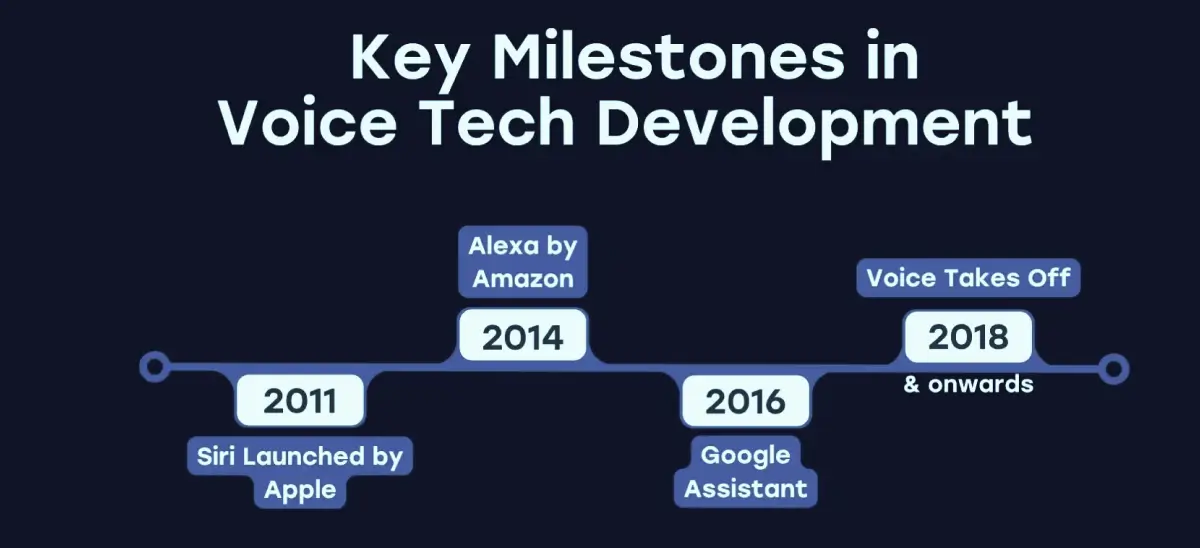
In the last 10 years, mobile apps evolved rapidly. The initial applications were predominantly touch based. Users tapped buttons, menu use and typed on on-screen keyboards. This was altered by new developments in AI, NLP, and voice recognition. They designed voice interfaces on mobile phones. Users now have the option of talking to their phones in order to search information. They are able to send messages and control smart things. They are also able to do daily tasks. Siri, Google Assistant, and Amazon Alexa assisted in accelerated adoption. They popularized voice use in mobile platforms.
Digital experiences are being transformed thanks to voice search and conversational AI. Citizens talk rather than typing numerous commands. This accelerates and makes experiences more natural. Another area of investment by businesses is voice enabled mobile apps. These voice-powered mobile apps may enhance access and customer engagement. They are also capable of simplifying tricky tasks. Voice is on the rise in the fields of healthcare, banking, and eCommerce. It is also prevalent in intelligent home management. A modern mobile solution has become voice tech.
This guide discusses the ways in which voice-powered mobile applications transform communication. We discuss the technology of voice interfaces. We also describe major user and business advantages. Next we consider the future work of voice in mobile applications.
What Are Voice-Powered Mobile Apps?
Voice recognition in mobile apps allow users to use voice instructions to navigate apps. They minimise tapping or typing. These applications apply speech recognition, AI, and NLP to comprehend speech. They act then according to what users say. Voice is increasing as phones get smarter. It is natural and can be quite effective.
Voice apps are hands-free, unlike touch-only apps. Drivers have the ability to speak to find information and deliver messages. They are also able to accomplish tasks without involving their hands. This may enhance accessibility by a greater number of users. It is also capable of accelerating routine duties. Voice features are added by many businesses to their apps. They desire quick, convenient, and more natural communication.

Definition of Voice-Powered Applications
Voice-powered apps let users control features with voice commands. They do not rely only on manual input. These apps use voice recognition to understand speech. They turn speech into commands the app can run.
When a user speaks, the app records the audio. It converts the audio into text with speech recognition. It then reads the meaning of that text. After that, it performs the requested action.
For example, a user might say:
- “Search for nearby restaurants.”
- “Send a message to John.”
- “Play relaxing music.”
The app then completes the requested task automatically.
Voice-powered apps often use tech from major platforms, such as:
- Siri
- Google Assistant
- Amazon Alexa
These platforms show how voice can replace or support touch controls.
Key differences between voice-powered apps and traditional apps include:
Input Method
- Traditional apps use touch, typing, or gestures.
- Voice apps use spoken commands.
User Interaction
- Traditional apps require manual navigation.
- Voice apps support conversational interaction.
Accessibility
- Traditional apps often need visual focus.
- Voice apps offer hands-free access.
Speed of Interaction Voice commands can finish tasks faster than manual input.
Core Components of Voice Technology in Apps
Voice-powered apps use several technologies together. These tools help apps understand speech and respond. They turn spoken words into actions in the app.
Core technologies include:
1. Speech Recognition Engines
Speech recognition turns speech into readable text. It can detect words, accents, and speech patterns. This helps the app understand the command.
Key functions include:
- Capturing audio from the microphone
- Converting voice signals into text
- Handling different accents and pronunciations
Many apps use engines built by major tech companies.
2. Natural Language Processing (NLP)
NLP helps apps understand meaning, not just words. It helps them handle real conversation.
NLP helps apps:
- Understand natural phrasing
- Identify user intent
- Handle complex voice questions
- Return accurate results
For example, it can treat these as the same request. “Find nearby coffee shops” and “Show me cafés near me.”
3. Artificial Intelligence (AI)
AI helps voice apps improve over time. It can learn from user behavior and history.
AI can help apps:
- Offer personalized replies
- Predict user needs
- Improve speech accuracy
- Give smarter recommendations
4. Machine Learning Models
Machine learning improves voice systems using lots of data. Over time, it can make results more accurate.
These models help apps:
- Adapt to accents and speaking styles
- Improve speech recognition accuracy
- Learn new phrases and commands
- Give more relevant responses
5. Voice Command Processing Systems
These systems manage the full voice workflow. They connect speech, meaning, and action.
A typical flow includes these steps:
- Capture the spoken command
- Convert speech to text
- Analyze the text with NLP
- Identify the user’s intent
- Run the action inside the app
Together, these tools create smooth voice experiences.
Examples of Voice-Enabled Mobile Applications
Many mobile apps now include voice features. They show how voice can simplify tasks. They also improve convenience across industries.
Common examples include:
1. Virtual Assistants
Virtual assistants handle many tasks by voice. Users can ask questions and set reminders. They can also search the web or control devices.
Examples include:
- Siri
- Google Assistant
- Amazon Alexa
2. Smart Home Control Apps
Smart home apps let users control connected devices by voice. Users can control lights, thermostats, and security systems.
Users can say:
- “Turn on the living room lights.”
- “Set the temperature to 22 degrees.”
- “Lock the front door.”
These apps work with smart home systems for automation.
3. Voice-Based Navigation Apps
Navigation apps support voice control while driving. This reduces the need to touch the phone. Google Maps is a common example.
Voice navigation helps users:
- Search for destinations
- Get real-time directions
- Avoid traffic
- Drive more safely
4. Voice-Enabled Search Tools
Voice search lets users find answers using speech. It is often faster than typing.
Users can ask:
- “What’s the weather today?”
- “Find the best Italian restaurants nearby.”
- “What time does the mall close?”
Voice search keeps growing due to speed and ease.
5. Voice Messaging and Dictation Apps
Many messaging apps support dictation and voice notes. WhatsApp is one example. Users can speak instead of typing.
Benefits include:
- Faster message creation
- Hands-free communication
- Better access for users with disabilities
Voice-powered mobile apps are changing how people use technology. Voice recognition and AI keep improving each year. These apps will likely become a core part of mobile experiences.
The Evolution of Voice Technology in Mobile Apps
Voice technology has changed a lot over the past few decades. It started as a simple test feature in early computers. Now it powers advanced voice interfaces using AI and machine learning. Today, voice is a key part of mobile technology. Users can talk to apps instead of typing or tapping.
This change came from better speech recognition app development and language tools. Cloud computing and stronger mobile hardware also helped. As a result, voice apps respond faster and more accurately. They also sound more natural than before.
Early Voice Recognition Systems
Early voice recognition began in early computer research. These Voice user interface (VUI) systems tried to detect basic spoken commands. But they were far weaker than modern tools.
Early systems faced several problems:
- Limited computing power
- Small voice data sets
- Low recognition accuracy
- Trouble with accents and speaking styles
Many systems required user training before they worked well. Users had to teach the software their voice first.
Key traits of early systems included:
- A small set of known words
- Trouble with continuous speech
- Slow processing
- Many errors
Early mobile voice features were also limited. They could only handle simple tasks like these:
- Dialing contacts by voice
- Opening specific apps
- Running basic voice searches
Even so, these tools set the stage for modern voice apps.
Rise of AI-Powered Voice Assistants
Voice search mobile apps changed most with AI voice assistants. They paired speech recognition with AI and language processing. This lets devices respond to more natural speech.
A big step came with built-in assistants like:
- Siri
- Google Assistant
- Amazon Alexa
These assistants made device use feel more natural. Users could speak in a more conversational way.
Key features from AI assistants include:
- Voice web searches
- Sending messages and making calls
- Setting reminders and alarms
- Controlling smart home devices
- Getting live weather or traffic updates
Another key change was multi-device support. Voice is now used on more than just phones. It also appears on:
- Smart speakers
- Smart TVs
- Wearables
- Smart home systems
- Connected cars
This widened voice technology beyond mobile apps. It is now central to many digital experiences.
Modern Advances in Conversational AI
New advances made voice apps smarter and faster. Modern systems can understand context and user intent. They can also keep a more natural conversation.
Context awareness is a major improvement. Older systems treated each command as separate. Modern systems can handle follow-up questions.
For example:
- A user asks, “What’s the weather in Dubai?”
- Then asks, “Will it rain tomorrow?”
Modern AI voice assistant apps know both questions are about Dubai. Key improvements in modern voice tech include:
1. Better Context Understanding
Modern AI can review:
- Past conversation
- User preferences
- Location data
- Previous commands
This helps assistants give more relevant answers.
2. Real-Time Voice Processing
Cloud systems and faster chips speed up processing. This allows quick speech handling in many apps.
This enables:
- Fast voice responses
- Real-time action steps
- Faster speech-to-text
- Smoother conversations
3. More Human-Like Interaction
Modern assistants aim to sound more natural. They also try to match how people speak.
New tools now support:
- More natural voice output
- Basic emotion tone detection
- Multiple languages
- Better accent support
These changes make voice apps easier to use. They also make them more practical day to day.
Voice tech will keep improving over time. Voice apps may become a standard way to use phones.
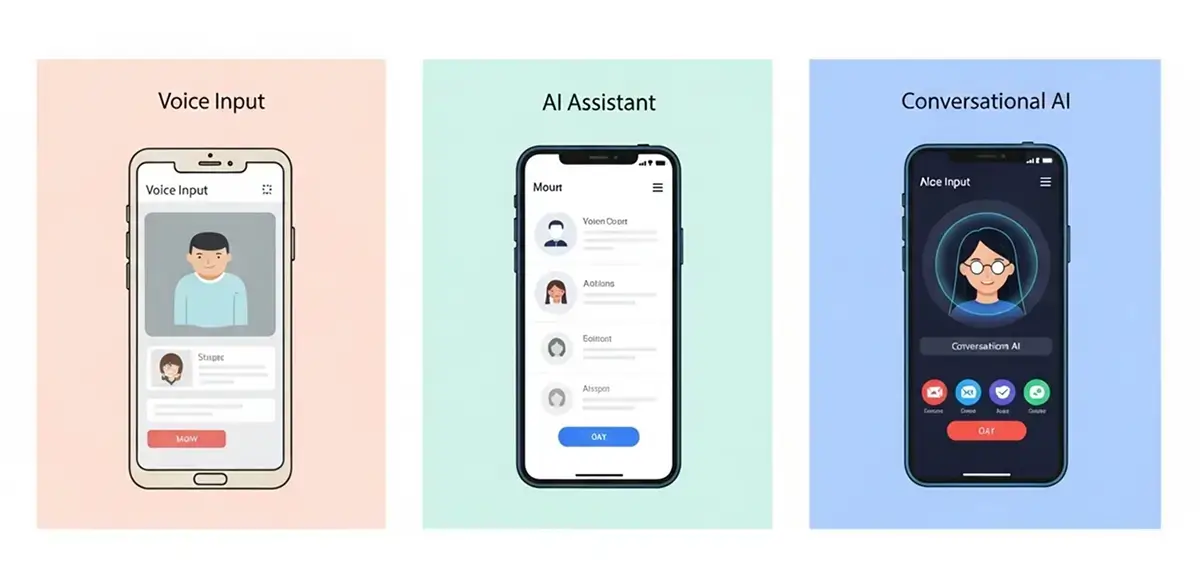
How Voice Technology Works in Mobile Applications?
Voice apps use several tools that work together. They turn spoken words into actions. They use speech recognition, NLP, AI, and cloud systems. The app records audio and then processes it.It finds the intent and completes the task quickly.
Speech Recognition Technology
Speech recognition is the first step in voice use. It turns spoken words into text. Apps can then read and analyze that text.
This uses Automatic Speech Recognition, or ASR. ASR detects words, accents, and speech patterns in audio.
Key speech recognition tasks include:
- Recording audio from the microphone
- Turning sound into digital data
- Converting speech into text
- Noting accents and pronunciation
Siri and Google Assistant rely on ASR systems. They use it to understand voice commands more accurately.
Natural Language Processing (NLP)
After the text is created, the NLP finds the meaning. It helps the app understand what the user wants. It does this by looking at grammar and keywords.
NLP helps apps:
- Detect user intent
- Understand sentence meaning
- Handle conversational questions
- Give accurate responses
For example, these two requests mean the same thing. “Find nearby restaurants” and “Show restaurants near me.”
Machine Learning and AI Models
AI and machine learning improve voice tech over time. They study large voice data sets. This helps make recognition more accurate.
Machine learning helps apps:
- Adjust to accents and speaking styles
- Learn new phrases and commands
- Improve recognition accuracy
- Personalize replies based on user habits
Over time, systems learn from user speech. This leads to smarter and faster responses.
Cloud Processing and Voice Data Handling
Many voice apps use cloud computing for processing. They often send voice clips to cloud servers. Servers analyze the audio and return results.
Cloud processing helps apps:
- Run complex recognition tasks
- Use large data sets for accuracy
- Provide real-time answers
- Improve models over time
Fast cloud speed matters for good voice use. Users expect quick replies to voice commands.Platforms like Alexa rely on cloud systems for this.
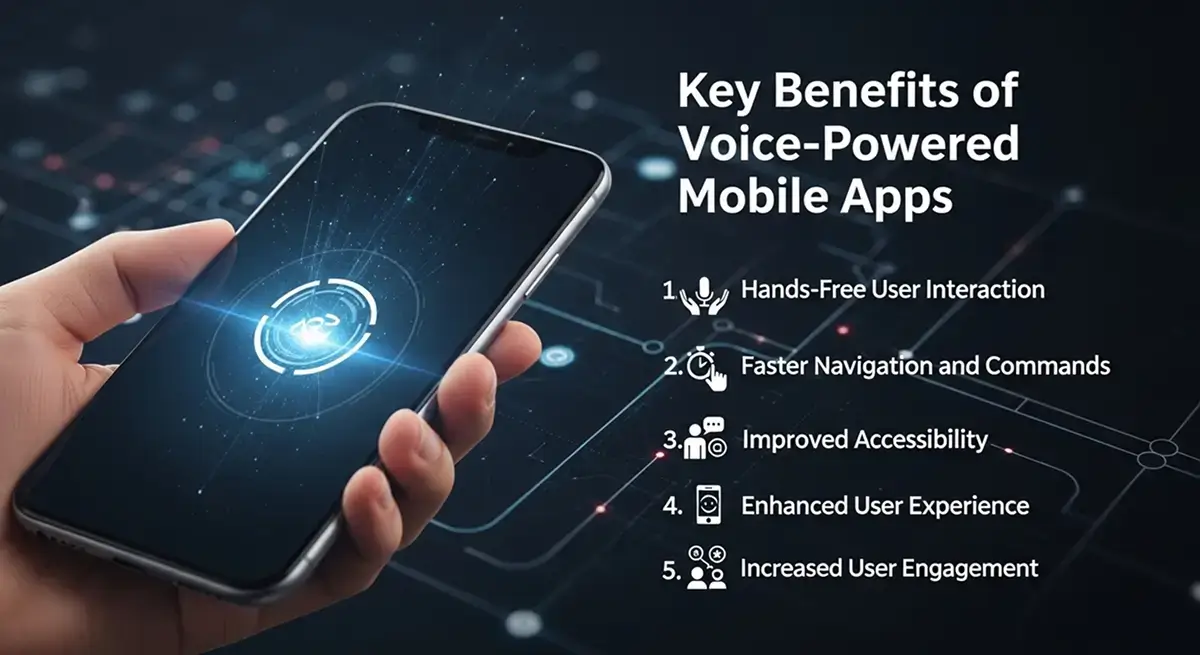
Key Benefits of Voice-Powered Mobile Apps
Hands-Free User Interaction
Voice apps let users act without touching the screen. This helps when typing or tapping is hard. Users can speak to search or send messages. They can also play music or set reminders. They can control app features right away.
This helps while driving, cooking, or exercising. It also helps during multitasking. Users can keep working while using the app. This adds convenience and can improve safety. Voice can be a valuable mobile feature.
Faster Navigation and Commands
Voice commands can speed up app navigation. Users can skip menus and long search steps They can finish tasks with one spoken request. This can be faster than manual steps.
For example, users can say, “book a cab.” They can also say, “open my last order.” Or they can say, “play my workout playlist.”
Faster navigation saves time and boosts efficiency. It also reduces steps in the user flow. That matters for apps that need quick actions. Voice apps can feel smoother and more convenient. This helps users who want fast results.
Improved Accessibility
Another major benefit of voice-powered apps is better accessibility. Voice features help users who may have difficulty using traditional touch-based interfaces, including people with visual impairments, mobility limitations, or certain learning difficulties. By allowing users to speak commands and hear responses, apps become easier to use for a wider audience.
This supports inclusive digital design, which is becoming more important in modern app development. Businesses that add voice capabilities can make their mobile apps more user-friendly and accessible to people with different needs, improving usability while also showing a stronger commitment to digital inclusion.
Enhanced User Experience
Voice interaction creates a more natural and human-like way for users to communicate with an app. Instead of relying only on buttons and text input, users can interact conversationally, which feels more intuitive and engaging. This makes the overall experience smoother and more enjoyable, especially when voice systems understand context and respond intelligently.
Many AI-powered voice apps can also personalize responses based on user behavior, preferences, and past interactions. This level of personalization helps users feel that the app understands their needs, which leads to better satisfaction and stronger brand connection.
Increased User Engagement
Voice-powered features can make apps more interactive, dynamic, and enjoyable to use. When users can talk to an app and receive immediate responses, the experience feels more active than traditional app interaction. This often encourages users to spend more time in the app and return to it more often.
Higher engagement is especially valuable for businesses that want to improve retention and build stronger relationships with users. Whether in eCommerce, healthcare, education, entertainment, or productivity, voice technology in mobile apps can create a more engaging digital environment that keeps users interested and involved.
Industries Using Voice-Powered Mobile Apps
E-Commerce and Online Shopping
The e-commerce industry has rapidly adopted voice-powered technology to simplify the shopping experience. Voice-enabled apps allow users to search for products, place orders, and track deliveries without typing. This makes online shopping faster and more convenient, especially for users who prefer hands-free interactions.
Common uses of voice technology in e-commerce include:
- Voice-based product search that allows users to find items by speaking instead of typing
- Hands-free shopping experiences for browsing, adding products to carts, and checking out
- Voice ordering systems that enable quick repeat purchases or instant product orders
By reducing friction in the buying process, voice technology helps improve customer convenience, engagement, and conversion rates in mobile shopping apps.
Healthcare and Medical Apps
Voice-powered features are increasingly being integrated into healthcare mobile applications to support both medical professionals and patients. These features help streamline documentation, improve patient monitoring, and make health management easier.
Examples of voice integration in healthcare apps include:
- Voice notes for doctors, allowing quick recording of patient observations or medical records
- Patient monitoring and assistance, enabling patients to report symptoms or request help using voice commands
- Voice-controlled health tracking for logging medication schedules, physical activity, or vital health data
This technology helps healthcare providers save time while also improving accessibility for patients who may have difficulty using traditional interfaces.
Banking and Fintech
The banking and fintech sector is using voice technology to provide faster and more secure financial services through mobile applications. Voice-enabled banking features allow users to access financial information and perform basic transactions through simple voice commands.
Common voice banking capabilities include:
- Voice-based banking services integrated into mobile apps or virtual assistants
- Checking account balances and reviewing recent transactions through voice queries
- Executing simple banking tasks, such as bill reminders or payment confirmations
These features improve convenience while maintaining security through authentication technologies such as voice recognition and biometric verification.
Smart Home and IoT Applications
Voice-powered mobile apps play a major role in managing smart home and Internet of Things (IoT) ecosystems. Users can control connected devices through voice commands, creating a seamless and automated home environment.
Key applications include:
- Controlling smart devices such as thermostats, lighting, and entertainment systems
- Managing home security systems, including cameras, alarms, and door locks
- Operating appliances like smart TVs, washing machines, and kitchen devices
Voice integration makes smart home systems easier to manage, allowing users to control multiple devices quickly without navigating complex app interfaces.
Navigation and Travel Apps
Voice functionality is also widely used in navigation and travel applications. Voice assistance allows users to access directions, travel updates, and booking services without distracting from their activities, especially while driving.
Typical voice-enabled travel features include:
- Voice-guided navigation with real-time route updates and traffic alerts
- Hands-free location searches for nearby restaurants, hotels, or fuel stations
- Voice booking systems for flights, ride-hailing services, or hotel reservations
By enabling safer and more convenient interactions, voice-powered technology helps travel and navigation apps deliver a smoother user experience.
Key Technologies Behind Voice-Powered Mobile Apps
Artificial Intelligence
Artificial Intelligence (AI) plays a central role in making voice-powered mobile apps intelligent and responsive. AI algorithms allow apps to process voice commands, learn from user behavior, and deliver more relevant responses over time. This enables voice assistants and voice-enabled features to become more accurate and helpful with continuous usage.
Key roles of AI in voice-powered apps include:
- Enabling smarter voice interactions by analyzing speech patterns and user behavior
- Supporting personalization, where apps adapt responses based on user preferences
- Providing predictive responses by anticipating user needs and frequently used commands
Through AI, mobile apps can evolve into more adaptive and context-aware systems.
Natural Language Understanding (NLU)
Natural Language Understanding (NLU) is a core component of voice technology that allows apps to interpret what users actually mean when they speak. Instead of simply recognizing words, NLU focuses on identifying the intent behind the voice command.
Important capabilities of NLU include:
- Interpreting user intent accurately even when commands are phrased differently
- Understanding context and conversational patterns
- Handling complex or multi-step voice interactions within an app
This technology allows voice-powered apps to communicate with users in a more natural and conversational way.
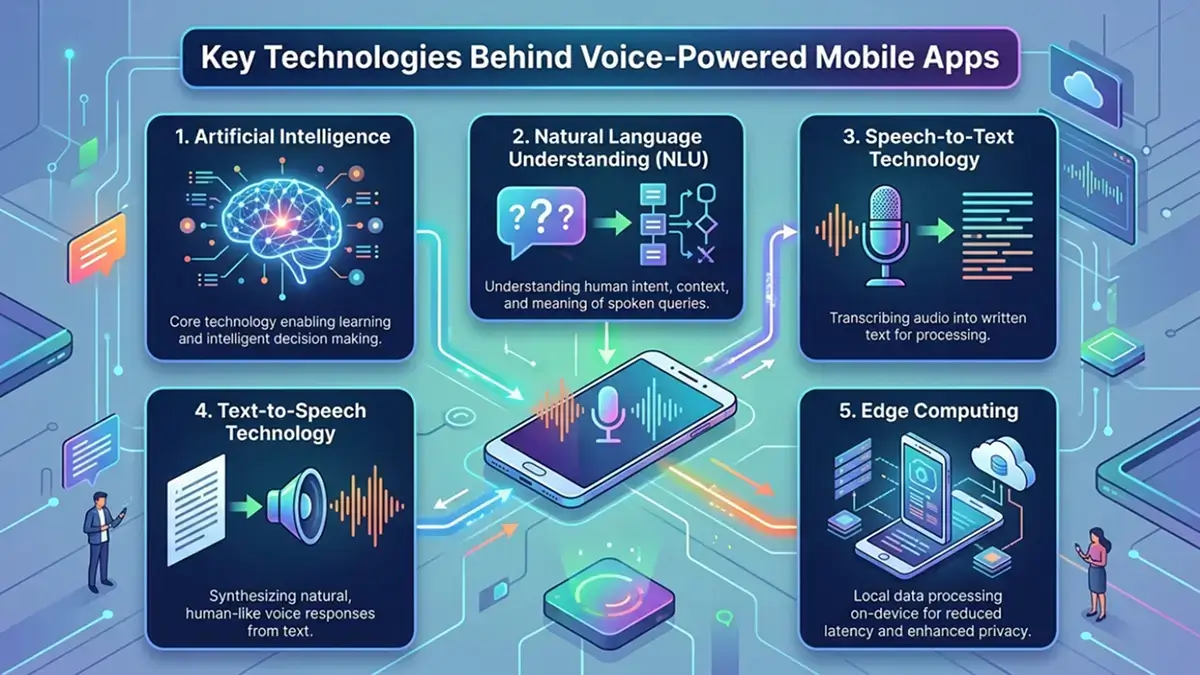
Speech-to-Text Technology
Speech-to-Text (STT) technology converts spoken language into written text that mobile applications can process. When a user gives a voice command, the system captures the audio input and transforms it into digital text for further analysis.
Functions of speech-to-text technology include:
- Converting spoken commands into text for processing by the app
- Enabling features such as voice search, voice messaging, and voice input
- Supporting core voice functionalities across different mobile app services
This technology forms the first step in the voice interaction process.
Text-to-Speech Technology
Text-to-Speech (TTS) works in the opposite direction of speech recognition. It converts written responses from the system into spoken audio output, allowing the app to respond verbally to users.
Key uses of text-to-speech technology include:
- Transforming system responses into voice output
- Providing spoken feedback or instructions to users
- Creating more natural and conversational interactions in mobile apps
TTS technology helps voice-powered apps deliver a more engaging and human-like user experience.
Edge Computing
Edge computing improves the performance of voice-powered apps by processing voice data closer to the user’s device rather than relying entirely on remote cloud servers. This reduces delays and allows faster response times.
Benefits of edge computing in voice-powered apps include:
- Reducing latency for quicker voice command processing
- Improving real-time response speed
- Enhancing data privacy and reliability by processing some data locally
By combining edge computing with cloud processing, modern voice-powered mobile apps can deliver faster, smoother, and more efficient voice interactions.
Voice Search and Its Impact on Mobile Apps
Growth of Voice Search Usage
Voice search has grown rapidly with the increasing use of smartphones, smart speakers, and voice assistants. Many users now prefer speaking to their devices rather than typing, especially when they need quick answers or want to perform tasks while multitasking.
Key trends driving the growth of voice search include:
- Rising adoption of voice assistants on smartphones and smart devices
- Increasing number of users relying on voice search for everyday tasks
- Faster and more convenient access to information through spoken queries
As voice search becomes more common, it is changing how users discover information, services, and apps on mobile devices.
Voice SEO for Mobile Apps
With the rise of voice search, businesses and developers must consider voice search optimization when building mobile applications. Traditional search strategies focused on short typed keywords, but voice queries tend to be more conversational and detailed.
Important aspects of voice SEO include:
- Optimizing app content for natural language queries
- Using long-tail keywords and question-based phrases
- Structuring information so voice assistants can easily retrieve answers
Voice SEO ensures that mobile apps remain visible and accessible when users search using voice commands instead of typed queries.
Conversational Search Patterns
Voice searches are typically more conversational than typed searches. When users speak to their devices, they tend to ask full questions or describe their needs in natural language rather than using short keyword phrases.
Common characteristics of conversational voice searches include:
- Longer queries, often structured as complete questions
- More natural and human-like language patterns
- Greater emphasis on understanding user intent and context
For mobile app developers, understanding these conversational patterns is important. Apps that interpret intent correctly and deliver relevant responses are more likely to provide a better user experience and perform well in voice-driven search environments.
Challenges in Developing Voice-Powered Mobile Apps
Accuracy of Voice Recognition
One of the primary challenges in building voice-powered mobile apps is maintaining high accuracy in voice recognition. Users speak with different accents, tones, and speaking speeds, which can make it difficult for systems to interpret commands correctly.
Key challenges include:
- Handling different accents and speech variations across regions and languages
- Understanding informal speech, slang, or unclear pronunciation
- Dealing with background noise that may interfere with voice input
Developers must train voice recognition models with diverse datasets and apply noise reduction technologies to improve accuracy.
Privacy and Security Concerns
Voice-powered apps collect and process voice data, which raises important privacy and security concerns. Users expect their personal information and voice recordings to be handled securely.
Major security considerations include:
- Protecting voice data and user information during transmission and storage
- Implementing secure voice authentication systems to verify user identity
- Ensuring compliance with data protection regulations and privacy policies
Strong encryption and secure cloud processing are essential to maintain user trust in voice-enabled applications.
Integration Complexity
Integrating voice technology into an existing mobile application can be technically complex. Developers must ensure that voice features work smoothly with the app’s existing functionality and user interface.
Common integration challenges include:
- Connecting voice recognition systems with app workflows and features
- Ensuring compatibility with multiple operating systems such as Android and iOS
- Managing integration with APIs, cloud services, and backend systems
Proper architecture and well-designed APIs are necessary to make voice functionality reliable and scalable.
Performance and Latency Issues
Voice-powered apps require fast processing to deliver a smooth user experience. If the system takes too long to interpret commands or respond, users may become frustrated.
Performance challenges include:
- Ensuring quick responses to voice commands
- Reducing delays in voice processing, especially when using cloud-based services
- Maintaining consistent performance even with high user activity
Technologies such as edge computing, optimized AI models, and faster cloud infrastructure help reduce latency and improve real-time voice interactions.

Best Practices for Building Voice-Enabled Mobile Apps
Voice-enabled applications are changing how users interact with mobile technology. Instead of tapping and typing, users expect fast, natural, and effortless voice interactions. To create effective voice-powered mobile apps, developers must focus on usability, clarity, performance, and security. The following best practices help ensure that voice features provide a smooth and reliable user experience.
Designing Conversational User Interfaces
A well-designed conversational user interface (CUI) allows users to interact with the app in a natural, human-like way. Voice interactions should feel intuitive and guide users toward completing tasks without confusion.
Key practices include:
- Designing natural interaction flows that resemble everyday conversation
- Structuring commands so users can complete tasks in simple voice steps
- Providing clear voice feedback or prompts when the system needs clarification
- Avoiding overly complex commands that require long phrases or specific wording
For example, instead of requiring a user to say a complicated command, apps should allow flexible phrases such as:
- “Book a ride to the airport”
- “Find nearby restaurants”
- “Play my workout playlist”
This flexibility improves usability and makes voice interaction more accessible for a wider range of users.
Keeping Commands Simple
One of the most important principles in voice interface design is simplicity. Users should be able to speak naturally without remembering complicated command structures.
Best practices include:
- Using easy-to-understand voice instructions
- Supporting multiple variations of the same command
- Limiting the number of steps required to complete an action
- Providing short guidance prompts when the system cannot understand the request
Simple commands reduce cognitive load and help users feel comfortable using voice features. This also lowers the chances of errors and reduces user frustration, especially for first-time users.
Optimizing for Voice Search
Voice-enabled apps must be optimized to handle conversational search queries, which are typically longer and more natural than typed searches. Users tend to ask complete questions when using voice.
Developers should:
Support conversational queries such as
“Where is the nearest pharmacy?”
“What’s the weather like tomorrow?”
- Improve voice command accuracy by training models with diverse speech patterns
- Use natural language processing (NLP) to better understand user intent
- Continuously refine voice models based on real user interactions
Optimizing for voice search helps apps deliver faster, more accurate results and improves overall user satisfaction.
Ensuring Strong Data Security
Voice-enabled applications process sensitive user data, making security and privacy protection essential. Developers must implement strong safeguards to maintain user trust.
Important security practices include:
- Applying encryption for voice data during transmission and storage
- Using secure authentication methods, such as voice biometrics or multi-factor authentication
- Protecting sensitive user information from unauthorized access
- Ensuring compliance with privacy regulations and data protection standards
Strong security measures not only protect users but also enhance the credibility of voice-enabled applications in industries such as finance, healthcare, and e-commerce.

Future Trends in Voice-Powered Mobile Apps
Voice technology is evolving rapidly as artificial intelligence, machine learning, and cloud computing continue to advance. In the coming years, voice-powered mobile apps will become more intelligent, personalized, and deeply integrated with digital ecosystems. Several emerging trends are shaping the future of voice-based interactions.
AI-Driven Conversational Interfaces
Modern voice systems are becoming increasingly sophisticated due to advancements in artificial intelligence and natural language processing. These technologies enable apps to understand context, intent, and conversational patterns more accurately.
Key developments include:
- More intelligent and human-like conversations with improved contextual understanding
- Ability to maintain multi-step conversations without repeating commands
- Personalized voice interactions based on user preferences and past behavior
- AI systems that continuously improve by learning from user interactions
As conversational AI improves, voice assistants will feel more natural and efficient, allowing users to interact with apps in a more intuitive way.
Multilingual Voice Recognition
Voice technology is expanding beyond single-language support. Future mobile apps will offer multilingual voice recognition, enabling users to interact with applications in their preferred language.
Important advancements include:
- Supporting multiple languages and dialects within the same application
- Improved recognition accuracy for regional accents
- Real-time translation capabilities during voice interactions
- Expanding accessibility globally for diverse user groups
This development will allow businesses to build apps that serve global audiences more effectively.
Voice Commerce (V-Commerce)
Voice technology is transforming the way people shop online. Voice commerce (V-commerce) allows users to browse products, place orders, and complete transactions using voice commands.
Major benefits include:
- Voice-based online purchases without manual browsing
- Faster product searches through voice queries
- Hands-free shopping experiences for busy users
- Integration with digital payment systems for quick transactions
As voice assistants become more reliable, V-commerce is expected to grow significantly across eCommerce platforms.
Voice Integration with Smart Devices
Voice-enabled mobile apps are increasingly connected to smart devices and Internet of Things (IoT) ecosystems. This integration allows users to control multiple devices from a single interface.
Common use cases include:
- Controlling smart home devices such as lights, thermostats, and security systems
- Managing wearable devices and health trackers
- Connecting mobile apps with smart TVs, speakers, and appliances
- Controlling multiple devices through voice commands from a centralized platform
This interconnected environment will make voice technology a central component of smart digital ecosystems.
Emotion Detection in Voice Technology
One of the most advanced developments in voice technology is emotion detection through speech analysis. AI systems are beginning to identify emotional cues from tone, pitch, and speech patterns.
Potential applications include:
- AI detecting user emotions through speech to understand mood or intent
- Delivering more personalized responses based on emotional context
- Improving customer service interactions in voice-based support systems
- Enhancing accessibility for users who rely heavily on voice interfaces
Emotion-aware voice systems could significantly improve user experiences by making interactions more empathetic and adaptive.
Why Should Businesses Invest in Voice-Powered Mobile Apps?
Voice technology is becoming a key component of modern digital experiences. As more users rely on voice assistants and hands-free interactions, businesses that integrate voice-powered features into mobile apps can improve usability, increase engagement, and remain competitive in a rapidly evolving digital landscape.
Competitive Advantage
Adopting voice technology early allows businesses to differentiate themselves in crowded markets. Companies that integrate voice capabilities into their mobile applications often appear more innovative and forward-thinking.
Benefits include:
- Early adoption of voice technology improves innovation and brand perception
- Differentiation from competitors that rely only on traditional interfaces
- Ability to offer modern, intelligent app features that attract tech-savvy users
- Stronger positioning in industries rapidly adopting digital automation
Organizations that embrace voice technology early can establish themselves as leaders in digital innovation.
Better Customer Experience
Voice-enabled apps simplify interactions by allowing users to perform tasks through natural speech instead of manual navigation. This reduces effort and improves overall convenience.
Key advantages include:
- Faster and easier interactions for users through voice commands
- Reduced time spent navigating menus or typing queries
- Hands-free functionality for multitasking users
- More accessible interfaces for users with disabilities
A smoother user experience can significantly increase satisfaction and retention rates.
Increased Customer Engagement
Voice interaction introduces a more interactive way for users to engage with mobile apps. When users can simply speak commands, they are more likely to use the app frequently.
Important engagement benefits:
- Voice interactions encourage more frequent app usage
- Faster task completion improves user satisfaction
- More interactive and personalized user experiences
- Higher likelihood of repeat usage and long-term engagement
Apps that support voice features often create a more dynamic and engaging user experience.
Future-Ready Digital Strategy
Voice technology represents the next phase of mobile interface design. Businesses that invest in voice-enabled applications today are preparing for future user expectations.
Strategic advantages include:
- Preparing businesses for the next generation of mobile interfaces
- Alignment with emerging technologies such as AI and smart devices
- Compatibility with voice assistants and smart ecosystems
- Long-term scalability as voice interactions become more common
Integrating voice capabilities into mobile apps helps businesses build a future-ready digital strategy that adapts to evolving user behavior and technological advancements.
The Role of DXB APPS in Voice-Enabled Mobile App Development
As voice technology becomes a core component of modern mobile applications, businesses require development partners with strong expertise in AI, user experience design, and scalable mobile architecture. DXB APPS is one of the best mobile app development agency in Dubai that supports organizations in building advanced voice-enabled mobile applications that combine intelligent voice interaction with high performance and strong security standards.
Expertise in Advanced Mobile App Technologies
DXB APPS is one of the top app development companies in Dubai has extensive experience working with modern mobile technologies, including artificial intelligence, machine learning, and conversational interfaces. DXB APPS as top app development companies in Dubai allows businesses to integrate intelligent voice capabilities into their applications.
Key capabilities include:
- Experience building AI-powered mobile applications with smart voice functionality
- Integration of speech recognition and natural language processing (NLP) technologies
- Development of intelligent systems that understand user intent and context
- Building modern mobile apps for Android, iOS, and cross-platform environments
This technical expertise enables businesses to implement voice features that enhance both functionality and user experience.
Custom Voice-Enabled App Solutions
Every business has unique operational needs and user expectations. DXB APPS is one of the top android app development company in Dubai that develops custom voice-enabled app solutions tailored to specific business goals and industry requirements.
Services include:
- Developing apps with voice commands and conversational interfaces
- Designing intuitive voice interaction flows for seamless usability
- Implementing voice search and voice navigation features
- Creating industry-specific solutions for sectors such as healthcare, retail, fintech, and logistics
Custom mobile app development Dubai solutions ensures that voice technology aligns with business objectives and delivers meaningful value to users.
Scalable and Secure Voice Integration
Voice-enabled applications require strong infrastructure and advanced security measures to handle voice data safely and efficiently. DXB APPS is one of the top mobile app development companies in Dubai focused on building systems that maintain both performance and data protection.
Key features include:
- Scalable voice integration capable of handling large user volumes
- Optimization for fast processing and real-time responses
- Implementation of data encryption for voice interactions
- Secure storage and protection of sensitive user information
This approach by DXB APPS as one of the best app development companies in Dubai ensures that voice-powered apps remain reliable, secure, and capable of supporting business growth.
End-to-End Mobile App Development
DXB APPS is one of the best mobile app development company in Dubai provides complete mobile app development services, supporting businesses throughout the entire application lifecycle. From initial planning to final deployment, the company manages every stage of the development process.
DXB APPS as best mobile app development company offers approach that includes:
- Concept planning and product strategy
- User experience and interface design
- Mobile app development Abu Dhabi and voice feature integration
- Testing, optimization, and performance improvements
- App deployment and ongoing maintenance support
This end-to-end process helps businesses launch high-quality voice-enabled mobile apps that are ready for real-world use and future scalability.

Conclusion
Voice-powered mobile apps are rapidly transforming the way users interact with digital technology. By enabling natural, hands-free communication, voice interfaces make mobile applications faster, more convenient, and more accessible for users across different industries. As advancements in artificial intelligence, speech recognition, and natural language processing continue to evolve, voice technology will become an even more integral part of everyday mobile experiences.
For businesses, adopting voice-enabled mobile app features is no longer just an innovation but a strategic investment in the future of digital interaction. Companies that integrate voice capabilities into their applications can improve user engagement, enhance customer experiences, and stay competitive in an increasingly voice-driven digital ecosystem. As technology progresses, voice-powered apps will play a central role in shaping the next generation of mobile user interfaces.
FAQS
What are voice-powered mobile apps?
Voice-powered mobile apps allow users to interact with an application using spoken commands instead of typing or tapping. These apps use technologies such as speech recognition and artificial intelligence to understand user requests and perform actions like searching, controlling features, or completing tasks through natural voice interactions.
How does voice recognition work in mobile applications?
Voice recognition in mobile apps works by converting spoken audio into digital data using automatic speech recognition (ASR). The system analyzes the speech, processes it with natural language processing (NLP), and identifies the user’s intent. The app then executes the requested action or provides a relevant response.
What industries benefit most from voice-enabled apps?
Many industries benefit from voice-enabled mobile apps, including healthcare, eCommerce, banking, travel, and smart home services. Voice technology improves efficiency by enabling hands-free interaction, faster information access, and improved user convenience, making it especially useful in industries where speed, accessibility, and customer experience are important.
Are voice-powered apps secure?
Voice-powered apps can be secure when developers implement strong data protection measures. Security features typically include encryption for voice data, secure authentication methods, and strict privacy controls. Many applications also use voice biometrics or multi-factor authentication to protect sensitive user information and prevent unauthorized access.
Can voice technology improve mobile app accessibility?
Yes, voice technology significantly improves mobile app accessibility. It allows users with visual impairments, physical disabilities, or limited mobility to interact with apps more easily through voice commands. Voice-enabled features also help users perform tasks hands-free, making mobile applications more inclusive and user-friendly.
How will voice technology shape the future of mobile apps?
Voice technology will play a major role in the future of mobile apps by enabling more natural and intuitive interactions. As artificial intelligence and conversational interfaces improve, voice commands will become faster and more accurate, allowing users to control apps, devices, and digital services seamlessly through speech.