In the ever changing digital era, custom mobile app development UAE aids business customer communication, service delivery, transaction processing, and employee management. Operations streamline and optimize. Retail, healthcare, logistics, real estate, education, hospitality, finance, and government sectors rely on mobile technology for timely and convenient digital solutions.
UAE Digital Economy Strategy aims from 9.7% to 19.4% in contribution to GDP from the digital economy. It indicates the commitment to digital innovation in the UAE.
Also, popular apps don't support some workflows, bilingual app interfaces, payment gateways in UAE, progressive integrations, full data control, etc. Then, custom Mobile App Development UAE is the best suited solution to the requirements of specific workflows, customers, business operations, and business goals.
What Is Custom Mobile App Development?
Custom mobile app development refers to creating mobile applications tailored to specific businesses, users, services, or needs. Compared to off-the-shelf software, custom applications offer business workflows, branded interfaces, and app-specific controls, including security, third-party integrations, and admin tools.
Custom applications can be built for the Android and/or iOS platforms and may even include a web-based admin panel for the business to control app users, manage orders and app content, handle transactions and reports, and configure app settings.

Why Is Mobile App Development Important in the UAE?
In regard to market trends, customers in the UAE highly value fast, safe, and convenient digital service, which suggests strong demand for online connected services. As competition intensifies in the UAE, businesses differentiate themselves through superior digital interfaces in addition to their core offerings.
A well-designed mobile application brings businesses and customers closer by eliminating the need for in-person transactional business and reliance on a web browser. Mobile applications make it easy to:
- Conduct online transactions
- Schedule an appointment
- Communicate with the business
- Make electronic payments
- Manage an account
- Access customer service
The digital infrastructure in the UAE is gaining sophistication through enhanced connectivity and sophisticated services.
The TDRA publishes an ongoing data flow about mobile subscriptions, internet and broadband statistics, smartphones, and assessment of networks.
The digital progressive environment empowers businesses to develop mobile solutions for residents and tourists as well as the professional and business communities worldwide.
Benefits of Custom Mobile App Development in the UAE
The Mobile app solutions Dubai allows companies to implement solutions that create better digital experiences and improve operations and branding. This development is flexible, secure, and scalable. Integrated custom apps also connect local business and payment platforms.
Solutions Designed Around Business Requirements
The perk of custom mobile app development services in UAE is flexibility. The app development serves the company’s processes, objectives, and customer needs. Including driver tracking, route management, and delivery updates can be useful for logistics apps.
Features such as property searches, maps, employee profiles, appraisers, and enquiry management can be developed for real estate apps. The standard apps have custom mobile app development.
Better Customer Experience
Custom apps by a top mobile app development agency UAE center around actions that customers cannot complete without the app. This optimizes the experience for speed and simplicity. Key features may include:
- Account registration
- Service booking
- Online payments
- Order tracking
- Document uploads
- Customer support
Optimizations for the user experience within the app may include saved preferences, recommendations, notifications, and even their preferred payment option.
Stronger Brand Identity
A custom app by a leading AI app development company in UAE lets businesses have complete control over design elements. These include colors, fonts, icons, and customer interfaces.
As a result, businesses create a seamless brand experience on their websites. Marketing channels and even in-person customer service. This also builds customer trust and creates a more professional business.
Arabic and English Language Support
UAE businesses usually require bilingual apps due to user diversity.
With custom iOS app development UAE, right-to-left Arabic layouts, improved navigation, and proper text, form, date, and UI element adaptation are all possible. Other languages can be provided when needed.
Integration With Existing Business Systems
Custom-built applications enhance productivity and data accessibility by integrating with already established systems. Some frequently used integrations are:
- CRM and ERP systems
- Payment systems
- Booking systems
- Inventory systems
- Accounting software
- Customer support tools
- Third-party APIs
Additionally, companies may integrate services that use the UAE PASS for safe authentication and digital services.
Improved Operational Efficiency
Custom apps can be designed to meet the needs of end users (employees, drivers, technicians, managers). Some examples of features that can be included in custom apps are:
- Task Management
- Attendance Tracking
- Document Sharing
- Inventory Management
- Custom Reporting
- Team Collaboration
Greater Scalability
Custom applications are created to accommodate expansion. New features, new users, new locations, new payment methods, and new integrations can be added as needs grow.
Because of this, custom applications are well suited for both startups and businesses in growth phases.
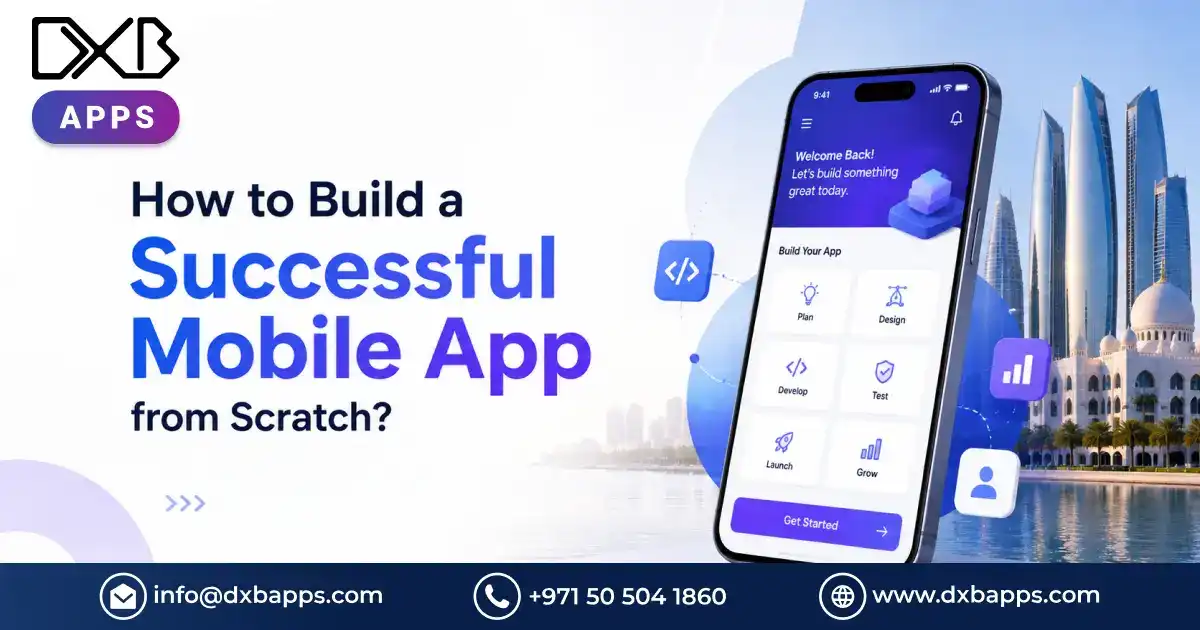
Custom Mobile App Development Process
An effective android app development UAE process allows you to take an initial concept and use secure coding practices to create a scalable application.
Step 1: Business Discovery
In this first step, we look to understand business aims, identify users, and assess obstacles, budgets, and outcome expectations. The main questions for this are:
- Who are the users?
- What is the problem?
- What features must be included?
- What integrations are required?
At this step, the project is much clearer, and redundant features are prevented.
Step 2: Requirements Planning
A structured feature plan is created based on the requirements, and features are categorized as essential, future, and optional elements. A plan may define:
- User roles
- Workflows
- Screens
- Integrations
- Security needs
- Admin controls
This determines the minimum viable product (MVP).
Step 3: Technical Planning
The app creation team chooses the tech and framework for the app. They make the following choices:
- Use of Native or Cross-Platform technologies
- The Structure of the Back-end and Databases
- Cloud Services
- APIs
- Ways to Authenticate
- Payment Systems
- Integrations
- Other 3rd party Services
They will choose a design framework to allow for app growth.
Step 4: User Experience Design
UX design involves the simplification of user journeys. Wireframes are sketch layouts of an app screen. These are used to plan potential ways a user would take to complete actions. A design with good user flow is less confusing and encourages more interaction.
Step 5: User Interface Design
After finalizing the structure, designers prepare the visual interface which includes:
- Fonts and Colors
- Buttons and Icons
- Menus and Forms
- Images and other Interactive Elements
The design must be appealing, ergonomic, responsive, and fit for both Arabic and English users.
Step 6: Prototype Development
A clickable prototype shows intended app functionality prior to any actual development. This allows businesses to validate certain aspects of the design, like usability. Feedback and necessary adjustments can also be identified early on.
Step 7: Application Development
The mobile application, backend systems, databases, APIs, integrations, and admin panels are all constructed by the Dev team.
Development is normally finished in sprints and allows clients to assess and comment on the state of development at various points.
Step 8: Testing and Quality Assurance
Testing makes sure the application is reliable on various devices and under different conditions. Quality checks include:
- Functionality testing
- Performance testing
- Security testing
- Device compatibility
- Payment testing
- Notification testing
- Arabic interface testing
- Integration testing
These contribute to a stable and user-friendly application.
Step 9: App Store Submission
After internal approvals, the app is ready to go live on the Apple App Store and Google Play. During submission, the following are required:
- Screenshots
- Text descriptions
- Privacy information
- Icons
- Support info
Companies must keep their developer accounts in order to manage their own apps.
Step 10: Launch and Post-Launch Support
The development of an app does not halt after its launch. It requires regular viewing, updating, and improving after its launch. Tasks performed after the launch include:
- Correcting malfunctions
- Enhancing app functionality
- Updating security
- Adding new features
- Updating integrations
- Evaluating user feedback
Regular updating after the launch helps the app become and stay useful and valuable for the users and competitive compared to the other apps.

How Much Does Mobile App Development Cost in the UAE?
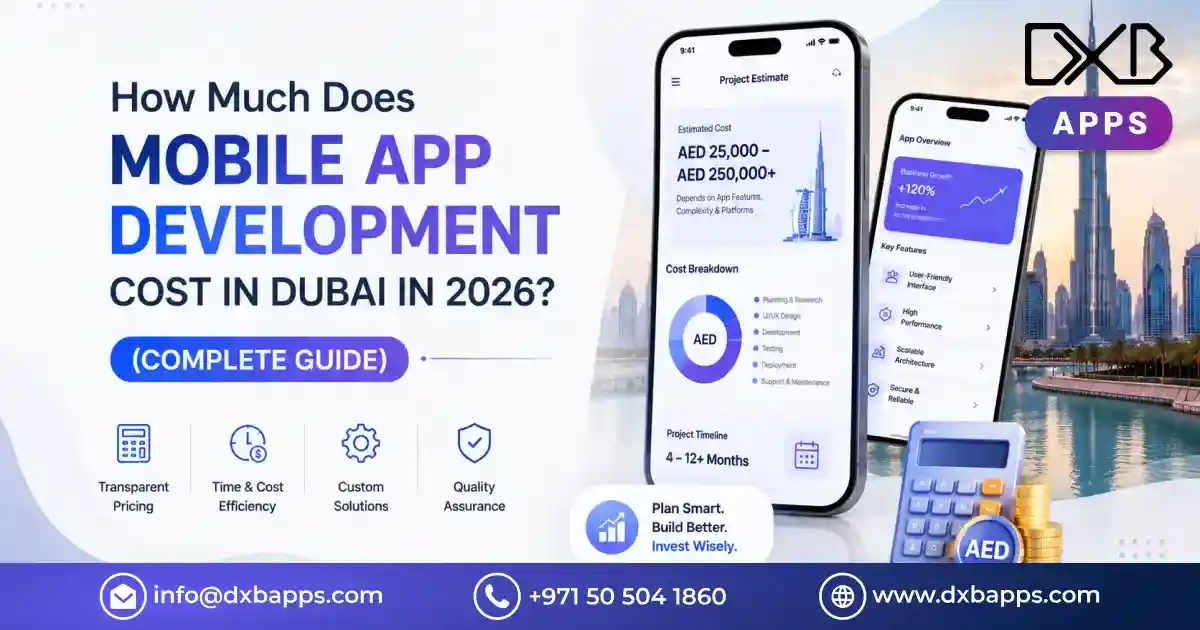
The cost of developing a mobile application in the UAE is impacted by the scale of the app, the platform, UI/UX design, features, security, third-party services, and the app development method.
Published estimates of the UAE market and guides say a simple app is around AED 15,000 to AED 40,000, and estimates for advanced or enterprise apps go beyond AED 700,000. Other guides on pricing in the UAE say the market costs around AED 18,000 to AED 1.1 million.
| Application Type | Estimated Cost |
|---|---|
| Prototype or Basic Proof of Concept | AED 15,000–AED 40,000 |
| Simple MVP Application | AED 35,000–AED 90,000 |
| Mid-Level Custom Mobile App | AED 90,000–AED 250,000 |
| Advanced Mobile Platform | AED 250,000–AED 600,000+ |
| Enterprise or Multi-Application Ecosystem | AED 600,000–AED 1,200,000+ |
Factors Affecting App Development Cost
The mobile app development Dubai process requires consideration of various factors, such as the app's complexity, the number of features, the design of the app, the operating platforms, the necessary integrations, the required security, and the time required for the development.
App Complexity
Development costs and app complexity scale together. Basic apps with simple accounts and pages tend to cost less. Basic implementations of functionality like live tracking, subscriptions, AI, video calls, and advanced dashboards and reporting tend to be more costly.
Number of Platforms
If both an Android and iOS app are necessary, typically it is more costly and time-consuming to develop native apps than to create a cross-platform solution.
When performance or advanced features for the device are more important, native apps are typically preferred.
UI and UX Design
A simple UI/UX tends to be less expensive. Interactivity, advanced design, custom experiences, illustrations, animations, and interactive maps all increase the cost.
Backend Development
Apps that require user accounts, payments, bookings, products, and especially those that require real-time data all require backend support.
Cost drivers include:
- APIs
- Database design
- Admin panels
- User permissions
- Reporting
Third-Party Integrations
Time and budget for development tend to increase with integrations for payment gateways, mapping, various CRMs and ERPs, SMS services, delivery, and identity verification.
Security and Compliance
If an app stores sensitive user data, then the features of that app will require security and testing of compliance in that vertical.
Number of User Roles
The more types of users an app supports, the more dashboards, permissions, and workflows need to be developed.
Maintenance and Updates
Ongoing costs will typically include hosting and monitoring as well as bug fixes and security. App size, features, and long-term goals will drive how often features need to be added.
How Long Does It Take to Develop a Mobile App?
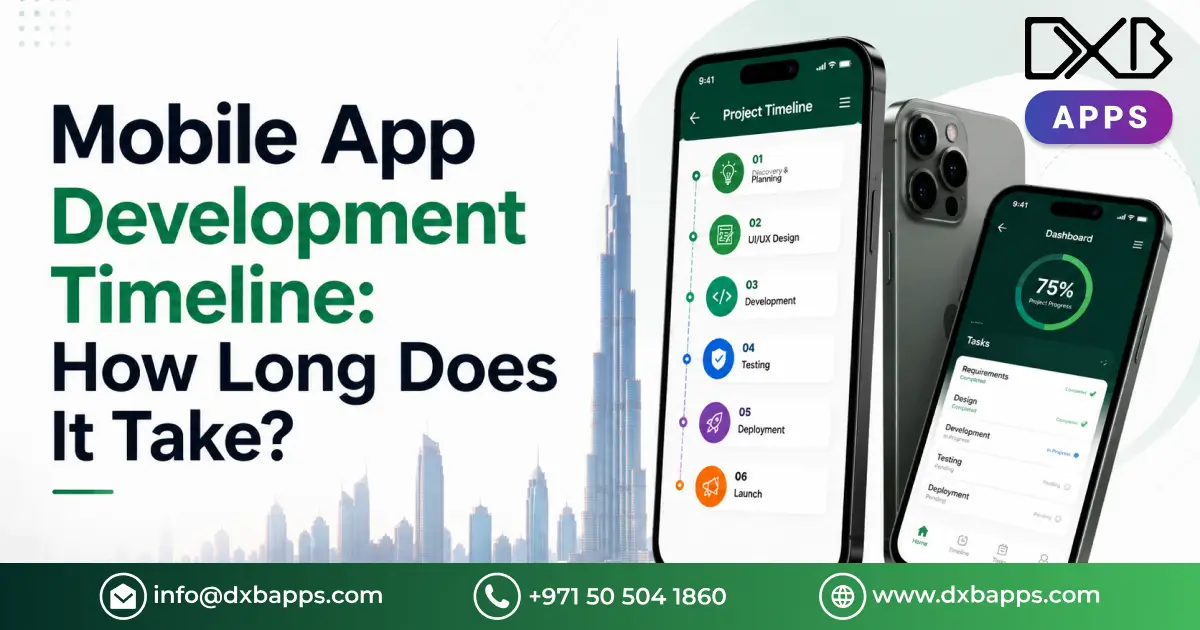
A simple app can take about two to four months. A more advanced, mid-level custom app can take about four to eight months. Building very complex, advanced apps can take more than eight to twelve months. The standard mobile app development services timeline accounts for:
- Discovery and planning
- UI and UX design
- Technical architecture
- Mobile Development
- Backend Development
- Integration
- Testing
- App Store Preparation
- Launch Support
Having the appropriate API or system access reduces the amount of time required to develop an app or custom system. Efficient app development also relies on prompt approvals for designs, defined clear requirements, and responsive API or system access.
How to Choose a Mobile App Development Company in the UAE?
Selecting the right mobile app development company is just as critical as deciding on the features for your app. A development company in UAE for your mobile application should ideally have expertise in both technology and business strategy. You should expect the company to describe the different ways that your application will solve a problem, assist your customers, and/or generate positive ROI.
Consider the following aspects of the company:
- Industry relevance
- Previous app work
- Designs of UI and UX
- Apps on Android and iOS
- Backend development
- Security
- Testing
- Communication
- Management of the project
- Support after launch
- Ownership of the source code
- Terms of documentation and handover
Be wary of quotes that are unusually low. These quotes tend to leave out critical components such as design, backend systems, testing, integration, deployment, and maintenance.
An elaborate project proposal will detail inclusions and exclusions and provide guidance on change requests and ownership of source code and application accounts.
Build a Robust Custom Mobile App with DXB APPS
DXB APPS being a leading mobile app development company in UAE provides mobile app development services focusing on bespoke app development solutions for startups, small and medium businesses, and large corporations. The services include secure app planning, design (UI/UX), development, testing, deployment, and app support and maintenance services.
Custom Mobile Apps for Business Needs
DXB APPS develops mobile applications on Android and iOS and also develops cross-platform applications. DXB APPS also offers development services for web-based applications. DXB APPS offers various app development UAE solutions that serve multiple business domains, like retail, health care, real estate, logistics, education, finance, hospitality, and eCommerce. Each developed app is feature rich and designed keeping in mind the end users and the business workflows.
Comprehensive App Development Solutions
DXB APPS being one of the reliable app development companies in UAE has immense experience in mobile app development. DXB APPS takes care of all the app development process steps from app idea and goal setting, UI designing, and configuring back end and necessary third party application solutions, to extensive quality assurance and publishing the app to relevant app stores, and maintenance and support.

Conclusion
Custom mobile app development Abu Dhabi enables businesses to create apps that fulfill their operational requirements and the needs of their customers. Improving convenience and automating processes are two of the many advantages a business can gain from a well-developed mobile app. The app can strengthen the identity of the business by incorporating multiple languages, business integrations, and even providing multiple revenue streams for the business.
Your total investment is based on the app’s level of complexity, the platform, the design, integrations, security, and the future you’d like to envision for the app. Instead of including every potential integration, a business will often profit more from releasing a focused minimum viable product (MVP), and then expanding the app based on actual user data.
Custom mobile apps that are properly planned and developed can become an important business platform and a part of the business’s long-term strategy, instead of just providing a marketing channel.
FAQS
What is the cost of mobile app development in the UAE?
The cost of app development depends on multiple factors including app complexity, design, and advanced features. A simple app or prototype would cost around AED 15,000 to AED 90,000. An app designed for the general public would cost between AED 90,000 and AED 250,000, while enterprise level apps would start from AED 600,000.
What would be the preferred mobile app development option for a UAE based business? Android, iOS, or both?
It depends on the apps targeted demographic, budget, and its required features. Businesses that are focused on the general consumer public would develop the app on both platforms. A cross-platform app development is a viable option, however, for businesses that want to develop the app on both platforms and are fine with a single codebase, while native app development would be preferred for apps that are feature rich or would need access to device specific features.
What are the main elements that should be part of a custom mobile app?
The main elements of a mobile app should be its answer to a particular customer or a business need. Some of the common features would be bilingual language support, various payment options, online bookings, push notifications, help desk support, and tracking. The initial app release should contain core functionalities and only the necessary features post that.