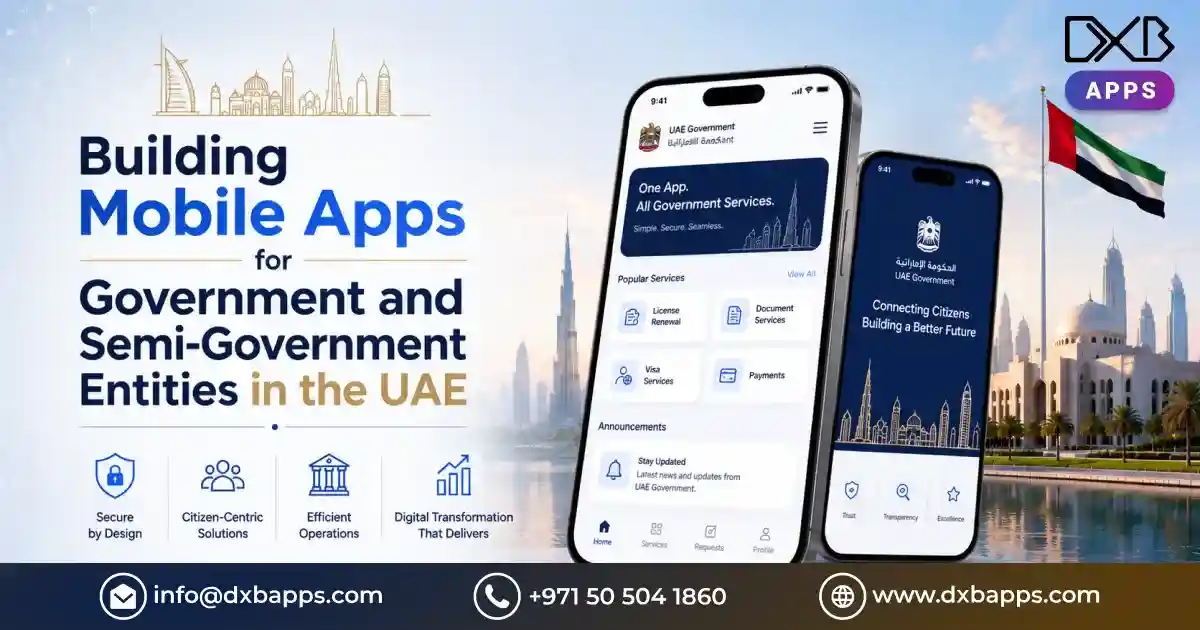
With a rapid digital transformation, the UAE is dominating the emerging digital services industry. Its residents now expect seamless access to government services. The public now have the option to pay fees, renew permits, submit forms, book appointments, and track requests via mobile applications without the need to visit a service center.
Despite the rapid digital transformation, the UAE has strict requirements for government app development UAE and semi-government sectors. Attractive government mobile applications are not sufficient. Mobile applications in the government sector must support complex business processes, secure sensitive data, integrate with other government services, and provide accessibility to the entire population.
Types of Government Mobile Apps
Government and semi-government organizations can develop customized semi-government mobile apps using their services to suit their users and operational requirements.
Citizen Service Applications
These applications allow citizens to access a single, unified platform to:
- Request and receive certificates and permits
- Pay fees
- Book appointments
- Lodge complaints
- Track requests
- View and receive notifications and announcements
- Store digital certificates and documents
Municipal Service Applications
These applications allow citizens to access various local services and report issues to local councils such as:
- Public complaints regarding the collection of waste, road and streetlight complaints
- Parking services including parking permits and fees
- Booking a facility (venue) service
- Community notifications
Citizens can post comments, upload pictures, share their location and track the status of their requests.
Government Employee Application
These secure internal applications can be used for:
- Attendance and leave management
- Approvals
- Document sharing
- Task assignment
- Mass notifications and announcements
- Employee performance dashboards
Role-based application security enhances information security.
Inspection and Field Service Applications
These applications can be used by inspectors, technicians and field staff and can provide:
- Digital checklists
- GPS based task assignment
- Offline data capture
- Document and media uploads
- Electronic signing
- Violation reporting
- Real-time notification
- Centralized Systems Supervisor Approved requests
These applications enhance communication with centralized systems and reduce the amount of paperwork.
Key Features of Government Mobile Apps
Government apps need to meet the users' needs, including the requirements of an organization as well as the complete service journey.
UAE PASS Integration
UAE PASS provides identity verification, digital signatures and documents, and their main advantages are the following:
- Logins and registrations are done faster
- User information is confirmed
- Access is done without passwords
- Signatures and documents are done
- Government services are easier to access
- UAE PASS Integration is done with OAuth 2.0 authentication.
Digital Applications and Approvals
Within one app, users should be able to access services with the following:
- Digital Forms and Data are Auto Filled
- Documents with Eligibility Checks
- Multi-level Approvals
- Applications are Saved
- Progress is tracked
- Certificates are generated
Secure Digital Payments
Payments to government applications can include:
- Fees for permits and licenses
- Paying fines and utilities
- Receiving digital receipts
- Requesting refunds
- Viewing history
Smart Notifications
Push notifications as well as short message and electronic mail services can be used for:
- Updates for the status of and appointments for services
- Reminders for payment due dates and permit expiration
- Alerts for missing documents
- Announcements for services and emergencies
- Updates for policies
Feedback and Complaint Management
Useful features include:
- Forms for feedback and complaints
- Surveys and rating systems
- Location and photo attachments
- Reference ID generation and complaint tracing
Arabic and English Design
A bilingual application should contain:
- Arabic right-to-left layouts
- Professionally localized content
- Clear terminology and form labels
- Readable typography
- Easy language switching
- Equal features in both languages
Government App Architecture and Integrations
Government applications depend on having a secure backend due to the necessity of data sovereignty, integrations, permissions and administrative workflows.
API Integrations
Secure APIs build the connection of the application with UAE PASS, payment gateways, CRM, ERP, GIS, government databases, and various notification systems.
Scalable Infrastructure
The application’s performance and the availability is enhanced and ensured with load balancing, caching, backups, monitoring and disaster recovery.
Administrative Dashboard
With a secure dashboard, teams that have the authorization can manage users, approvals, content, complaints, notifications, reports, and audit trail.
Security and Data Protection
Government digital services UAE could deal with sensitive data such as personal documents, names, contact details, payment data, and identity data. Security has to be integrated during the first stage of the development process of the application and has to be aligned with the UAE Personal Data Protection Law.
Fundamental Security Requirements
Fundamental security requirements have to consider the enforcement of data encryption, multi-factor authentication, role-based access control, session management, and API management. The creation of secure environments relies on the implementation of logging, device tracking, vulnerability scanning and penetration testing. Finally, the formulation of incident response procedures will automatically lower the security risk.
Privacy by Design
Privacy has to be a part of every service and every data flow. The government apps have to make data collection as minimal as possible, provide users with adequate and transparent privacy notices, and of course obtain the user's consent and create the data retention schedule. Access to expired data, backups, third-party data, and data transfers have to be managed securely as well as the expired data itself.

Government Mobile App Development Process
The methodical structured development process focuses on reducing technical risks and enhancing service quality while harmonizing technical teams, service owners and stakeholders. Multiple avenues of the process refine the development of an application ensuring it is secure, accessible, scalable, and user-centric.
Service Discovery
Understanding users and service journey workflows helps identify process gaps and challenges. Operational and service requirements are furthered by understanding cybersecurity compliance, protection and security standards. Integration and performance requirements specify service and technical feasibility.
UX Research and Prototyping
Service journeys and experience design are prioritized for the users (citizens, residents, and visitors) and government employees. Usability testing of the service workflows and designs helps refine the service before development.
Technical Architecture
Selecting frameworks and structuring the service at the front and backend defines the pathways for integration and security. User roles, controls, data, and flows determine the service’s scalability and recovery from disruptions.
App Development
Developing the service involves constructing the administrative dashboard, backend, and APIs. Depending on the project requirements, development may further involve native or cross-platform technologies for iOS and Android.
Quality and Security Testing
Quality testing ensures service functionality across devices and banners. Testing APIs, payments, and document uploads along with security, load, and performance testing ensure the application serves its purpose.
Deployment and Training
Post technical and stakeholder approval, the application goes live on the app stores. Training for government employees along with administration and customer support documentation goes live with the e-government mobile solutions.
Continuous Improvement
Updates based on analytics, user feedback, and support requests are prioritized post-launch. We regularly update our application to protect security, maintain compatibility, and maximize performance. New features, integrations, and automation are also included.
Common Government App Development Challenges
There are many challenges that government application projects must deal with.
Incorporation of Previous Government Systems
Many older government data systems do not support things like modern APIs, real time data updates or cloud data connections.
Complicated Approval Processes
There are many steps and reviews from numerous employees, departments, and external entities that are required for a simple request.
Security vs Usability
Data protection requires strong authentication, however, this should not create an unnecessary burden for users.
Diverse Participants
There will be numerous participants from different internal departments such as legal, citizen services, IT, and security, as well as external providers.
Dynamic Service Demands
The architecture and workflows of smart government administration can change rapidly requiring adaptable systems and flexible procedures.
DXB APPS- Leading Mobile App Development Company in the UAE
DXB APPS is one of the best mobile app development company in UAE that builds mobile applications that are secure, scalable, and user-friendly for both government and quasi-government organizations in the UAE. DXB APPS's apps offer a variety of services, such as providing a digital platform for public services, managing internal operations, processing payments and documents, tracking services, and integrating systems.
With the bilingual interface design, strong backend architecture, and structured development processes, DXB APPS helps organizations improve the accessibility of their services, the efficiency of their operations, and the satisfaction of their clients.
Secure and Compliant Government App Solutions
DXB APPS are security-first developers. In their apps, privacy and reliability are incorporated in a variety of ways. These include secure APIs, role-based access, UAE PASS integration, encrypted data exchange, audit logs, and multi-level approval workflows.
End-to-End Public-Sector App Development
DXB APPS takes care of the entire mobile app development Abu Dhabi process. This includes all service discovery, UX design, development, testing, and deployment. DXB APPS also provides support for all of the services provided. Each of mobile app development Dubai services are tailored to the needs of the government agency and the digital transformation requirements of their users.
Conclusion
Developing mobile applications for government and semi-government organizations in the UAE involves striking the right balance between accessibility standards and convenience from the user's perspective, as well as security and technical reliability. A successful mobile application from a government organization will simplify the delivery of services to the public, securely connect to government systems, and offer users a coherent and consistent digital experience.
The public sector app development can offer efficient public service delivery with services that are more secure and affordable. By implementing UAE PASS and providing interfaces in both Arabic and English, as well as secure payment systems and flexible infrastructures. Trust with users can be enhanced by the public sector through the ongoing assessment and refinement of services to cope with varying user expectations and the needs of the government.

FAQS
What are essential features for a mobile app for the UAE government?
Must-have features are a secure log in system, UAE PASS capabilities, digital forms, the ability to upload documents, the option to make online payments, and the ability to track services. Based on the nature of the service, the mobile app may have features like electronic signing, the ability to set appointments, manage complaints, provide location services and an admin dashboard.
What is the typical time frame for developing a government mobile app?
The time it takes to develop a mobile app depends on the number of services the app provides, the required integrations, and the security and approval setup for the app. An app that is singular in purpose may take several months to develop. However, a more complex, multi-service app may take even longer.
Why is integrating UAE PASS a necessity?
UAE PASS provides secure log in, identity verification, the ability to upload documents, and digital signatures. It makes the process of registering for services easier, eliminates the need for multiple sign in credentials, and makes the user experience more seamless and integrated.