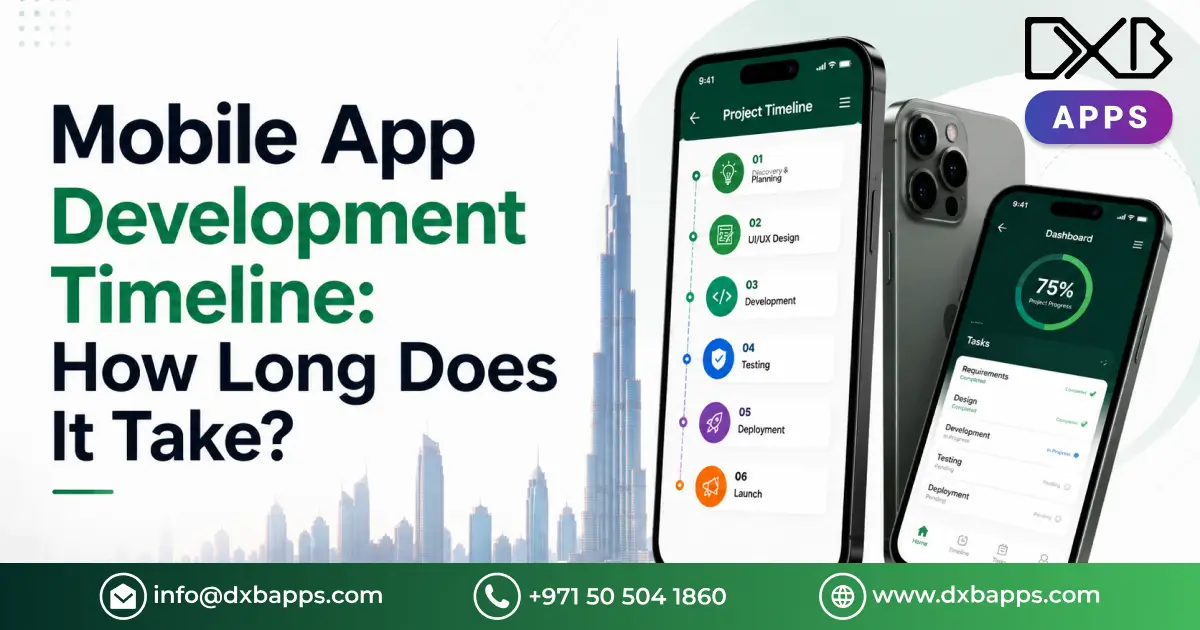
Time spent on developing mobile apps varies from a few months to well over a year. The mobile app development timeline varies based on the technical requirements of the mobile app, the app idea, development work and testing, technology and third-party integrations used, and the development team experience.
On average, a mobile app with basic features may take approximately two to four months. Moderately complex apps are in the range of four to eight months. Apps that are complex in nature (with AI, real time features, payments, and multiple user types, etc.) may take longer and vary in the range of nine to eighteen months and beyond.
Having an idea on the mobile app development stages and time frames allows businesses to budget efficiently and avoid lost time and opportunity costs of building an app. This document takes a close look at mobile app development time frames and the time and costs incurred at each stage of mobile app development. The guide captures the major determinants of mobile app development timeline. This guide also shows how to save time during mobile app development.

Average Mobile App Development Timeline
Even though every project has its unique qualities, three general classifications can be used to categorize mobile app timelines.
Simple Mobile App: 2 to 4 Months
A simple mobile app has a small number of screens and basic functionality. Simple mobile apps likely do not require complex back end services and do not require a large number of third-party services. Some simple app examples are:
- Calculators
- Simple informational apps
- Simple booking apps
- Simple product catalogs
- Event apps
- Internal company apps
- Apps that showcase a product, portfolio, or a company
The design is also likely simple and the users have a small number of actions to perform. When the requirements of the app are defined at the beginning of the app development, a simple app is likely developed easily and quickly.
Medium-Complexity App: 4 to 8 Months
Moderately complex applications tend to include additional interactive features like user accounts, notifications, payments, location services, and admin controls. Examples include:
- E-commerce applications
- Food delivery apps
- Fitness apps
- Appointment booking apps
- Education apps
- Real estate apps
- Customer service apps
- Social community apps
These applications require careful planning, testing, and a stronger backend. Additionally, they require careful integration of external services.
Complex Mobile App: 9 to 18 Months or More
Mobile applications of varying complexity can be made for a variety of use cases. However, applications using complex technologies that have a lot of users, handle large amounts of data, or have multiple user roles tend to fall into the same category. Examples of complex mobile applications are:
- Banking
- Healthcare
- Marketplaces
- Ride hailing
- Video Streaming
- Enterprise Systems
- AI Apps
- IoT Apps
- Social Networks
These application development services require a lot of standards to be met during their creation, including safety and security standards. The architecture of the application also needs to meet scalability standards. These applications also require a great deal of testing and have multiple integrations.
Key Stages of the Mobile App Development Timeline
The process of developing an app consists of more than a few defined app development stages and skipping any specific stage may seem time effective, but will result in wasted resources and created problems in the long-run.
1. Discovery and Requirement Analysis
During the app development roadmap, we focus on the app’s concept. We identify your business objectives. The users who will be targeted are identified. We will discover the essential components of your app as well as the relevant platforms, the financial resources, the required integrations, the security, and the time frame for your app’s launch.
Your team will be able to analyze the competition and the market. What you will have is an understanding of the project, a list of the required components, a strategy for development, and a draft for the initial time frame.
2. Project Planning and Technical Architecture
The development team designs the detailed project plan and makes the necessary technology selections for building the app. This phase may be comprised of:
- Selection of native vs cross-platform development.
- Design of the database and backend.
- Definition and design of APIs and security.
- Identification of project phases and milestones.
- Construction of the project plan.
- Establishment of the testing plan.
The infrastructure must provide for both present needs and the ability to expand and adapt to future requirements.
3. User Experience and User Interface Design
This stage of development sets the appearance of the application and also sets the guidelines for how users will interact with the application.
User Experience
This is the stage of development when user experience (UX) designs the following:
- User personas
- User journeys
- Wireframes
- Navigation Structures
- Screen flows
Interactive prototypes
Prototyping is a fundamental part of this stage of development, and helps identify any large potential issues.
User Interface
This is the stage of development when a user interface (UI) designer determines the:
- Colors, typefaces, type, buttons, navigation menus, forms, images, space, and animation
- Affects to the timeline may arise from custom designs, additional screens, and separate layouts for tablet or mobile.
4. Backend Development
The backend is responsible for the data, business logic, user accounts, payments, notifications, and integrations of the app. It can encompass:
- Sign up and authentication
- Designing a database
- Dashboards for admins
- Role-based permissions
- Management of payments and orders
- Cloud storage and APIs
- Security and analytic measures
Marketplaces, banking, healthcare, and other complex apps tend to need more backend development.
5. Mobile App Development
The design team designs clickable prototypes as part of the app development process. The prototype follows the accepted design. Make it functional by connecting APIs. Integrate all features and regularly test the app to check for bugs.
Native App Development
Native apps are separately built for the two platforms. They are performant apps due to the platforms being separately catered to. However, the cost and time of the app development increases since two separate codebases are needed.
Cross-Platform App Development
Apps that are cross-platform utilize one codebase to cater to the two platforms. Due to the single code base, development costs and time decreases for most app development projects.
6. Third-Party Integrations
There are many apps that connect with multiple platforms and services. Integrations that are typically seen include:
- Payment gateways
- Maps and Navigation
- Social media login
- CRM/ERP systems
- Booking and Shipping services
- SMS, Email, and Video call services
- Analytics and AI services
The time frame is based on the quality of the API, the quality of the documentation, how quickly access is approved, the data, and security compliance.
7. Quality Assurance and Testing
Testing guarantees stability, security, and usability of the application on all devices and operating systems. Testing includes:
- Functional and usability check
- Performance and security check
- Device and compatibility check
- Payment and API check
- Network interruption check
- Accessibility check
- User acceptance check
Continuous testing helps identify problems and fix them before the user submits the problem/request.
8. App Store Submission and Launch
Once testing is complete, iOS app development UAE and android app development UAE can be submitted for distribution. Requirements can include, but are not limited to, the following:
- An app name and description
- Images and Videos of the app
- An icon
- A privacy policy
- A content rating
- Information on data collection
- A developer account
Businesses should account for potential app store review, rejection, and correction times.
9. Post-Launch Support and Improvement
App development doesn’t stop after publishing. The team works on the app’s issues and performance and works on enhancements based on user feedback. Continued support may consist of:
- Security updates
- Improved performance
- Additional features
- Updates based on OS changes
- Monitoring server health
- Analytics assessment
- App store improvements
- Support improvements
In the weeks following the app’s launch, real user issues are first discovered. These weeks are especially critical during the mobile application development lifecycle.

Factors That Affect the Mobile App Development Timeline
Multiple elements caters to the answer of the question, how long to develop an app? Below mentioned are some of the factors that influence that:
Number and Complexity of Features
The planning, designing, development, integration, and testing phases must be completed for every feature added. Features such as secure payment processing, offline access, AI integration, and functions for real-time and direct communication; video calling; and live tracking will add extra time to the overall project.
Number of Platforms
When the decision is made to develop a single targeted platform as either Android or iOS, the time will be less than when both platforms are targeted. However, a cross-development platform may allow targeting both using a single code.
Design Complexity
A customized design that involves detailed illustrations, bespoke animations and transitions, and a highly interactive design will take more time than a standard design that is built with common components.
Backend Requirements
Designing an application that supports transactions, data storage, and multiple user roles will require more time to develop the backend and will also require more testing.
Use of Third-Party Services
The availability of Third-Party Services will affect the timeline. If the services require an early testing phase, but access credentials, approvals, or technical documentation are unavailable, delays will be inevitable.
Client Feedback and Approval
One of the top causes of delays is a lack of client feedback. If feedback is given for design, feature, and development phase reviews, work will proceed without delays.
Changes in Project Scope
Delay control is achieved when new feature requests in the development phase are managed with a formal change control process.
Team Size and Experience
Simultaneous project activities can be achieved when a team has project managers, testers, and designers along with an experienced development team. Project timelines can be negatively impacted by a lack of coordination of an inexperienced team, even if the number of developers is increased.
How to Speed Up Mobile App Development?
There are a variety of practical methods businesses can utilize to minimize the mobile app launch timeline and maximize product quality.
Launch a Minimum Viable Product
MVP app development is usually created to address a single problem that the potential customer base deals with. Something that is important about MVPs is that the feedback that the target customer base provides is critical to the success and improvement of the product, so launching the MVP quickly allows the business to start on that early.
Finalize Requirements Early
Clearly and early established requirements will allow the development process to be efficient and will drastically minimize the number of meetings and the need for changes.
Use Proven Technology
Established third-party tools, reusable components, and reliable frameworks can help keep the quality of the product during development and help shorten the development process.
Provide Timely Feedback
There should be established deadlines for stakeholders to provide feedback on designs, and completed features and work.
Prioritize Features
It is useful to have a system that allows new features to be classified as essential, important, or can be added later. This helps keep the initial release working and small.
DXB APPS – An Advanced App Development Company in the UAE
DXB APPS, a premier mobile app development company in UAE, builds secure, efficient apps for enterprise, SME, and startup customers. The company builds apps for clients at every stage of the app lifecycle. This includes consulting for strategy, UI/UX, app design, development, testing, and deployment. Our team provides cross-platform, scalable, and secure apps for Android and iOS. These apps help clients interact with customers and optimize business and digital operations.
Custom Mobile App Solutions for Every Business
DXB APPS is a leading mobile app development company that builds custom mobile apps for clients based on the client’s industry, customers, and business operations. Specialized business apps such as e-commerce, delivery, booking, government, healthcare, and enterprise apps are built by the focused development team. Each app is built with client goals in mind and is easy and practical for users.
Advanced Technology, Security, and Scalability
DXB APPS practices secure mobile app development with modern technology using cloud-based and API backed scalable systems. Each app is thoroughly tested for security, performance, and functionality to ensure that users have the best experience on all devices.
Conclusion
For mobile app development, the minimum timeframe is around 2 months for basic apps and about 1 year for advanced digital solutions. The development, design, integration, testing, and submission process, includes many phases, as described.
A proper development schedule emphasizes the product's security, performance, and usability, rather than a rapid go-to-market strategy. Businesses may safely and reliably launch the app sooner if the app development company has a detailed requirements document, the business defined the app's core features, and a minimum viable product (MVP) strategy was employed.
Effective early-stage design and planning leads to decreased development costs for increasing user volumes and developing business functionalities over time.
FAQS
What is the timeframe for developing a basic mobile application?
Basic mobile app development generally takes between two and four months. This includes the time taken to gather requirements, design the user interface, code the application, conduct tests, and publish the app to the store. This time frame can increase with requirements changes and new integrations.
Is it possible to develop a mobile app in one month?
One month is the time frame to develop a very small, basic, and highly limited prototype app. The full development of a tested and commercially viable mobile application takes a lot longer than one month. App design, security, compatibility, and performance checks are highly likely to be skipped in a very restricted time frame.
Which phase of mobile app development takes the longest to complete?
Coding the front end and back end of the mobile application, the databases, APIs, and third-party integrations generally take the longest to complete the mobile application development phase. The app testing phase could also take quite a substantial amount of time if the app is complex and has many different user roles.