iOS app development in Dubai, UAE is booming as startups, enterprises, and government-backed initiatives increasingly rely on mobile-first solutions to reach customers, streamline services, and stay competitive in a fast-moving digital economy. With a strong base of iPhone users and a market that values high-quality design and performance, many brands in Dubai prioritize iOS apps to deliver premium, secure, and seamless user experiences.
At the same time, one of the most common questions decision-makers ask before starting a project is: How much will it cost to build an iOS app in Dubai? The truth is, ios mobile app development cost can vary significantly based on your app’s complexity, feature set, UI/UX design requirements, third-party integrations, backend infrastructure, and even compliance or security needs.
Understanding these cost factors early is crucial because it helps you create a realistic budget, choose the right development approach, and evaluate agency or freelancer quotations with confidence. It also reduces the risk of scope creep, delays, and unexpected expenses during the build.
This article will guide you through the factors influencing the cost of iPhone app development, including custom iOS app development, and provide a comparative analysis of iOS versus Android app development costs in the current market landscape.
What is iOS App Development?
iOS app development is the process of designing, building, testing, and maintaining mobile applications that run on Apple devices such as the iPhone and iPad. These apps are typically developed using Apple’s official tools and technologies most commonly Swift (and sometimes Objective-C) along with Xcode, Apple’s integrated development environment.
iOS apps can be built as native apps (best performance and user experience), cross-platform apps (built using frameworks like Flutter or React Native and deployed on iOS), or hybrid apps (web-based apps wrapped for mobile use).
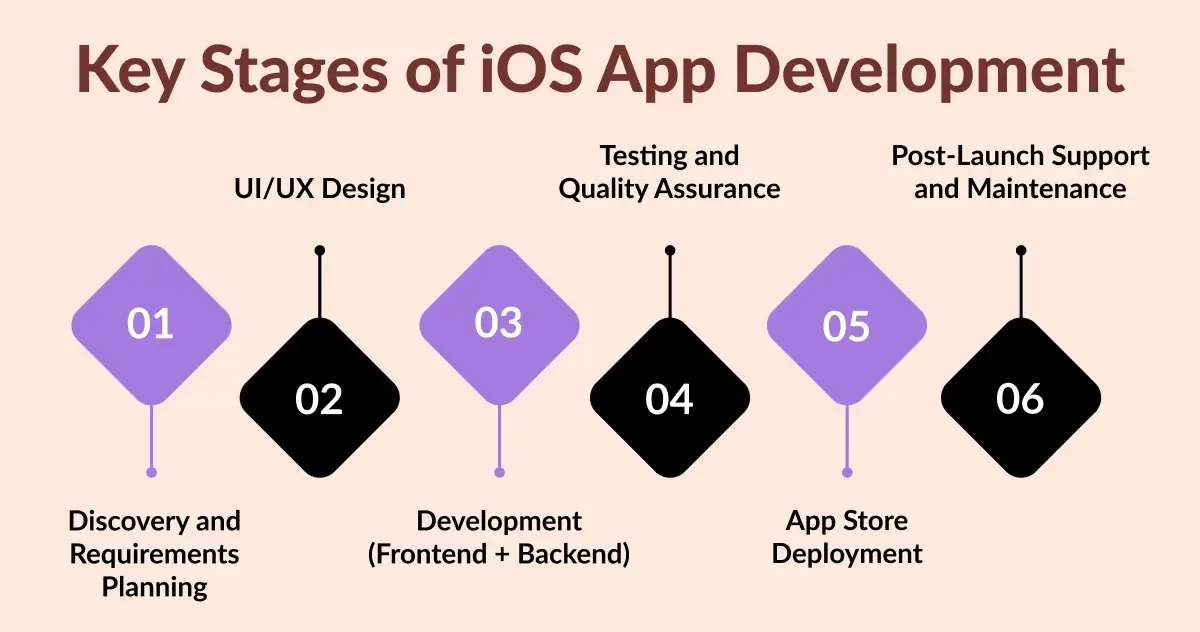
Key Stages of iOS App Development
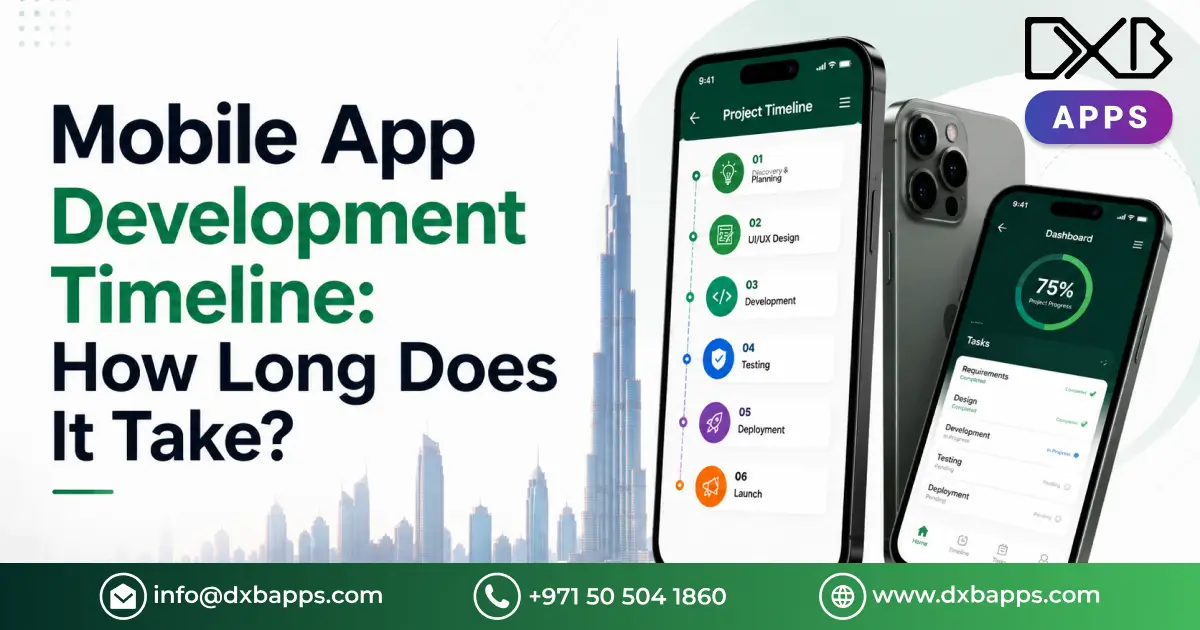
Building a successful iOS app is usually a structured process. While the details can vary depending on the project, most iOS apps follow these key stages:
1) Discovery and Requirements Planning
This is where the app idea becomes a clear plan. Teams define the goal of the app, target users, competitors, key features, and success metrics. Outputs often include a feature list, user personas, and a high-level roadmap. This stage is critical because it sets scope, timeline, and budget expectations from the start.
2) UI/UX Design
Designers create the app’s user journey and interface. This includes wireframes (layout drafts), clickable prototypes, and final UI designs. On iOS, the design must align with Apple’s standards while still reflecting the brand. A strong UX reduces drop-offs, increases retention, and improves conversion especially in competitive markets.
3) Development (Frontend + Backend)
This stage involves coding the app. The frontend is what users see and interact with screens, navigation, animations, and UI components. The backend powers features like logins, databases, real-time updates, dashboards, notifications, and integrations. Depending on the project, teams may also build an admin panel and integrate third-party services like payment gateways, maps, analytics, or CRM tools.
4) Testing and Quality Assurance (QA)
Testing ensures the app performs well on different iPhone models and iOS versions. QA covers functional testing, UI testing, performance testing, security testing, and bug fixing. This stage is often where apps become “release-ready,” reducing the risk of crashes, slow loading, or broken flows after launch.
5) App Store Deployment
Publishing on the App Store requires meeting Apple’s policies. Teams prepare screenshots, app descriptions, privacy details, and compliance documents. Apple reviews each app submission, so this stage includes final checks for guidelines, permissions, and user data handling.
6) Post-Launch Support and Maintenance
After launch, apps require updates bug fixes, performance improvements, new features, and compatibility updates for new iOS versions. Many businesses also monitor analytics, user feedback, and app performance to continuously improve the product.
Why is iOS App Development in Dubai Unique?
Dubai’s iOS app landscape is unique because it’s premium-driven, multilingual, and fast-paced often with complex features and strict standards.
- Premium UX is expected: Polished UI/UX and smooth performance are baseline requirements.
- Multilingual + cultural fit: English/Arabic (often more) with RTL support and proper localization.
- Industry-heavy demand: Real estate, logistics, eCommerce, fintech, healthcare, tourism, on-demand often needing tracking, payments, verification, and integrations.
- Compliance & security: Strong focus on privacy, encryption, authentication, and secure APIs.
- Fast time-to-market: MVP-first, agile delivery, and phased rollouts are common.
- Many vendor options: From freelancers to agencies so quotes must clearly cover design, backend, testing, deployment, and support.
Factors that Determine the Cost of iPhone App Development
The features, functionalities, and cost-affecting factors play a crucial role in ensuring your app meets the needs of both your customers and your business. It’s possible to integrate additional features into the app to cater to user demands. As a result, your iOS app should include business-driven features such as navigation, payment gateways, and other essential functionalities to enhance user experience and support your business goals.
These business-driven features are key factors in estimating your iOS app development budget, along with the following considerations:
iOS App Development Cost Based on Size
As the size of your iOS app increases, so do the number of screens and features, leading to higher development time and cost. Various ios app development in Dubai methods and processes are employed to determine the features and functionalities you select. It’s essential to begin by validating your app idea and its features before kicking off the development process.
Additionally, conducting thorough market research is crucial. This includes competitor analysis and focusing on factors such as the devices commonly used by your target audience, the features they value, and the elements that may hinder a great user experience. A valuable approach is to examine similar apps to gain insights into how your app idea can stand out and meet user expectations.
Here’s a checklist for estimating the cost of developing an iOS app based on its size:
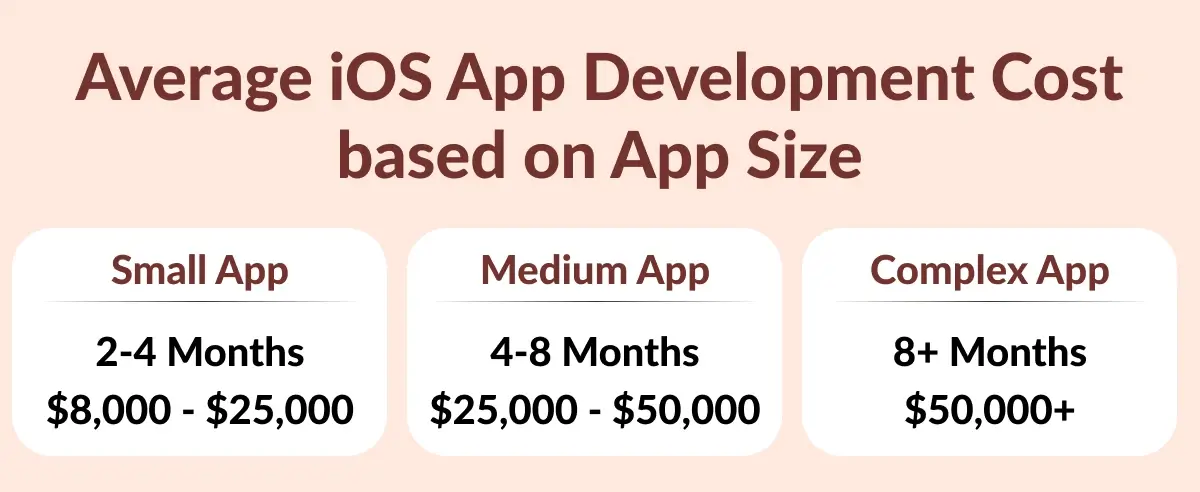
| IOS App Size | Average Development Time | Average Development Cost |
|---|---|---|
| Small app development cost | 2-4 months | $8,000-25,000 |
| Medium app development cost | 4-8 months | $25,000-50,000 |
| Complex app development cost | 8+ months | $50,000+ |
iOS App Cost Based on Complexity
An app is considered efficient when it incorporates a wide range of diverse features. To help estimate the cost of iPhone app development, we’ve categorized these features into five key groups, each playing a significant role in determining the overall development cost.
Deployment Model of Architecture: There are two types of backend development: Custom and BaaS. With custom software backend development, the backend architecture is built from the ground up. In contrast, BaaS (Backend as a Service) provides a pre-built backend architecture.
Development of Admin Panel: The admin panel is crucial for managing your app. It allows you to monitor app activities, view statistics, and update content at any time.
Third-Party App Integration: Your app may need to interact with third-party apps to perform functions such as signing up through Facebook or Google or integrating with a payment app for transaction purposes.
Addition of In-App Purchases: Many modern apps include in-app purchases to enable app monetization, allowing users to buy additional features or content within the app.
Use of Device Functions: Often, your app will need to access device features like GPS, Bluetooth, and other hardware functionalities. Including these features can add to the app’s development cost.
Here’s a checklist for estimating the cost of developing an iOS app based on its complexity:
| App Complexity | App Description | App Development Cost |
|---|---|---|
| Basic iOS app | Apps with basic UI requirements and functions | $10,000- 20,000 |
| Medium and complex iOS app | Apps with high backed and custom UI requirements | $50,000-$250,000 |
iOS App Cost Based on Industries
Given the wide variety of iOS mobile apps, the enterprise iOS app development cost largely depends on the app category. Each category has its own set of functionalities, target demographics, security requirements, and other unique factors.
Below is a graph illustrating the most popular iOS app categories. Here is a cost breakdown for developing an iOS app, categorized by its type:
| iOS App Categories | Average Development Time | Average Development Cost |
|---|---|---|
| Gaming app | 4-20 months | $30,000-250,000 |
| Business app | 2-10 months | $5,000-150,000 |
| Education app | 2-12 months | $10,000-80,000 |
| Entertainment app | 3-15 months | $15,000-100,000 |
| Travel app | 2-8 months | $5,000-50,000 |
| Shopping app | 3-8 months | $5,000-50,000 |
| Social networking app | 5-8 months | $10,000-60,000 |
| Health and fitness app | 1-15 months | $10,000-250,000 |
| Medical app | 2-6 months | $30,000-90,000 |
Understanding the eCommerce iOS app development cost is essential for businesses planning feature-rich shopping experiences, while on-demand iOS app development UAE focuses on real-time, service-based platforms that require scalability and seamless performance.
At the same time, fintech iOS app development Dubai demands advanced security, compliance, and smooth financial integrations, making it a specialized yet highly valuable investment for businesses in the region.
iOS App Cost Based on Design
The design process and animations of an app are crucial factors when considering the question, "What is the cost of developing an iOS app?" It's important to note that different design styles, animations, and illustrations will impact the cost of the same app.
Moreover, engaging and well-crafted app designs can significantly boost user engagement and conversion rates. For instance, Appinventiv helped KFC increase its conversion rate by 28% by creating a highly intuitive and visually appealing iOS mobile app.
Here are the top three iOS app design processes you should be familiar with:
Wireframing – Wireframing is essential for creating the user experience map and outlining the app's features. This step is typically done using tools like Photoshop, Balsamiq, and MARVEL.
UI Design – For iOS apps, flat design is used to provide clarity and depth, while Android apps prioritize material design to emphasize creativity and simplicity. For further details, you can refer to the "iOS vs Android app design differences."
Animation – Animation plays a key role for apps in certain categories, such as social media, restaurant, and gaming, where dynamic visuals enhance the user experience.
Here’s a comprehensive breakdown of mobile app development cost based on your app design requirements:
| App Process | Tasks | Average Development Time | Average Development Cost |
|---|---|---|---|
| App design research |
|
Based on niche and available resource | $100-$350 |
| UX design |
|
|
$2000-$8000 |
| UI design (visuals) |
|
|
$10,000-$40,000 |
| Branding |
|
Logos, icons and social media | $5,000-$20,000 |
| Animations and illustrations |
|
Based on level of animations | $1000-$20,000 |
iOS App Development Cost Based on Team Size
The cost of iOS app development largely depends on whether you hire a freelance iPhone app developer or an expert ios app development company in Dubai. Here's a breakdown of iOS app development costs based on the size and expertise of the team:
| Development Role | Global Avg. Development Cost (based on /hour) |
|---|---|
| iOS app developer | $20-$100 |
| UI/UX designer | $15-$50 |
| Scrum master | $50-$150 |
| Project manager | $12-$40 |
| QA engineer | $30-$70 |
| Business analyst | $60-$150 |
Hiring individual talent can be expensive, which is why it's recommended to hire a full-stack iOS app development team from a trusted iOS app development company Dubai at a more affordable price.
IOS App Cost Based on Development Team Location
Location significantly influences the price of iPhone app development. For example, the cost of iPhone app development in the UAE differs from the rates charged by ios app development company in the US.
Services worldwide differ considerably in both quality and cost, with the most noticeable differences occurring when comparing the West to the East.
Considering the impact of location, here’s a breakdown of the costs associated with iPhone app development:
| Region | App Development Cost |
|---|---|
| United States | $80-170/hr |
| Ukraine | $30-100/hr |
| Australia | $80-200/hr |
| Russia | $60-150/hr |
| UAE | $50-120/hr |
While the factors mentioned above provide an overall cost estimate for iOS app development services, post-development processes such as app launch and ongoing maintenance also contribute significantly to the final budget.
Some other aspects include:
iOS App Launch
A key goal when developing an iOS app is to successfully launch it on the App Store. However, this isn’t as simple as it sounds. An app can only be published on the App Store if it complies with all of Apple’s guidelines. This is why getting an app approved and published on the App Store is often considered a challenging task.
iOS App Maintenance
The work doesn’t stop once your app is launched on the App Store. Other ongoing tasks can increase the overall cost of developing an iOS app, such as app maintenance.
Here’s an overview of the startup IOS app development Dubai cost and app maintenance costs associated with the following services:
Constant Updates
As technology evolves, your app must be updated whenever a new OS version is released. These updates ensure your app remains compatible with the latest software and provides a seamless user experience.
Troubleshooting Bugs
Bugs can appear at any stage whether your app is in development or already live on the App Store. Maintaining a bug-free app requires continuous attention, and fixing these issues comes at an additional cost.
Changes in the App’s Design
“Change is the only constant.” With rapidly changing technology and trends, it’s essential to keep improving your app. Regular updates to your app's design will add to the overall frontend maintenance costs in iOS app development.
Looking to build a high-performance iOS app for your business?
DXB APPS delivers custom iOS app development using Swift and Apple’s latest technologies to create secure, scalable, and user-centric apps that drive engagement, growth, and long-term success.
Talk to iOS App ExpertsCost Comparison: Dubai vs. Global Market
Dubai (and the wider UAE) typically sits in the mid-range globally more affordable than North America and many Western European hubs, but priced higher than classic outsourcing markets like India. UAE developer rates are often quoted around AED 50–250/hour (depending on seniority and team structure).
A practical takeaway: Dubai pricing often reflects a “quality + speed + proximity” tradeoff especially for businesses that need premium UI/UX, bilingual support, and fast delivery.
Why Is Dubai a Competitive Market for App Development?
1. Strong value-for-money vs. US/Western Europe
North America commonly runs $100–$250/hour, while Western Europe is often $70–$150/hour, so Dubai can offer comparable product quality with a more flexible cost band.
2. Time zone advantage for MENA + Europe
Dubai overlaps well with GCC and European working hours, which reduces project delays and speeds up approvals, sprints, and releases (especially compared to far-offshore teams).
3. Market-ready expertise
Teams in Dubai frequently build apps for real estate, logistics, retail/eCommerce, fintech, healthcare, and tourism, so common “regional essentials” (Arabic/RTL, payments, verification, tracking, etc.) are familiar rather than “new scope.”
4. Wider talent mix in one place
Dubai’s ecosystem combines local product experience with international engineering talent, creating more choices in price tiers (startup MVP → enterprise build) without leaving the region.
Comparison of iOS App Development Costs in Other Major Cities
| City / Region | Typical hourly cost (approx.) | Notes |
|---|---|---|
| Dubai / UAE | AED 50–250/hr | Wide range depending on freelancer vs. agency, and complexity. |
| United States (major cities) | $100–$250/hr | Many US agencies fall within high bands; examples include $150–$199/hr in top US listings. |
| United Kingdom (e.g., London) | ~£425/day (median contractor rate) | Day-rate benchmark for mobile developers; agencies may be higher. |
| Canada (e.g., Toronto) | CAD 120–150/hr | Toronto often priced as a premium market. |
| Australia (e.g., Sydney) | AUD 100–200/hr | Rates rise with seniority/specialization. |
| Singapore | SGD 70–130/hr | High-cost market in APAC; strong enterprise demand. |
| Western Europe (avg.) | $70–$150/hr | Common benchmark range for agencies and experienced teams. |
| Eastern Europe | $35–$70/hr | Often chosen for strong engineering + moderate cost. |
| India | $12–$50/hr | Typically lowest cost among popular destinations. |
Top iOS App Development Agencies in Dubai
1) DXB APPS
A Dubai-based iOS app development company offering end-to-end services—from planning and UI/UX to development, testing, App Store launch, and ongoing support. Ideal for businesses that want premium quality and a team that understands UAE market expectations.
2) Eurisko
A strong MENA-focused agency known for native iOS development and handling complex, feature-rich apps across multiple industries. Often preferred for product-grade builds that need scalability and solid engineering.
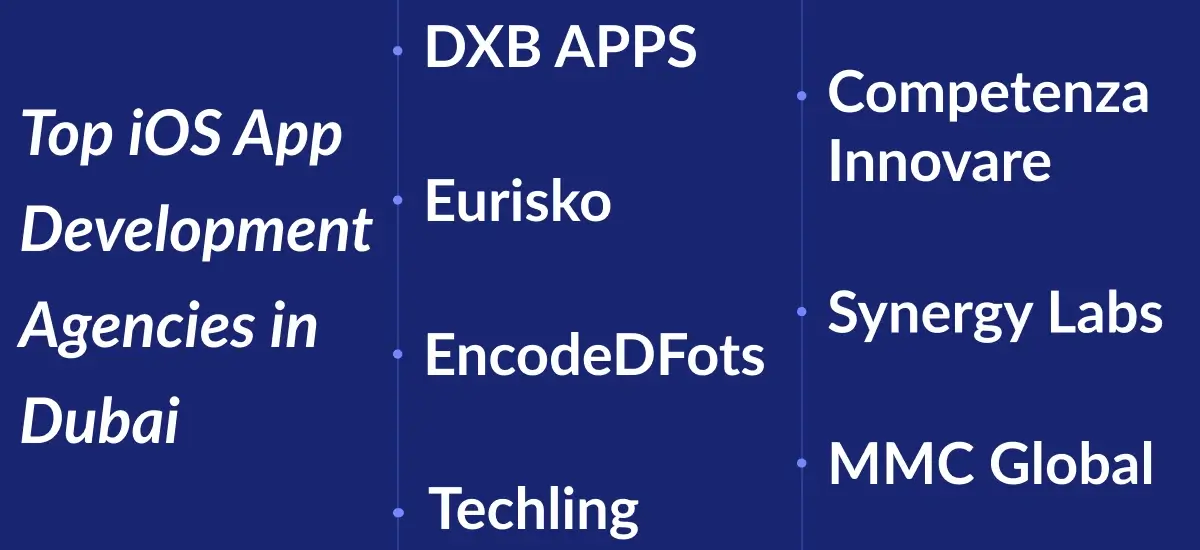
3) EncodeDFots
A Dubai-based digital product team that combines iOS development with UI/UX and broader digital services. Suitable for brands that want an agency that can support design, development, and growth-oriented execution.
4) Techling
A modern development partner offering iOS app development, UI/UX, and maintenance. Known for building clean, optimized apps and supporting businesses with long-term updates and improvements.
5) Competenza Innovare
A UAE-based team focused on performance-driven mobile development and structured delivery. A good option for companies looking for stable execution, clear processes, and reliable communication.
6) Synergy Labs
A boutique-style agency that emphasizes discovery, design, and agile delivery. Often a fit for startups and growing businesses that need fast MVP development with a clear roadmap.
7) MMC Global
A full-service development company offering iOS app development plus backend, testing, and support. Works well for businesses that want a complete delivery partner for custom apps.
| Agency | Why it leads |
|---|---|
| DXB APPS | Strong local market understanding with premium end-to-end iOS delivery |
| Eurisko | Scalable native iOS engineering and experience with feature-heavy apps |
| Digital Gravity | Strong alignment of UI/UX and iOS development under one delivery team |
| Techling | Focus on optimization, stability, and long-term updates |
| Competenza Innovare | Structured execution, consistent communication, predictable outcomes |
How to Choose the Right iOS App Development Company in Dubai?
Dubai offers many app development options, but the right partner is the one that can build a reliable iOS product, align with your business goals, and support you beyond launch. Use the criteria below to evaluate companies confidently.
1) Define your Goals and Scope Early
Start with clarity on your target users, core features, timeline, and success metrics. A strong custom iOS app development company will help you prioritize an MVP, reduce unnecessary complexity, and build a realistic roadmap.
2) Review iOS-specific Portfolio and Proven Results
Look for recent iOS apps similar to your industry and complexity. Ask for App Store links, measurable outcomes (performance, retention, conversions), and confirmation of what work the company delivered in-house.
3) Assess Technical Capability and iOS Best Practices
Choose a team experienced in Swift (and SwiftUI/UIKit as needed), scalable architecture, API integration, and Apple Human Interface Guidelines. They should also be comfortable with App Store submission and compliance requirements.
4) Evaluate UX Quality and Product Thinking
A polished user experience is non-negotiable. Strong companies provide wireframes, prototypes, and clear user flows before development, ensuring the app is intuitive, fast, and consistent across iPhone devices (and iPad if required).
5) Verify QA Standards and Delivery Process
Ask about their testing approach (device coverage, TestFlight cycles, bug tracking, performance checks) and how releases are managed. A structured QA process reduces post-launch risk and rework.
6) Confirm Security and Data Protection Measures
If your app handles personal data or payments, validate their practices for secure authentication, encryption, safe storage (e.g., Keychain), and privacy policy readiness.
7) Check Communication, Ownership, and Post-Launch Support
Ensure you have a clear point of contact, regular progress updates, and documented milestones. Confirm you own the source code, design files, and Apple Developer account access. Finally, review maintenance options for iOS updates, monitoring, and ongoing improvements.
Quick checklist: iOS-focused portfolio, modern Swift expertise, strong UX + QA process, clear ownership terms, transparent timelines, and reliable post-launch support.
Ready to start your iOS app development journey?
Partner with DXB APPS to build a custom iOS application that aligns with your business goals, engages users, and delivers long-term value.
Get a Free iOS ConsultationTips to Reduce iOS App Development Costs
Budget constraints are a common challenge, especially for startups and small businesses. The good news is that you can manage costs while still building a high-quality iOS app with the help of top ios app development company in UAE. Here are some practical strategies to help you get the most out of your budget:
Prioritize a Minimum Viable Product (MVP)
- Focus on the core value of your app, not every feature you can think of. An MVP includes only the essential features, allowing you to launch sooner and control your iOS app development costs in Dubai.
- After releasing the MVP, measure user behavior and gradually add features in updates.
- This approach helps you avoid spending on unnecessary features that don’t contribute to retention, conversion, or revenue.
Use Existing Solutions and Libraries
- Not everything requires custom code. By using trusted iOS libraries, SDKs, and pre-built components for features like social login, chat, or analytics, you can reduce build time and lower development costs in Dubai.
- Pre-tested, reliable components are often more stable, but it’s important to ensure they are secure and well-maintained.
- Modern Apple frameworks like SwiftUI can speed up UI development, and cross-platform tools are also useful for non-core screens if the user experience remains strong.
Opt for Cross-Platform When Suitable
- If you plan to develop for Android later, a cross-platform solution can reduce your iOS mobile app development costs in Dubai by allowing one team to build both iOS and Android apps from the same codebase.
- Flutter or React Native can be more cost-effective than hiring two separate native teams. This approach works well for apps that don’t require heavy native performance or highly platform-specific UIs.
- For many business and content apps, cross-platform development provides solid UX and helps you reach both audiences faster.
Choose the Right Development Partner
- If you’re outsourcing, the team you choose can significantly impact the iOS app development pricing Dubai, just as much as the feature list.
- The cheapest option can become costly if the quality drops or timelines extend. Look for a team with proven experience in apps similar to yours, and validate their expertise through portfolios and relevant case studies.
- Clear communication reduces rework, and a well-defined scope ensures your budget stays on track, even if requirements change during development.
Plan for Scalability and Maintenance from Day One
- Making good architecture choices early can help reduce Apple app development cost UAE over time. Modular code and a scalable cloud infrastructure reduce the need for refactoring as your user base grows or new features are added.
- Automated testing early on helps catch bugs when they’re cheaper to fix, and analytics will show you what users are actually doing, so you can focus on the right updates.
- Many teams in Dubai offer a paid discovery phase to lock in requirements and system design early, which helps avoid costly rework later on.
By following these strategies, you can maximize your budget without sacrificing quality. Keep in mind that cutting corners on critical areas like security, user experience, or code quality is never a good idea, these are the foundations of your app’s success. Instead, save money through careful planning, phased development, and smart, efficient choices.
Hidden iOS App Development Costs You Should Know About
The factors influencing the cost of iOS app development (as mentioned above) are quite obvious and hard to overlook. However, some hidden criteria in iPhone app development may slip under your radar while developing your app. Don’t worry, we've outlined these criteria below to ensure you don’t miss any important details.
| Hidden Cost Factors | Average Cost /Year |
|---|---|
| Data storage | $500 |
| CDN | $150 |
| App developer account cost | $99 |
| Annual iOS updates | $1000 |
| Monitoring and maintenance | $4,000-12,000 |
How Long Does iOS App Development Takes in Dubai?
iOS app timelines in Dubai vary based on scope, integrations, and the level of UI/UX polish required. A well-defined MVP can move quickly, while complex platforms take longer due to architecture, security, testing, and approval cycles.
MVP (Minimum Viable Product): 6–12 weeks
Best for validating the idea with core features only. Typical MVP scope includes login, a few key screens, basic backend integration, and a simple admin flow.
Mid-level app: 3–5 months
Often includes more screens, payment integration, dashboards, push notifications, analytics, and stronger UI/UX refinement.
Complex app: 6–9+ months
Common for apps with advanced features like real-time tracking, chat, marketplace functionality, multi-role permissions, heavy third-party integrations, offline mode, or high security/compliance requirements. These projects also require more QA, performance optimization, and staged releases.
Note: App Store review usually adds several days, and can take longer if the app needs privacy, payment, or data-handling clarifications.
What slows projects down?
Even strong teams can lose time when planning and decision-making aren’t controlled. The most common causes include:
- Scope creep: Adding “small” features mid-build can trigger new screens, backend changes, testing, and rework. The fix: lock the MVP scope and schedule enhancements for later phases.
- Unclear requirements: Vague user flows, missing edge cases, or changing assumptions lead to frequent revisions. The fix: confirm detailed requirements, user stories, and acceptance criteria before development.
- Too many revision cycles: Repeated UI changes late in development slow delivery because they affect layouts, logic, and testing. The fix: approve wireframes and prototypes early, and limit revision rounds per milestone.
- Delayed feedback: Waiting days for approvals or content (text, images, policies) pushes timelines. The fix: assign a decision-maker and set weekly review checkpoints.
- Third-party dependencies: Payment gateways, maps, CRM/ERP systems, and API readiness can become bottlenecks. The fix: verify integration requirements and access early.
- Testing and device coverage: Supporting multiple iPhone models and iOS versions takes time, but skipping QA increases post-launch issues. The fix: plan QA from day one, not at the end.
- A clear scope, fast approvals, and a phased roadmap are the simplest ways to keep iOS development on schedule in Dubai.
For instance, getting an idea about the eCommerce app development cost is important for businesses planning online stores with secure payments, product management, and smooth user experiences, while the grocery app development cost often includes real-time inventory, delivery tracking, and order management features tailored for on-demand shopping.
Comparative Analysis of iOS and Android App Development Cost
To give you a clearer understanding of iOS development, let's compare the mobile app development costs between Android and iOS.
1. Design
In terms of design, the time required to build an intuitive and functional UI for Android and iOS is fairly similar. However, it is often believed that iOS app design tends to be of higher quality than Android. This can be attributed to the stringent high-quality standards set by the App Store, which explains this small yet notable difference.
2. App Development Time
Determining the exact time required to develop an iPhone app versus an Android app can be complex, as several factors influence the time efficiency of each process.
Regarding coding languages, Java and Kotlin (used for Android development) are heavier and require more lines of code compared to Swift (used for iOS development) or Objective-C. As a result, iOS development tends to be faster when using Swift.
Additionally, fragmentation plays a crucial role in determining the development time and costs. Android faces a wide range of devices with varying screen sizes and OS versions, requiring extensive preparation.
In contrast, Apple has around 20+ devices, making its device fragmentation process far simpler than Android's. As a result, iPhone development generally requires less time and incurs lower costs in certain aspects compared to Android.
3. Duration of Testing
Testing is an essential part of the development process, making it a crucial factor in deciding between iOS and Android app development.
As mentioned earlier, iOS’s device fragmentation is simpler than Android's, which makes the testing process more streamlined and efficient for iOS. On the other hand, Android requires testing on a wide variety of devices with different resolutions, screen sizes, OS versions, and more, making the testing process much longer and more complex.
4. App Development Hourly Rates
The difference in hourly rates largely stems from the languages used in the development process for Android and iOS. As previously mentioned, iOS apps are built using Swift or Objective-C, which are generally more expensive than the languages used in Android development, such as Kotlin and Java. iPhone app developers working with Swift or Objective-C typically charge 10% to 15% more than those using Java.
5. App Launch
Due to Apple’s strict standards for app submission and publication, getting your app approved can be more challenging. Once approved, you'll need to pay an annual fee of $99 for the App Store. In contrast, Google Play Store charges a one-time fee of $25 and has more relaxed rules and regulations.
As you can see, there are various development costs to consider when creating your iOS app. To ensure smoother development and gain practical, cost-effective solutions, it’s wise to partner with an experienced iPhone app development company.
Comparative Analysis of iOS and Android App Development
Now that you're familiar with the various pricing factors influencing iPhone app development cost UAE, let's delve into the benefits that make iOS development stand out and give it an edge over Android.
High Revenue Potential
iOS users generally spend more on apps and in-app purchases, making it a highly profitable platform for businesses looking to monetize. This trend is fueled by a user base with higher disposable incomes and a greater willingness to invest in premium digital products and services.
Uniformity in Devices
A key advantage of iOS apps over Android apps is the uniformity of the ecosystem. With fewer device models and versions compared to Android’s fragmented landscape, iOS simplifies testing, optimization, and compatibility, making development more efficient.
Better Security Standards
Apple’s stringent app review process and closed ecosystem offer superior data security and authorization, which can be more reassuring than Android's more open platform. This heightened security makes iOS an ideal choice for business applications requiring high data protection.
Faster Deployment and Updates
iOS apps usually experience quicker approval times on the App Store compared to Google Play, allowing developers to deploy updates and new features faster than on Android.
How to Develop an iOS App?
Building an iOS app is a structured app development process, not only coding, but also product planning, UI/UX, architecture, integrations, testing, and App Store compliance. When each phase is done correctly, you get an app that is fast, secure, easy to maintain, and ready to scale.
1) Discovery and Requirements Planning
This phase turns an idea into clear documentation that developers and designers can build against. It also reduces cost and timeline risk by preventing rework later.
Key outputs include:
- A defined MVP scope (must-have features) and Phase 2/3 roadmap
- User roles and end-to-end user journeys (onboarding → core action → payment/checkout → support)
- Acceptance criteria and edge cases (failed payments, low network, invalid inputs, permissions)
- Basic product metrics (retention, conversions, orders, session time)
2) UI/UX Design and Prototyping
Design for iOS must feel natural to Apple users. Teams typically start with wireframes and then move to high-fidelity UI and clickable prototypes.
This stage usually includes:
- Information architecture and navigation style (tab bar, stack flows, sheets)
- High-fidelity UI in tools like Figma, aligned with Apple HIG
- Responsive layouts for multiple iPhone sizes (and iPad if needed)
- Accessibility basics (Dynamic Type, contrast, tappable sizes) and localization planning (English/Arabic, RTL if required)
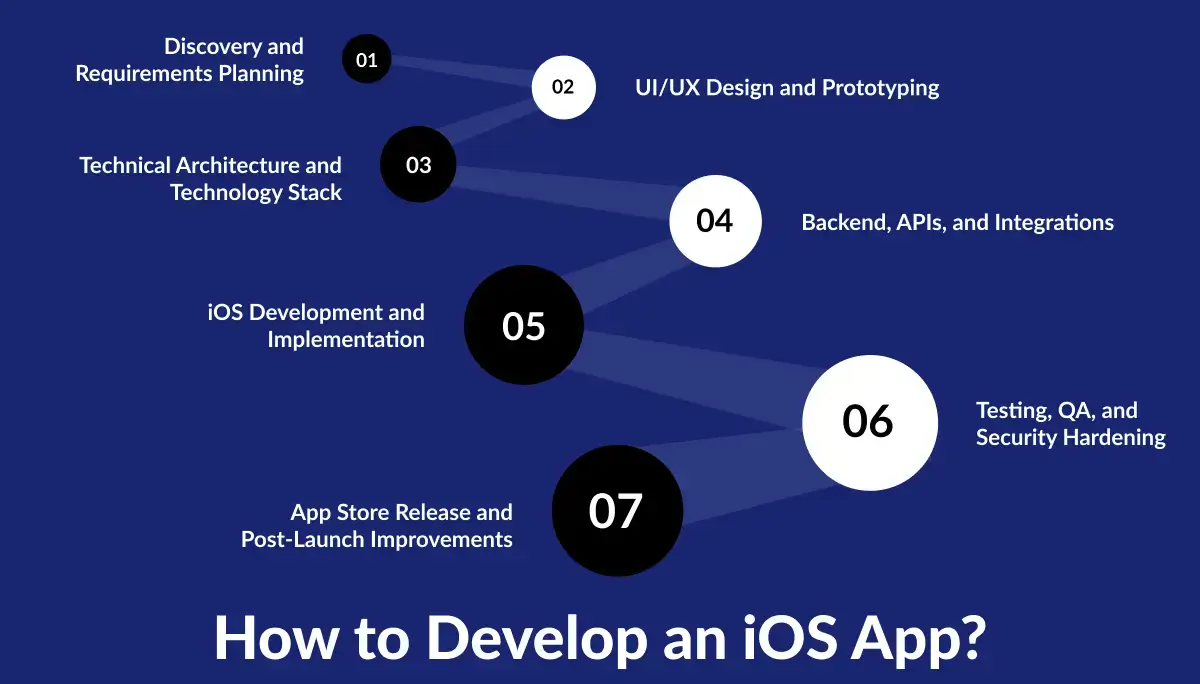
3) Technical Architecture and Technology Stack
Before development begins, define how the app will be structured to keep it stable and scalable. A clean architecture makes upgrades and new features much easier later.
Typical iOS tech decisions:
- Language: Swift
- UI: SwiftUI or UIKit (or a hybrid)
- Architecture: MVVM or Clean Architecture for separation of concerns
- Networking: URLSession-based layer with proper error handling, retries, and pagination
- Storage: Core Data/SQLite for offline needs; Keychain for secure data (tokens/credentials)
4) Backend, APIs, and Integrations
Most production apps depend on a backend for accounts, data sync, and payments. To avoid delays, define API contracts early so mobile and backend teams can work in parallel.
Common backend/integration components:
- Authentication (JWT/OAuth flows, refresh tokens, role-based access)
- REST/GraphQL APIs with clear versioning and validation rules
- Admin panel for content, users, orders, or listings
- Integrations such as payments, maps, SMS/OTP, email, analytics, push notifications
5) iOS Development and Implementation
Development typically runs in weekly or biweekly sprints with demos. Engineers implement UI screens, business logic, and all integrations while maintaining performance and stability.
Core development work includes:
- Screen development + state management + navigation flows
- API integration and robust error states (empty states, retry, offline handling)
- Push notifications (APNs), deep links/universal links
- App performance optimization (fast loading, smooth scrolling, memory control)
- Analytics event tracking for funnels and key actions
6) Testing, QA, and Security Hardening
Testing is where a good app becomes a reliable app. A proper QA cycle reduces crashes, improves performance, and prevents App Store review issues.
Testing typically covers:
- Unit tests for critical logic and data parsing
- Integration testing for API flows and authentication
- UI testing for core journeys (sign-up, checkout, booking, etc.)
- Device testing across multiple iPhone models and iOS versions
- Security checks (secure storage via Keychain, permission handling, data protection)
7) App Store Release and Post-Launch Improvements
App Store submission requires more than uploading a build. Your metadata, privacy disclosures, and app behavior must meet Apple’s guidelines. After launch, continuous improvement is essential.
Release and growth tasks include:
- App Store assets (screenshots, description, keywords) and privacy policy
- App Store review submission and compliance fixes (if requested)
- Monitoring crashes and performance, then releasing updates
- Iterating features based on user feedback and analytics
ROI on iOS App Development in Dubai
Dubai’s iOS app ROI usually comes from three main outcomes:
1. Revenue growth
More bookings/orders, higher conversion rates, repeat purchases, subscriptions, and upsells driven by premium UX and faster journeys.
2. Operational savings
Reduced branch visits and call-center load through self-service features like booking, payments, document upload, tracking, and automated notifications.
3. Competitive advantage
Faster launch cycles (MVP → iterations) and better user experience help businesses win market share in a highly competitive, app-first market.
How to Measure ROI for iOS Apps?
Step 1: Pick your primary ROI goal
- Growth: sales/leads/bookings
- Retention: repeat usage, churn reduction
- Efficiency: cost-to-serve reduction, time saved
- Experience: ratings, NPS, fewer drop-offs
Step 2: Track KPIs that match your model
| App type | Core ROI KPIs | What to look for |
|---|---|---|
| eCommerce / delivery | CAC, AOV, repeat rate, LTV, churn | Higher LTV + repeat rate, lower CAC |
| On-demand / logistics | on-time rate, cancellations, utilization, dispatch time | Fewer cancellations, faster fulfillment |
| Real estate | qualified leads, booking rate, lead-to-deal | More qualified leads, shorter sales cycle |
| Fintech | activation, KYC completion, transaction volume, fraud rate | Higher activation, safer transactions |
| Government / utilities | digital adoption, in-app transactions, support tickets | More self-service, fewer support calls |
Step 3: Use Simple ROI Math
- ROI: (Benefit − Cost) ÷ Cost
- Payback period: time until cumulative benefit ≥ total cost
- Unit economics: LTV ÷ CAC, ARPU, retention curve
- Cost savings: (hours saved × hourly cost) + reduced service handling costs
Case Studies of Successful iOS Apps in Dubai
| App / Category | Why it succeeded | ROI impact (what it improved) |
|---|---|---|
| DubaiNow (Gov services) | Aggregated multiple services into one smooth app | Higher digital transactions, lower cost-to-serve |
| DEWA Smart App (Utilities) | Strong self-service features for payments and requests | Reduced service load, faster processing, better adoption |
| RTA Smart Apps (Transport) | Easy access to transport services + digital payments | Increased digital usage and channel efficiency |
| Careem (Mobility / Super app) | High-frequency services + convenience ecosystem | Strong retention, repeat usage, loyalty economics |
| talabat (Delivery) | Fast ordering, reliable fulfillment, high-frequency use | Repeat orders, scalable revenue growth |
Key Considerations for Launching an iOS App in Dubai
Premium user experience is the baseline
Dubai users expect polished UI/UX, fast performance, and stability. Plan for strong onboarding, smooth checkout/booking flows, and crash-free releases because “good enough” apps struggle to compete.
Localisation is not optional
Most Dubai apps need English + Arabic, including RTL layouts, Arabic typography, and culturally appropriate content. Building bilingual from day one avoids costly redesigns later.
Prepare operations before launch
Decide how you’ll handle customer support, monitoring, incident response, and update cycles. A great launch with weak post-launch support quickly hurts ratings and retention.
App Store Submission and Approval Process
Follow Apple’s review rules and documentation
Your app must comply with Apple’s App Review Guidelines across safety, performance, business, design, and legal requirements.
Get your “submission-ready” assets right
Prepare App Store Connect essentials: accurate metadata, screenshots, age rating, support/privacy URLs, and privacy disclosures (especially if you use analytics/ads SDKs). Apple also requires clear App Privacy Details for data collection practices
Understand review timelines and common delays
Apple notes that 90% of submissions are reviewed in under 24 hours on average, but incomplete or non-compliant submissions can delay approval.
Marketing and App Store Optimization
ASO Fundamentals that Move Installs
Focus on a clear title/subtitle, keyword coverage, strong first screenshots, and a value proposition users understand in seconds. Keep your page aligned with what the app actually does to avoid poor conversion and negative reviews.
Local ASO for Dubai Users
Use English and Arabic store content where relevant, and localize keywords to how people in the UAE search. Creatives and messaging should match local expectations (speed, convenience, premium feel).
Launch Marketing that Proves ROI
Set up attribution and deep links to measure the full funnel (install → signup → purchase/booking). Encourage reviews after a “success moment” (order confirmed, booking completed) to lift rankings sustainably.
Legal Considerations for App Development in UAE
UAE Personal Data Protection compliance (PDPL)
UAE PDPL establishes obligations around lawful processing, transparency, and safeguarding personal data, and supports data-subject rights such as access, correction, deletion, restriction/objection, and data portability in certain cases.
Security and Privacy-by-Design
If your app handles payments, healthcare info, or sensitive data, build security into the architecture early (secure authentication, encryption, secure APIs, audit logs). This reduces legal and App Store risk.
Advertising and promotions may need an “Advertiser Permit”
If you (or creators you hire) publish promotional content in the UAE, the UAE Media Council states an Advertiser Permit is required for advertising activities on social media platforms
Build an iOS App That Boosts Sales & Engagement
DXB APPS delivers performance-driven iOS development with user-first design, fast loading, and seamless functionality.
Get a Growth-Focused iOS AppHow DXB APPS Builds the Best Mobile Apps in the UAE?
DXB APPS builds some of the best mobile apps in the UAE by combining a strong mobile app development Dubai strategy, advanced UI/UX design, and high-end app development solutions under a structured delivery process.
The team of expert mobile app developers begin with clear discovery and planning to define requirements, user flows, and an MVP roadmap, then designs intuitive interfaces aligned with platform standards.
During mobile app development Abu Dhabi process, DXB APPS focuses on clean architecture, performance, and security, supported by disciplined QA testing across devices and iOS versions.
From validating ideas and refining features to selecting the right tech stack and integrations, our web development Dubai team prioritizes web and app solutions that scale smoothly as user demand grows. With a focus on clean code, strong security practices, rigorous testing, and App Store readiness, DXB APPS delivers applications that launch confidently and remain easy to maintain and enhance over time.
Conclusion
In conclusion, the cost to develop an iOS app in Dubai depends on multiple factors, including app complexity, features, design requirements, development approach, and the expertise of the team you hire. While Dubai may have higher hourly rates compared to some regions, businesses benefit from access to skilled developers, strong project management, and high-quality standards.
By carefully defining your scope, starting with an MVP, choosing the right technology stack, and partnering with an experienced development company, you can effectively control your budget while still building a powerful, scalable, and secure iOS app. Ultimately, smart planning and the right development strategy matter more than just the initial price tag.
FAQs
How to develop an ios app for online food delivery services?
To build an iOS food delivery app, define flows for customers, restaurants, and drivers, then launch an MVP with menus, ordering, payments, and live tracking. Use a strong backend, integrate maps and payment gateways, test thoroughly, and scale after launch.
How much does iOS app development cost in Dubai, UAE?
iOS app development in Dubai generally costs between AED 25,000 and over AED 500,000, depending on app complexity, features, and the development team. Simple, basic apps start around AED 20,000 - AED 35,000, while complex enterprise apps with AI or advanced API integrations range from AED 150,000 to over AED 500,000+.
What factors influence the cost of developing an iOS app in Dubai?
The cost of developing an iOS app in Dubai is primarily driven by app complexity, feature set, UI/UX design, and the development team's expertise/location.
How long does it take to develop an iOS app in Dubai?
Developing an iOS app in Dubai typically takes between 3 to 9 months, depending on complexity. Simple, basic apps generally take 1–3 months, medium-complexity apps (e.g., e-commerce) take 3–6 months, and advanced, feature-rich apps can take 6–9 months or more.
Is iOS app development more expensive in Dubai than in other countries?
Yes, iOS app development in Dubai is generally more expensive than in countries like India or Eastern Europe, but is less expensive or comparable to the United States or Western Europe. The cost differences are primarily due to variations in developer hourly rates and operational expenses.
Can I get a custom iOS app developed in Dubai within my budget?
Yes, developing a custom iOS app in Dubai within a budget is possible by focusing on a Minimum Viable Product (MVP), utilizing cross-platform frameworks like Flutter, or hiring specialized, cost-effective agencies.
Do Dubai iOS app development companies offer post-launch support?
Yes, iOS app development companies in Dubai, such as DXB APPS, provide comprehensive post-launch app support. These services typically include ongoing maintenance, bug fixes, performance monitoring, and OS updates to ensure apps remain secure, functional, and optimized.
Is ongoing app maintenance included in iOS app development cost?
No, ongoing app maintenance is rarely included in the initial iOS app development cost. Maintenance is a separate, recurring, post-launch expense, typically costing 15–25% of the original development price annually for updates, bug fixes, server costs, and Apple OS compatibility.
What is included in the iOS app development cost in Dubai?
iOS app development costs in Dubai include project management, custom UI/UX design, frontend/backend development, API integration, testing, and deployment. Costs vary by complexity, covering features like user authentication, payment gateways, AI/AR integration, and app store, often with 50-60% of the budget allocated to development/coding.
What is the cost difference between simple, medium, and complex iOS apps?
iOS app development costs range from $10,000–$50,000 for simple, $50,000–$150,000 for medium, and over $100,000–$500,000+ for complex apps, with development times spanning 1 to 8+ months depending on features.
Is developing an iOS app in Dubai worth the investment?
Developing an iOS app in Dubai is highly likely to be worth the investment, driven by the UAE's high smartphone penetration (over 97%), affluent demographic, and a strategic shift towards a digital-first economy.