The fast ongoing expansion of the mobile app development Dubai market is giving startups, companies, and entrepreneurs new opportunities. The amount of applications that exist and that offer solutions and enhance productivity is increasing every day. In addition, apps that provide entertainment and even change entire industries exist and are further evidence of the growing demand for mobile applications. To the contrary, a large number of mobile applications still fail shortly after they are launched.
One of the common causes of mobile application failure to validate mobile app idea before development. The failure of many apps comes from the emotional connection that many founders have for a specific idea. This connection is the reason they spend countless amounts of time and money in the development of the mobile application. They do all of this without the knowledge of a real market demand. The aftermath of this neglect is the creation of applications that customers have no desire or necessity for.
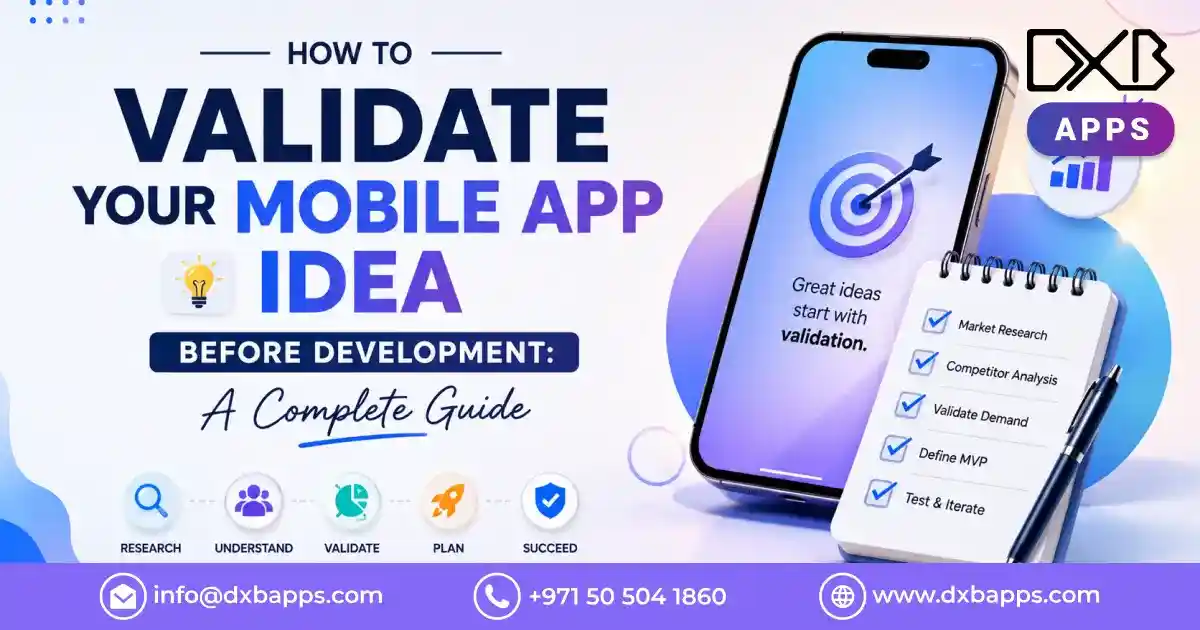
In this guide, we are going to discuss strategies that minimize risk and help you build a business app development Dubai that meets user demand. You will find out how to test your app idea before going into development.
What Is Mobile App Idea Validation?
Mobile app idea validation determines if a mobile app idea addresses a problem and identifies if a target market exists.
The focus should be determining if there is an interest for the app for purchase and for recommending it. Research, surveys, and interviews provide evidence and data for validation. Other sources include review and analysis of competitors, creation of landing pages, and mobile app testing before launch prototypes and MVPs.
Why Validating Your App Idea Is Important?
Many people think a great idea alone leads to the success of a business. While great ideas are important, there are a number of other elements that impact the success of a business such as execution and most importantly demand for the product in the market.
Without going through the proper validation, businesses are most likely to face a number of challenges such as:
- Poor user adoption
- Low download numbers
- Negative reviews
- High app development costs
- Weak product-market fit
- Difficulty attracting investors
Creating a valid product reduces the likelihood of the challenges above as a valid product is made/purpose built for the needs of the customer.

Key Benefits of App Validation
Reduces Financial Risk
Build a mobile app in UAE can be a major expense. Validation helps ensure that money isn't spent on a product that no one will buy.
Saves Time
Building an app takes a lot of time. Validation helps ensure that this time isn't spent on features that customers don't want.
Improves Product-Market Fit
Knowing how to meet customer demands helps ensure that the right solution is built at the right time.
Increases Investor Confidence
Creating a solution based on proven market needs gives an added edge over your business solution compared to others.
Enhances User Satisfaction
Customer-feedback-designed apps are satisfying for users, and user satisfaction promotes app adoption.
How to Validate Your Mobile App Idea Before Development?
Step 1: Clearly Define the Problem Your App Solves
Every successful custom mobile app development Dubai starts with a problem. One of the biggest mistakes entrepreneurs make is focusing on what features the app will have before identifying what the real problem will be for the user. Downloading an app is not about the features; it is about the problems that the app resolves or the convenience that the app provides.
Before continuing with your plan, figure out what exactly is the problem, with as much detail as possible, and who the problem is relevant for. Also think about the consequences of leaving the problem up to be resolved and what the other options are that have already been created.
Step 2: Identify Your Target Audience
Validating mobile app business ideas UAE means understanding its users. These users are the ones that face the problem that your app addresses.
You can understand your app’s potential users by creating detailed customer avatars. Include age, job, salary, location, lifestyle, and familiarity with tech. An example would be a marketing executive that can’t separate work and personal tasks. Such an executive would most likely want a solution that organizes tasks and lessens work-related stress.
Step 3: Conduct Thorough Mobile App Market Research
Researching the market will determine if you have a real app idea. You can do this based on the demand for your idea, the interest, and if the market is big enough.
You should look at:
- Market trends
- Emerging technology relevant to your app
- The size of the market
- Potential number of users
- Most probable future customers
- Opportunities for app expansion in the future.
Existing data about your idea is found in industry reports, online communities, social media, app reviews, and Google Trends. A clear demand in the market for a need indicates that your idea is worth pursuing.
Step 4: Analyze Your Competitors
Competition is not a disadvantage during validation. Competitors may demonstrate that there is a market, since their apps are pulling in customers. They are solving some problems, resulting in demand.
In your analysis, consider the:
- Competitors’ functionality
- Cost structure
- User experience
- Reviews
- Monetization
Watch for frequent complaints and noted user research for mobile apps needs. These shortcomings present the opportunity to offer a better solution.
Step 5: Create a Strong Unique Value Proposition
A Unique Value Proposition (UVP) identifies the reason a target user will select your application over the competition. It identifies the target user, the problem the application is solving, and the differentiating factors of the application.
Stating an application is “a budgeting app” is a poor example of a UVP. An example of a good UVP is “a budgeting app, designed for freelancers, allowing for easy management of irregular income and easy tracking of expenses.” This provides the target user and a unique advantage of the app.
Step 6: Interview Potential Users
One of the best ways to validate app idea before development is to have actual conversations with potential users. Unlike surveys, user interviews delve into real-life difficulties, behaviors, and expectations that help you gain unique insights.
Examples of useful user interview questions include:
- What do you do to solve this problem now?
- What problems do you encounter with available solutions?
- How often is this an issue for you?
- What would solve your problem the best?
Instead of describing your mobile app development services UAE and asking users if they would use it, ask them about their current behaviors and pain points. If you see that same problem across several user interviews, this may indicate that a market opportunity exists.
Step 7: Use Surveys to Gather Data
Surveys capture quantitative data from a big sample, while interviews capture qualitative data from a small sample. Interviews capture deep insights and surveys capture breadth. Using both methods creates a fuller picture, seeing more patterns and user pain points.
Your survey can collect data on:
- Current pain points
- Software solutions currently being used
- Desired features
- Potential users’ willingness to pay
Google Forms, Typeform, and SurveyMonkey are some of the tools that can aid you in making surveys. Your data is only as trustworthy as your sample, and a large, representative sample will improve your data.
Step 8: Create a Landing Page
Creating a landing page is an efficient and budget-friendly way to gauge interest in your idea. Full application development is not necessary, as the page provides a product preview to your potential users.
A good landing page will provide a description of the problem your product/set of services will help to solve, as well as, your solution and its respective benefits. It is also helpful to add a visual aid. Users can be prompted to take action by joining a waitlist or signing up for early access.
Actively offering email addresses or signing up to receive updates is a good measure of the validity of your concept in the audience’s eyes.
Step 9: Run Small Advertising Campaigns
Advertising is an effective way to gain validation data since you essentially find out what level of interest there is in an in-market offer. A limited ad budget can protect you from making large development investments and get an actionable data return.
You will need to assess the following metrics:
- Click-through rate (CTR)
- Conversion rate
- Cost per click (CPC)
- Cost per lead (CPL)
- Registrations and email signups
Engagement rates and strong metrics signal active demand. If you see weak performance this may indicate a need to improve targeting, messaging, or value prop.
Step 10: Build a Prototype
Before going into full-scale development, an app prototype development gives a sample of the user experience (UX) and main functions built in an app. It is a working model that shows how the app will look and work for users.
Figma, Adobe XD, Sketch, and InVision all allow developers and UX designers to build interactive models of an app without writing a single line of code. These apps allow for user practice and critique of the navigation and feature sets and help improve the development model.
A prototype is a great app model to help find usability issues before the app even goes into the actual mobile app development process.
Step 11: Develop a Minimum Viable Product (MVP)
After finishing the primary validation stage and confirming the demand, the next relevant step is building a minimum viable product (or MVP). An MVP concentrates solely on core functionality and center features that understand primary problem(s). This allows for very quick product launches and the ability to collect feedback in the real world.
Instead of spending on a complex feature set, a basic product that's easy to implement and offers immediate usefulness is a better, more cost-effective option. There is lower risk to development and significantly lower time to launch a mobile app in Dubai.
An MVP helps users test assumptions by getting feedback and allows for improvement of the product based on real data of how the product is being used.
Step 12: Validate Your Monetization Strategy
A great app idea has the potential to attract an audience and yield continued income. Thus, confirming the potential for profit is as necessary as assessing the product.
Traditional forms of monetization can be:
- Restitution through subscription
- Freemium model
- One-time purchases
- In-app purchases
The more you know what users want, the easier it is to make your business model sustainable for all stakeholders.
Step 13: Measure Validation Metrics
Validation should lean on actual data and not guesswork or subjective reasoning. The right KPIs will tell you if your app idea has potential pull in the market.
Metrics you could track are the following:
- Email signups
- Conversion rates
- Survey participation
- User Interviews
- Prototype Testing
- User Retention
The more signs you get from these metrics, the more evidence there is that your app should be developed.
Common Mistakes to Avoid
Entrepreneurs often unintentionally sabotage their own validation efforts. Here are a few validation pitfalls.
Building Before Validating
Most entrepreneurs have a natural desire to jump in and build the product they think customers will want, but you can’t assume a solution is wanted until you go out and test it.
Ignoring Negative Feedback
Negative feedback is often the most constructive and helps build a better product.
Surveying Friends and Family Only
Fulfilling social contract obligations isn’t really a basis for honest feedback, and can lead you to unproductively think your solution is wanted.
Focusing on Features Instead of Problems
When entrepreneurs think about the solution, they tend to think about the features, but customers care about the problem being solved and the outcome.
Assuming Downloads Equal Success
People will only download your app for the features, but the real success comes from continued use and engagement.
Signs Your Mobile App Idea Has Been Successfully Validated
Here’s what you might see if you’re ready to move forward with development:
- Users agree there is a problem that needs to be solved.
- There is demand for a solution in the market.
- Competitors are successfully making a profit.
- Conversion rates on the landing page are positive.
- Surveys indicate considerable interest.
- Interviewed users acknowledge the problem and express interest in the solution.
- There is positive feedback on the developed prototype.
- Users are prepared to invest in a solution.
If all of these indicators are present, you are ready to move to the development step.
How DXB Apps Helps Validate and Develop Mobile Apps?
DXB APPS is a leading mobile app development company Dubai that focuses on creating a successful app by validating and developing the app idea using a structured process. It incorporates market and user research along with technical considerations to make sure that the app development services UAE addresses an existing problem and suffices a market gap.
App Validation and Market Research
DXB APPS as top app development company UAE approaches the following for validation of the app idea:
- Needs of the target audience
- Demand and trends of the market
- Strengths and weaknesses of competitors
- Goals and opportunities of the business
This improves competitiveness and helps businesses avoid useless expenditures by training the idea and developing a strong value proposition before the app is developed.
MVP Development and App Launch
Once the idea is validated, DXB APPS offers MVP app development Dubai with core features to allow entering the market and collecting user feedback.
The important benefits are:
- Quicker entry to the market
- Lower total costs
- More opportunities for user feedback
- Opportunities to improve the product
With an emphasis on sustainable app development consultation Dubai and user-centric design, DXB APPS partners with businesses to create scalable, successful mobile applications.
Conclusion
Validating your startup app development Dubai idea is critical to one stage of the creation of the product. It mitigates risk, conserves resources, and increases the probability of success of the application.
You don’t have to rely completely on hypotheses before the creation of an application. By using one of the many alternative sources, you can gain a great deal of understanding of the market before investing in its development.
Estimating the probability of success and understanding your target populace is a critical aspect of the entrepreneurial process and value can be derived even in the absence of a final product.
The answer to the question “should I build this app?” is validation, and this offers a great deal of insight into the sustainable growth of your business and clientele.
FAQs
How long does it take to validate a mobile app idea?
The validation process is generally around 4 to 8 weeks. This time frame depends on how intricate the mobile app idea is. There are many components to the validation process including market research, competitive analysis, user interviews, surveys, landing page, and prototype testing. Spending this time to validate the app idea helps prevent wasted development resources over the months.
Do I need to build an MVP before validating my app idea?
No. There are many validation methods you can use to avoid building an MVP. A few of these methods include market research, competitive analysis, surveys, user interviews, and creating landing pages. The production of an MVP aids the app idea validation process since it creates a working version of the product that real users can interact with and provide feedback.
What is the most effective way to validate a mobile app idea?
The best method of app idea validation is actually a combination of multiple methods. The most valid methods are customer interviews, surveys, competitive research, landing page tests, digital ad campaigns, and the MVP itself. The combination of these methods is the best way to show demand in the marketplace, and helps avoid the risk of making a decision from too little data.