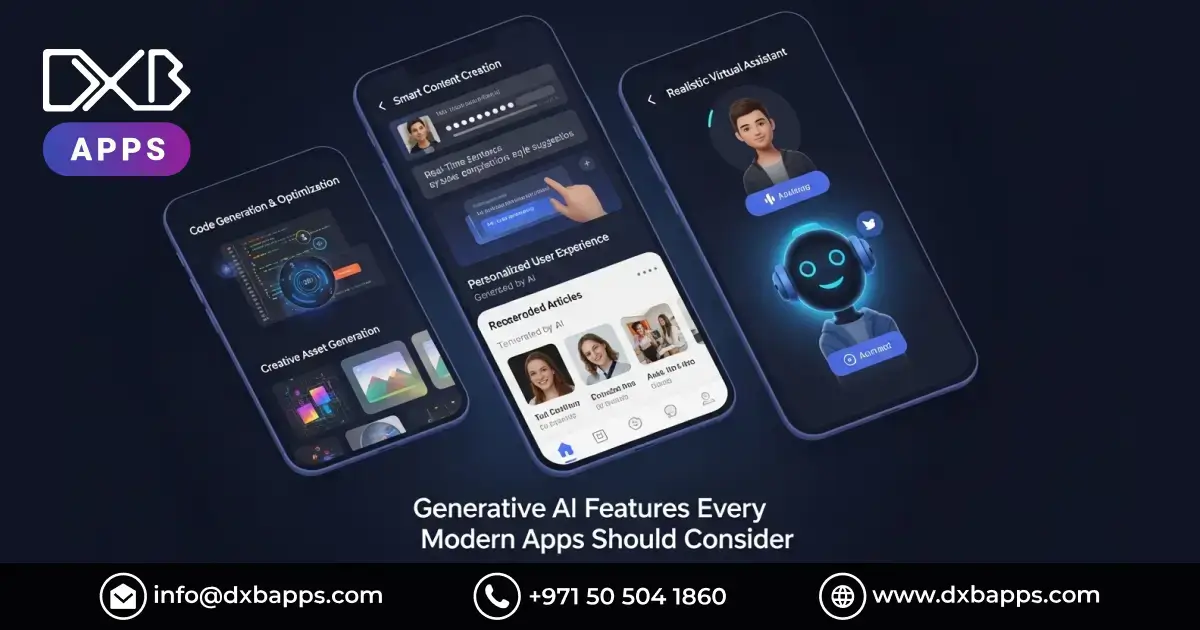
Generative AI is revolutionizing mobile and web applications by introducing intelligent capabilities such as personalized content, AI-powered chatbots, workflow automation, smart recommendations, and real-time interactions. For businesses investing in mobile app development Dubai, these technologies can create more intelligent and engaging digital experiences while improving operational efficiency. A professional mobile app development company can integrate generative AI into applications to deliver personalized user experiences, automate repetitive tasks, and provide faster responses.
For businesses targeting the UAE market, working with a mobile app development company in Dubai or an experienced mobile app development company in UAE can help turn AI-powered ideas into scalable mobile solutions. The best mobile app development company in Dubai can combine AI capabilities with modern app development strategies to create secure, user-friendly, and high-performing applications. Businesses looking for app development Dubai solutions can also leverage AI-powered features to improve customer engagement, while an experienced app development company Dubai can help implement technologies such as AI chatbots, recommendation engines, voice interfaces, and intelligent automation.
Key Takeaways
-
Generative AI is transforming apps from static tools into intelligent, adaptive platforms.
-
Modern users expect personalization, automation, and real-time responses.
-
Core features include AI chatbots, content generation, recommendation engines, and voice interfaces.
-
Advanced capabilities like multimodal AI and predictive interactions are shaping next-generation apps.
-
Industries such as eCommerce, healthcare, fintech, and education are leading AI adoption.
-
Generative AI can improve both user experience and operational efficiency.
-
Key technologies include NLP, machine learning, deep learning, and cloud-based AI APIs.
Mobile and web apps are changing rapidly because of generative AI. It enables applications to create content, automate tasks, analyze information, and personalize interactions. Instead of remaining static, apps can adapt to individual users, respond in real time, and use new information to deliver more relevant experiences.
The demand for AI-powered features is growing across industries. Businesses are increasingly using AI to automate workflows, improve customer support, personalize services, and make better use of their data. This shift is also creating new expectations among mobile app users.
Consumers want applications that feel natural, intelligent, responsive, and fast. Generative AI in mobile apps is being used across healthcare, finance, eCommerce, and education. Businesses can use AI chatbots to answer customer questions, automate financial data processing, provide personalized shopping recommendations, and create intelligent learning experiences.
Generative AI is becoming an important part of digital innovation. As the technology continues to evolve, businesses can use AI-powered features to differentiate their applications, improve user experiences, automate operations, and support long-term growth. In this blog, we explore the key generative AI capabilities being incorporated into modern mobile and web applications and how these features can help businesses meet changing user expectations.
What is Generative AI in Mobile and Web Applications?
Definition of Generative AI
Generative AI creates brand-new content, including text, images, audio, video, and code. It does not only review or process existing information. Instead, it produces new outputs. Traditional AI is mainly predictive and used for classification.
It also automates tasks by following set rules and guidelines. Generative AI learns patterns and produces new content. Generative AI stands out for its creative ability. Conventional AI finds trends and supports decision-making. It can recommend products or detect fraud. But generative AI does more by creating new material. It can write text, make images, and generate speech. This can make apps more interactive and creative.
How Generative AI Works?
Generative AI uses data and advanced tools to create helpful results.
-
Big Language Models (LLMs) are deep learning models that are trained on massive text. They acquire the structure, context and purpose of language. Apps utilize LLMs to chat, summarize and answer.
-
Machine Learning (ML) enhances machines through learning past data. It filters out results, therefore, content is more accurate and useful.
-
The neural network is a brain-inspired model. They discover meaning and patterns of complex data. A large number of generative AI systems are based on deep neural networks.
-
Training of data and generation of content: A system is trained on huge unstructured and structured data. It acquires ways and relationships. Once deployed, it generates real-time output of user input and context.
Why Generative AI is Important for Modern Apps?
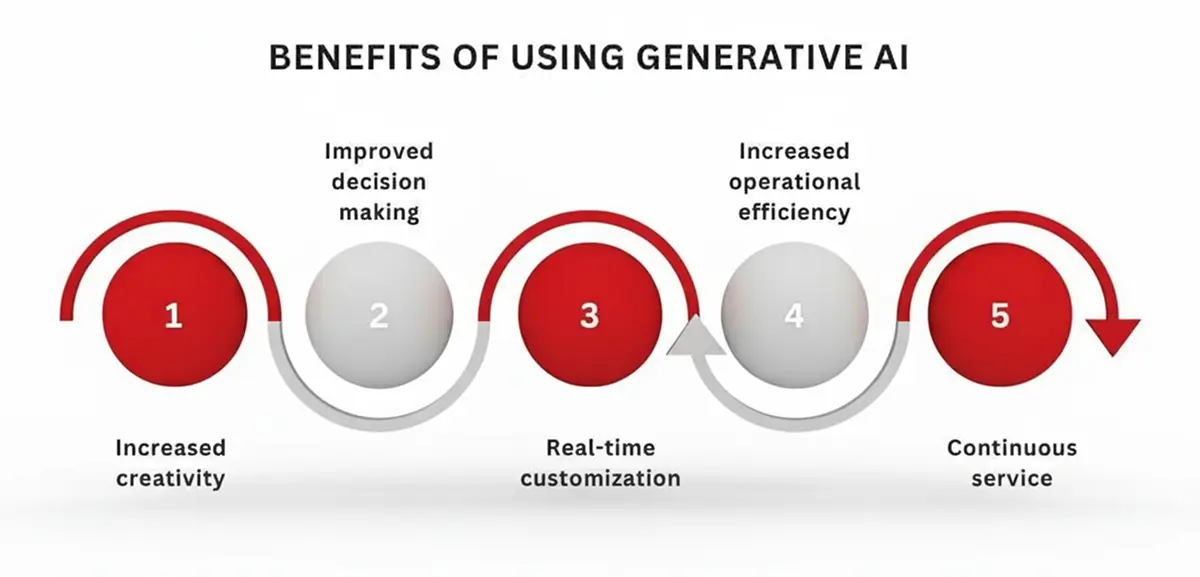
Generative AI is changing how apps are being developed and used. Apps will not be hard and unchangeable but become smarter and change according to every user. The expectations of users are increasing: users desire personal applications that will facilitate the tasks and provide quick and pertinent responses.
Chatbots are also available 24/7, and applications can create product descriptions in real-time. On-one-on-one lessons can be provided by learning platforms on command. All this is achievable through generative AI. In the business world, it has speeded up the delivery of services, minimized manual labor, and made more powerful and flexible applications possible. This is one of the technologies that will be important in mobile and web applications.
Why Are Businesses Adopting Generative AI Features?
Enhanced User Experience
General AI helps apps feel more personal. It tracks user behavior, preferences, and habits. It can suggest content and make recommendations. It can send helpful messages and support custom layouts. These updates keep users engaged and coming back.
Real‑time Help
Chatbots, virtual assistants, and smart interfaces use generative AI. They respond in a short time. Users get answers faster and finish tasks sooner. Conversations also feel more natural.
Enhanced Operational Effectiveness
Businesses use generative AI to automate repetitive work. This work would otherwise take a lot of time and effort. Examples include support replies, content creation, and report creation. It also supports workflow automation. This reduces workloads and lowers operating costs. Teams can focus on higher value work. AI can run these tasks often and quickly.
Digital Markets Competitive Advantage
Generative AI helps apps stand out in a crowded market. It adds smarter and more creative features. AI apps can offer interactive experiences that change over time. These interactions improve satisfaction and retention. This gives businesses an edge over apps with only basic features.
Data‑Driven Decision Making
Big data can be converted into valuable information by AI generation. It is able to generate summaries and reports as well as recommendations. This helps in making improved decisions. Predictive analytics will be able to predict user behavior and market trends. It is able to identify risks at an earlier stage and enhance business strategy.
Core Generative AI Features Every Modern App Should Include
AI-Powered Chatbots and Virtual Assistants
AI chatbot integration in apps supports natural conversations in apps. They can understand context and respond in useful ways. They can also improve over time through interactions.
They can provide 24/7 support for customers. This can reduce wait times and improve satisfaction. Common use cases include:
- Banking apps: handling account questions and transactions
- eCommerce platforms: helping with orders, returns, and product questions
- Healthcare apps: offering symptom checks and booking help
Personalized Content Generation
Generative AI can deliver personalized content for each user. It uses behavior, preferences, and past actions. It can recommend products, articles, and videos.
It can also change UI content in real time. App screens can adjust to each user’s needs. Examples include:
- Netflix suggesting shows based on viewing habits
- Spotify generating personalized playlists
Text Generation and Smart Writing Assistants
AI text tools can automate many writing tasks. Apps can generate:
- Emails and replies
- Messages and notifications
- Product descriptions and marketing content
Smart writing tools can also improve what users write. They can fix grammar and adjust tone. They can also suggest style improvements. This can improve speed and communication quality.
AI Image and Video Generation
AI features for mobile apps can create images and videos from text prompts. This can speed up content creation. It can also lower production costs.
This feature is used in:
- Marketing apps: creating ad visuals
- Social media platforms: generating posts and graphics
- Design tools: helping with prototyping and content creation
Voice Recognition and AI Voice Generation
Voice AI supports speech-to-text and text-to-speech. Users can control apps with voice commands. This can also make apps easier to use.
It also supports several added features. It can connect with voice assistants. It can offer multilingual voice support. It can also improve accessibility for many users.
AI Code Generation for Developer Tools
Generative AI can support software development. It can generate code and suggest improvements. Developers can work faster with tools like:
- Auto-completion
- Code recommendations
- Error detection and fixes
This can shorten development cycles. It can also improve productivity in modern IDEs.
Recommendation Engines
AI recommendation engines suggest items based on user data. They often use:
- User behavior
- Preferences
- Search history
These engines are used in:
- eCommerce apps: product suggestions
- Streaming platforms: content recommendations
- Learning platforms: personalized course paths
AI-Powered Search (Semantic Search)
AI search focuses on meaning, not just keywords. It tries to understand user intent. It uses context to return better results.
This can improve search accuracy and satisfaction. It can also improve navigation across the app.
Automated Content Summarization
AI powered mobile applications can summarize large content into key points. It can summarize:
- Articles
- Documents
- Reports
This helps users get important details quickly. It is useful in productivity and education apps. It also helps in business tools with heavy reading.
AI Translation and Localization
AI translation supports real-time language conversion. This helps apps reach global users. It can go beyond direct translation.
It will be able to adjust language to culture and context. It is also able to localize app content and UI. This facilitates effective multilingual experiences. This is significant when the business is venturing into the new market.
Advanced Generative AI Features for Next-Gen Apps
Conversational AI Interfaces
Conversational AI is replacing the traditional menu and button-based apps with chat-based applications. Users do not need to struggle with sophisticated screens to perform their tasks, as they simply need to type or speak to accomplish their tasks.
It allows a more natural, more intuitive interface, in which apps are able to read the intent of the user and can retain the context and react to the user in a natural manner. It eases user experience and makes the interface less frictious, particularly in complicated programs such as banks, customer care, and enterprise software.
AI Avatars and Digital Humans
AI avatars and digital humans are the virtual assistants which appear as real humans with the ability to talk and interact using facial expressions and gestures. These systems make the digital interactions more interactive and personal.
They are increasingly used in:
- Customer service: virtual agents handling queries with human-like responses
- Education: AI tutors delivering interactive learning experiences
- Healthcare: virtual assistants guiding patients and providing information
Predictive Content Generation
Predictive AI goes ahead to expand generative capabilities by being able to forecast user needs even before they are stated. Apps can create relevant content when they analyze the behavior and prior interactions to create content relevant to them.
Examples include:
- Replies Suggested in messaging applications.
- Auto-filled forms and inputs
- Individual prompts and recommendations.
This minimizes the effort of the users, increases speed and efficiency.
AI in Augmented Reality (AR) and Virtual Reality (VR)
Generative AI is being used to improve AR and VR, through the creation of real-time dynamic environments, objects and interactions. Users are exposed to dynamic and smart digital spaces in place of unresponsive virtual spaces.
It results in more interactive and entertaining experiences within applications like gaming, virtual shopping, training simulation, and visualization of a real estate.
Generative AI for Personalization at Scale
AI app development trends have shifted to the hyper-personalization trend where each user has their own version of the app, and generative AI makes this a reality with constant adjustments in content, recommendations, and even the UI/UX components depending on preference.
This results in:
- Tailored user journeys
- Customized interfaces
- Higher engagement and retention rates
At scale, this level of personalization allows businesses to serve millions of users individually, without increasing operational complexity.
Industry Use Cases of Generative AI in Apps
eCommerce Applications
Generative AI app development is revolutionizing eCommerce by allowing the creation of content automatically and the creation of very personalized shopping experiences. Product descriptions can be produced within seconds by the businesses and are consistent and scalable when dealing with large catalogs.
Virtual styling assistants are also run by AI and suggest clothes or items depending on the preferences of the user, the way they browse, and current trends. This, together with customized suggestions, provide a more interactive and conversion-oriented shopping experience.
Healthcare Applications
Automated medical content and smart help are among other ways that generative AI is making healthcare more efficient and patient-centered. Concise medical summaries can be produced by applications and this allows professionals to go through patient data within a short time.
Virtual health assistants offer general advice, support to schedule appointments, and symptom details, and patient engagement tools use AI to remind patients, provide education, and give them personalized health information.
Fintech Applications
Generative AI is also used by fintech apps to provide automated and real-time financial insights. AI may also examine the habits of spending and provide users with customized advice to enable them to spend money in a more efficient way.
It is also capable of generating automated reports and less work is done by hand in order to perform the financial analysis. Moreover, generative AI can be used to detect fraud by detecting suspicious patterns and producing alerts or explanations on suspicious behavior.
Education and eLearning Apps
Digital learning is being improved by generative AI with adaptive and personalized learning experiences. AI tutors are able to explain concepts, answer questions, and conduct students through real time.
It also allows the generation of content in terms of the lessons, quizzes, and study resources, which decreases the workload on educators. Individualized learning plans can help each student get content at their personal pace and strength, and weakness.
Social Media and Content Platforms
Generative AI is used by social media to ease the content-creating process and enhance interaction. AI tools help users to create posts, captions, and creative content in a short period of time.
The user also has the ability to use advanced editing capabilities on pictures and videos and the intelligent content recommendations which are based on user interests. This enhances user activity, retention and general platform engagement.

Key Technologies Behind Generative AI Features
Natural Language Processing (NLP)
Natural Language Processing (NLP) helps the machine to comprehend, decipher and produce human language. It enables text and voice to be meaningfully handled by applications and such functionalities as chat bots, voice assistants and text generation can take place. NLP assists the apps to understand the context, intent, and sentiment resulting in more accurate and human-like interactions.
Machine Learning and Deep Learning
Generative AI is based on Machine Learning (ML) and Deep Learning, enabling systems to learn on the basis of large datasets and to improve as time goes on. Specifically, deep learning models are able to extract more complex patterns and relationships in the data and generate high-quality and contextually relevant outputs. This life long learning is what allows AI systems to become more precise and effective as they are used.
Transformer Models (e.g., GPT)
Transformer models, such as GPT, are advanced neural network architectures designed for context-aware content generation. They process data by understanding relationships between words and sequences, enabling them to generate coherent and contextually accurate text. These models power many generative AI features, including conversational AI, content creation, and intelligent recommendations.
Computer Vision
Computer Vision allows AI systems to analyze, interpret, and generate visual content such as images and videos. It plays a key role in features like AI image generation, facial recognition, object detection, and video editing. Combined with generative models, computer vision enables applications to create visuals from text prompts and enhance multimedia experiences.
Cloud Computing and APIs
Cloud computing provides the infrastructure needed for scalable AI processing and real-time performance. Generative AI models require significant computational power, which is efficiently handled through cloud platforms.
APIs (Application Programming Interfaces) enable seamless integration with third-party AI services, allowing developers to incorporate advanced generative AI capabilities into their apps without building models from scratch. This accelerates development and ensures flexibility and scalability.
Challenges in Implementing Generative AI in Apps
Data Privacy and Security
Generative AI systems often process large volumes of user data, including sensitive information such as personal details, financial records, or health data. Ensuring secure data handling and storage is critical to prevent breaches and misuse.
Businesses must also comply with regulations like GDPR and other data protection laws, which require transparency, user consent, and strict data governance. Failure to meet these requirements can lead to legal risks and loss of user trust.
Accuracy and Bias Issues
One of the major challenges with generative AI is the risk of inaccurate or biased outputs. Since models are trained on existing data, they can inherit biases or generate misleading information.
To address this, organizations need continuous model training, monitoring, and validation. Regular updates and human oversight are essential to ensure outputs remain reliable, fair, and aligned with real-world expectations.
High Development Costs
Implementing generative AI can involve significant investment in infrastructure and technology. Training and deploying AI models require high computational power, often relying on cloud-based systems.
In addition, businesses need skilled professionals such as AI engineers, data scientists, and developers, which increases operational costs. This makes adoption challenging, especially for smaller organizations.
Integration Complexity
Integrating generative AI into existing applications is not always straightforward. It requires aligning AI models with current app architecture, databases, and workflows.
There are also cross-platform compatibility challenges, particularly when ensuring consistent performance across mobile, web, and different operating systems. Proper planning and scalable architecture are necessary to overcome these issues.
Performance and Latency
Generative AI applications must deliver fast and real-time responses to maintain a smooth user experience. However, processing large AI models can introduce delays if not optimized properly.
To address this, developers must focus on optimizing processing speed, reducing latency, and ensuring efficient resource usage. Techniques such as model optimization, caching, and edge computing can help improve performance.

Best Practices for Integrating Generative AI Features
Start with Clear Use Cases
Successful implementation begins with well-defined, high-impact use cases. Instead of adding AI features broadly, businesses should focus on areas where generative AI can deliver measurable value such as customer support automation, content generation, or personalized recommendations. This approach reduces complexity and ensures faster ROI.
Ensure Ethical AI Usage
Ethical considerations are critical when deploying generative AI. Applications should maintain transparency in AI-generated content, clearly indicating when users are interacting with AI.
It is also important to avoid misleading or harmful outputs by implementing safeguards, content moderation, and responsible AI guidelines. This helps build user trust and ensures compliance with regulatory standards.
Optimize for User Experience
AI features should enhance and not complicate the user journey. Developers should design simple, intuitive interactions that feel natural and easy to use.
Avoid overloading users with complex commands or unnecessary AI features. Instead, focus on delivering clear value through seamless integration into the app’s existing workflow.
Use Scalable AI Infrastructure
Generative AI requires strong computational support, making scalable infrastructure essential. Cloud-based solutions provide the flexibility to handle varying workloads, ensuring consistent performance as user demand grows.
This also allows businesses to scale AI capabilities efficiently without heavy upfront investment in hardware.
Continuous Monitoring and Improvement
Generative AI systems require ongoing refinement. Businesses should continuously monitor performance, collect user feedback, and analyze outputs to identify areas for improvement.
Regular updates and model tuning ensure that AI features remain accurate, relevant, and aligned with user expectations over time.
Future Trends in Generative AI for Applications
Rise of Autonomous AI Agents
The next phase of generative AI will introduce autonomous AI agents, systems capable of performing tasks independently on behalf of users. These agents can plan actions, make decisions, and execute workflows without constant user input.
In applications, this means AI can handle tasks such as scheduling, managing finances, responding to queries, or completing transactions, significantly reducing user effort and increasing efficiency.
Hyper-Personalized Digital Experiences
Future applications will move toward hyper-personalization, where every user experiences a fully customized digital environment. Generative AI will analyze real-time behavior, preferences, and context to deliver unique user journeys.
This includes personalized content, adaptive interfaces, and tailored recommendations, resulting in higher engagement, improved retention, and more meaningful user interactions.
Multimodal AI (Text, Voice, Image Combined)
Multimodal AI enables applications to process and generate multiple types of data simultaneously, including text, voice, and images. This creates more natural and flexible interactions where users can switch seamlessly between input formats.
For example, a user could speak a command, receive a visual response, and continue the interaction through text, all within the same app experience.
AI-First Application Design
A major shift is emerging toward AI-first application design, where apps are built around AI capabilities from the beginning rather than adding them later as features.
This approach allows developers to design smarter workflows, automate processes at the core level, and create more intuitive, intelligent systems. As a result, future applications will be more adaptive, efficient, and aligned with evolving user expectations.
How DXB APPS Can Help Build AI-Powered Applications?
DXB APPS is an AI-based mobile app development company that is building scalable mobile and web apps by combining machine learning, natural language processing, and intelligent automation. Their unit is specializing in creating secure, high-performance mobile app development Dubai solutions that provide individual user experiences and information-driven business development.
Custom Generative AI Integration
DXB APPS is one of the best mobile app development agency in Dubai providing tailored generative AI solutions designed to meet specific business requirements. Instead of using generic implementations, the team focuses on integrating AI features that align with your app’s goals, whether it’s intelligent chatbots, content generation, or personalized user experiences. DXB APPS is one of the top app development companies in Dubai ensures maximum impact and relevance for your target audience.
Scalable and Secure App Development
DXB APPS is one of the top app development companies in Dubai offering applications using enterprise-grade architecture that supports scalability, performance, and security. As AI-powered apps handle large volumes of data and user interactions, we as the best app development companies in Dubai ensure robust infrastructure, secure data handling, and compliance with modern standards, enabling long-term growth and reliability.
Expertise in AI Technologies
With strong expertise in Natural Language Processing (NLP), Machine Learning (ML), and AI-powered APIs, DXB APPS is one of the top mobile app development companies in Dubai that delivers advanced AI functionalities that enhance app performance and intelligence. Their technical capabilities allow seamless integration of cutting-edge AI models, ensuring accurate, efficient, and high-quality outputs.
End-to-End Development Services
DXB APPS is one of the top android app development company in Dubai offering complete development support, covering every stage of the app lifecycle, from idea validation and UI/UX design to development, testing, deployment, and ongoing maintenance. DXB APPS as the best mobile app development company in Dubai offers an end-to-end approach that ensures that businesses can launch and scale mobile app development Abu Dhabi solutions efficiently while maintaining consistent performance and updates over time.
Conclusion
Generative AI is no longer an emerging concept, it has become a core component of modern application development. From intelligent chatbots and personalized content to advanced features like multimodal interactions and predictive automation, AI is reshaping how users interact with digital products. Applications that integrate these capabilities are better positioned to deliver faster, smarter, and more engaging experiences.
As user expectations continue to evolve, businesses must move beyond basic functionality and adopt adaptive, data-driven, and AI-powered features. Generative AI not only enhances user experience but also improves operational efficiency, supports better decision-making, and creates new opportunities for innovation.
Looking ahead, the success of modern apps will depend on how effectively they leverage generative AI to stay relevant and competitive. By adopting the right features and following best practices, businesses can build future-ready applications that meet user demands and drive long-term growth in an increasingly AI-driven digital landscape.
For companies that need dedicated development resources, DXB APPS also offers Hire App Developers.
FAQS
What are generative AI features in mobile apps?
Generative AI features in mobile apps refer to capabilities that create new content automatically, such as text, images, videos, or responses. These features use advanced AI models to generate human-like outputs, enabling chatbots, content creation tools, and personalized recommendations that enhance user interaction and engagement.
How does generative AI improve user experience?
Generative AI improves user experience by delivering personalized content, faster interactions, and intelligent recommendations. It enables apps to understand user preferences, provide real-time assistance, and automate tasks. This results in smoother navigation, more relevant content, and a highly engaging, user-friendly digital experience.
Which industries benefit most from generative AI apps?
Several industries benefit significantly from generative AI, including eCommerce, healthcare, fintech, and education. It supports personalized shopping, medical insights, financial analysis, and adaptive learning. Additionally, sectors like media, marketing, and customer service leverage AI for automation, content creation, and improved user engagement.
Is generative AI expensive to implement?
The cost of implementing generative AI depends on factors such as feature complexity, infrastructure, and development approach. While advanced custom solutions can be expensive, many businesses use cloud-based AI services and APIs to reduce costs. Scalable solutions make generative AI accessible for both startups and large enterprises.
What technologies are used in generative AI development?
Generative AI development relies on technologies such as Natural Language Processing (NLP), Machine Learning (ML), deep learning, transformer models, APIs, and cloud computing. These technologies work together to process data, understand context, and generate accurate, high-quality content across text, voice, and visual formats.
Can small businesses use generative AI in apps?
Yes, small businesses can adopt generative AI using cost-effective and scalable solutions. Cloud platforms and ready-to-use APIs allow businesses to integrate AI features without heavy investment. This enables smaller companies to enhance user experience, automate processes, and stay competitive in the digital marketplace.